
IVF DUE DATE CALCULATOR
IVF Due Date Calculator
Your personalized fertility journey companion
Calculate Your Due Date
Table of Content
IVF Due Date Calculator: Complete Guide to Calculating Your Pregnancy Due Date
If you just had your embryo transfer and the very first question in your mind is “when is my baby due?” then you are in exactly the right place.
This guide is going to walk you through everything about your IVF due date. Not just the formula. Not just a quick number. I am going to teach you how the calculation actually works, why it is more accurate than a regular pregnancy due date, what the difference is between fresh and frozen transfers, what milestones to expect week by week, and how to use our free calculator to get your answer right now.
Think of this like sitting down with a knowledgeable friend who has already done all the research for you and is now explaining it in plain English. By the end of this page you will understand your IVF pregnancy timeline better than most people do when they walk out of their fertility clinic.
Our free IVF Due Date Calculator is right here on this page. Use it first if you want your number instantly. Then come back and read through this guide so you actually understand what that number means and what comes next.
What Is an IVF Due Date?
An IVF due date is simply the estimated date when your baby is expected to arrive after a successful in vitro fertilization treatment.
Think of it like a calendar reminder telling you when to prepare for the big day. Of course babies rarely arrive on that exact date but it gives both doctors and parents a reliable and structured timeline to work from.
Unlike natural conception where doctors calculate the due date based on your last menstrual period and make assumptions about when ovulation occurred, IVF is completely different. With IVF your medical team knows the exact day the embryo was created and the exact developmental stage it was at when it was transferred into your uterus. There is zero guesswork about ovulation timing.
This is why IVF due date calculations are considered more precise than traditional pregnancy dating methods. The embryo’s biological age at the moment of transfer is a documented fact sitting in your medical file.
That said even an IVF due date is still an estimate. It tells you the most likely window for your baby’s arrival. Babies arrive when they are ready and only a very small percentage are born on their exact estimated due date. Think of your IVF due date as the center of a two to three week window not a guaranteed appointment on the calendar.
How Is an IVF Due Date Calculated? The Exact Formula Explained
This is the part that sounds complicated at first but is actually very simple once you see it laid out clearly.

The core formula is:
Due Date = Transfer Date + (266 days minus Embryo Age at Transfer)
Let me break this down step by step the way a teacher would.
A full term pregnancy from the moment of fertilization to birth is approximately 266 days. That is the biological starting point. In a natural pregnancy doctors round this to 280 days because they add the approximate two weeks between your last period and ovulation to account for that uncertainty.
But in IVF you do not need that estimate at all. You know the exact fertilization date. So the calculation goes straight to 266 days from known conception.
Now here is where embryo age comes in. When the embryo was transferred into your uterus it was not brand new. It had already been growing in a lab for three, five, or six days. Those days already count toward development. So you subtract the embryo’s age from 266 and add what is left to your transfer date.
Here is exactly how that looks for the three most common transfer types:
Day 3 Transfer (Cleavage Stage): 266 minus 3 equals 263 days. Add 263 days to your transfer date. Example: Transfer on March 1st means estimated due date around December 19th.
Day 5 Transfer (Blastocyst – Most Common): 266 minus 5 equals 261 days. Add 261 days to your transfer date. Example: Transfer on March 1st means estimated due date around November 17th.
Day 6 Transfer (Extended Culture): 266 minus 6 equals 260 days. Add 260 days to your transfer date.
The Day 5 blastocyst transfer is by far the most common type in modern fertility clinics. If you had a blastocyst transfer and you are not sure which day it was, it was almost certainly Day 5.
Want to skip the math entirely? Just use our IVF Due Date Calculator right on this page. Enter your transfer date, select your embryo day, and get your answer instantly.
3-Day Embryo Transfer vs 5-Day Embryo Transfer: What Is the Difference?
This is one of the most important concepts to understand because the type of embryo transfer you had directly affects your due date calculation.
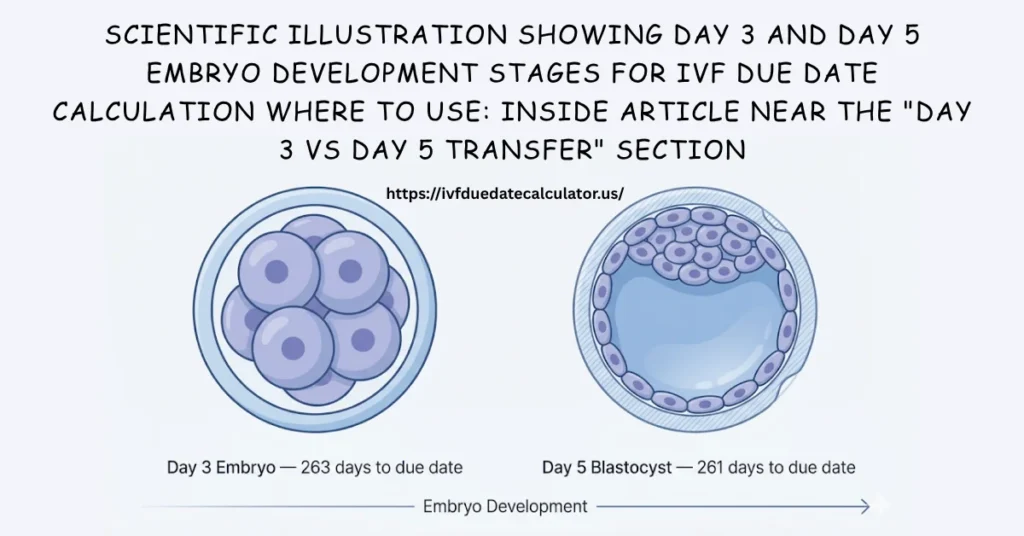
3-Day Embryo Transfer
A 3-day embryo transfer means the embryo was placed into your uterus three days after egg collection and fertilization. At this stage the embryo typically has around 6 to 8 cells and is still in what doctors call the cleavage stage of development.
Doctors sometimes choose this option when they believe the embryo will continue growing better inside the natural environment of the womb rather than continuing in a laboratory setting. It is also sometimes selected when fewer embryos are available for observation.
For due date calculation you add 263 days to your transfer date. This is because the embryo is already 3 days old at the time of transfer so your pregnancy timeline is slightly further along than if the embryo were brand new.
5-Day Embryo Transfer (Blastocyst)
A 5-day embryo transfer means the embryo was transferred on the fifth day after fertilization. By this stage the embryo has developed into a blastocyst with significantly more cells and much greater structural complexity.
Most modern fertility clinics prefer Day 5 transfers because blastocysts have a higher rate of successful implantation. The extra days of laboratory development allow embryologists to identify which embryos are strongest before selecting one for transfer.
For due date calculation you add 261 days to your transfer date.
The key difference in terms of due dates: a Day 3 transfer gives you a due date that is approximately 2 days later than a Day 5 transfer for the same calendar date. This is because the Day 5 embryo is already further developed.
Both are valid paths to a healthy pregnancy. Your fertility clinic chose the approach that was right for your specific situation.
IVF Due Date Calculator: How to Use It Step by Step
A lot of people land on our calculator and wonder whether they are entering information correctly. Let me walk you through it so you get the most accurate result possible.
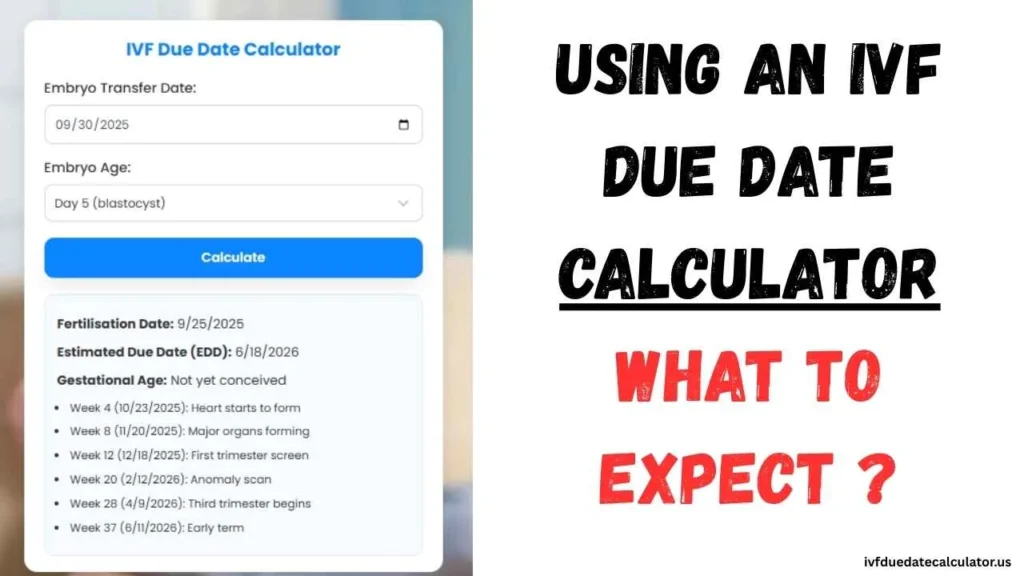
Step 1: Find your embryo transfer date. This is on your clinic paperwork, your discharge instructions, or in your patient portal. It is the specific calendar date when the embryo was placed into your uterus. Even a one-day error here can shift your due date so make sure you have the right date.
Step 2: Know your embryo’s day. Was it a Day 3 embryo or a Day 5 blastocyst? Your clinic should have communicated this to you. If you had a frozen embryo transfer this information will be in your paperwork. Do not guess here because this detail makes a real difference in your result.
Step 3: Select fresh or frozen. This does not change your due date calculation but helps you keep accurate personal records and is useful information when discussing your timeline with your care team.
Step 4: Hit calculate. You will instantly see your estimated due date, how far along you are today, what trimester you are in, and key milestone dates throughout your pregnancy.
Our calculator also shows your current gestational age in weeks and days which is something your OB will ask at every single appointment. Having this number ready and accurate saves time and reduces confusion at prenatal visits.
You can also visit our dedicated Embryo Transfer Due Date Calculator page for a more detailed breakdown of how your specific transfer type affects your full timeline.
What Other Ways Can You Calculate Your IVF Due Date?
While our IVF Due Date Calculator is the easiest and most reliable option, there are other methods doctors and fertility specialists use to estimate or confirm the due date. In practice most clinics use more than one approach to cross-check results.
Last Menstrual Period (LMP) Method: Even in IVF cases doctors sometimes ask about your last menstrual period. This method counts 280 days from the first day of your LMP. However in IVF pregnancies this method is generally less accurate because the exact date of embryo transfer is already known. The LMP method exists as a backup reference, not the primary tool.
Conception Date Method: If you know the exact day of fertilization which is always the case in IVF you can add 266 days to that date. In IVF the fertilization date is documented so this method is very reliable. For natural conception this date is usually just an estimate.
Early Ultrasound Scan: An ultrasound performed between 6 and 10 weeks of pregnancy measures the baby’s size using a measurement called crown-rump length. Doctors use this to confirm or fine-tune the due date the calculator provides. Ultrasound is especially valuable if there are any questions about growth or development.
Manual Calculation by Your Fertility Specialist: Some reproductive endocrinologists prefer to manually calculate by adding 38 weeks from the date of fertilization or 36 weeks from the transfer date as a quick cross-check.
In practice the most trusted combination for IVF patients is the transfer-date calculator method confirmed by an early ultrasound scan. Using our IVF Due Date Calculator gives you the calculator result instantly and your first ultrasound will confirm it a few weeks later.
Fresh vs Frozen Embryo Transfer: Does It Change Your Due Date?
This is one of the most common questions and it deserves a clear and direct answer.
The due date formula is exactly the same for fresh and frozen transfers. What matters is the embryo’s biological age at the time of transfer, not whether the embryo was used fresh or thawed from frozen storage.
A frozen Day 5 blastocyst is still biologically 5 days old when it is thawed and transferred. So you still add 261 days to the transfer date. The math does not change.
What does change is the clinical experience and the timeline leading up to transfer day.
Fresh Embryo Transfer
A fresh transfer happens in the same cycle as egg retrieval. After retrieval on Day 0 your embryos grow in the lab for 3 to 5 days. The best embryo is selected and transferred directly. The whole process from retrieval to transfer takes less than a week.
The main advantage is speed. There is no additional waiting cycle. The potential consideration is that your body has just been through ovarian stimulation and hormone levels may still be elevated which can sometimes affect the uterine environment.
The cost of a fresh embryo transfer is typically included within the standard IVF treatment package at most clinics.
Frozen Embryo Transfer (FET)
In a frozen embryo transfer your embryos were cryopreserved after the retrieval cycle through a process called vitrification, where water in the cells is replaced with a protective fluid and the embryos are flash-frozen with liquid nitrogen. They are then stored until you are ready for transfer, which may be weeks or months later.
Research increasingly shows that frozen transfers can lead to better outcomes for many patients. Since the transfer happens in a completely separate cycle from ovarian stimulation, hormone levels have had time to normalize which creates a more receptive uterine environment. Studies have found that IVF pregnancies following a frozen embryo transfer are in many ways more similar to natural conception pregnancies than fresh transfer cycles.
Frozen transfers also allow time for genetic testing of embryos before transfer which is one reason many clinics now favor this approach. The typical cost of a frozen embryo transfer is approximately 3,000 to 6,000 dollars and may be a separate expense from the initial IVF package.
The tradeoff is time. A frozen cycle requires a separate preparation cycle with its own medications and monitoring before transfer can occur.
For patients specifically planning around a frozen cycle visit our Frozen Embryo Transfer Due Date Calculator which is purpose-built for FET patients. Also visit our page on IVF Transfer Due Date for a detailed explanation of how your transfer date connects to every subsequent milestone.
Gestational Age in IVF: Why You Are Already Pregnant at Transfer
Here is something that surprises almost everyone going through IVF for the first time.
At the exact moment your embryo is transferred into your uterus, you are already considered more than two weeks pregnant by standard medical counting.
This sounds strange. How can you be pregnant before the embryo was even placed inside you?
Here is the simple explanation.
Obstetric medicine counts gestational age starting from your last menstrual period, not from the actual moment of fertilization. In a natural cycle your period arrives approximately two weeks before ovulation and conception. So by the time conception actually happens you are already “two weeks pregnant” by medical counting convention.
IVF mimics this same system. For a Day 5 blastocyst transfer the calculation works backward to establish a theoretical last menstrual period that occurred 19 days before your transfer date. So at the moment of transfer you are already considered to be approximately 2 weeks and 5 days pregnant in gestational terms.
This is correct. It is not a mistake in the calculator. It is simply the standard obstetric system that all IVF clinics and OBs use worldwide.
This is also why when you go in for your first ultrasound 3 to 5 weeks after transfer the doctor will talk about being at 6 or 7 weeks of pregnancy even though the transfer only happened about a month ago. The numbers are right.
The Two Week Wait: What Happens After Your Embryo Transfer
The two week wait is one of the most emotionally intense parts of the entire IVF journey. Understanding what is biologically happening during this time can help manage the anxiety.
After your embryo is placed in the uterus here is what ideally happens over the following days.
The blastocyst, if it is Day 5, is already in an active phase of development. Over the next day or two it begins to hatch out of its outer shell called the zona pellucida and starts seeking a location to attach to the uterine lining.
Around 6 to 10 days after transfer implantation occurs. The embryo burrows into the lining and the placenta begins to form. Once implantation happens the embryo starts producing human chorionic gonadotropin (hCG), which is the hormone that pregnancy tests detect.
Some women notice very light spotting during the implantation window. This is called implantation bleeding and it is normal. Many women notice nothing at all. Both experiences are completely normal.
Your beta hCG blood test is typically scheduled 9 to 14 days after transfer. This blood test is far more sensitive than a home urine test and can detect very low hCG levels accurately.
If you are wondering when the best time to take a home test is, visit our Early Pregnancy Test Calculator which is specifically designed for IVF patients to understand their hCG timeline.
A positive beta hCG result is followed by a second beta test 48 to 72 hours later to confirm that levels are rising appropriately. hCG that roughly doubles every 48 to 72 hours is a positive and encouraging sign.
Your First IVF Ultrasound: When and What to Expect
After a positive and confirmed beta hCG your clinic will schedule your first ultrasound. This typically happens around 6 to 7 weeks of gestational age which is approximately 3 to 5 weeks after your embryo transfer.
The first ultrasound is usually performed transvaginally for the clearest possible images at this early stage. It confirms several critical things.
Is the pregnancy in the correct location inside the uterus rather than in a fallopian tube. Is a fetal heartbeat visible, which typically becomes detectable between 6 and 7 weeks of gestational age. How many gestational sacs are present, especially relevant if two embryos were transferred. And whether the size and crown-rump length measurement matches your calculated gestational age.
If the size measurement differs significantly from expected your doctor may adjust your due date slightly. This happens more often in naturally conceived pregnancies than IVF pregnancies because IVF dating is inherently more precise, but it can still occur.
After this appointment your care typically transitions from your fertility clinic to your regular OB-GYN or a maternal-fetal medicine specialist who will manage your care through the rest of the pregnancy.
IVF Pregnancy Week by Week: Key Milestones to Track
Understanding your pregnancy milestone timeline helps you stay informed and emotionally prepared for each phase. Here is a practical guide organized by what happens and when.
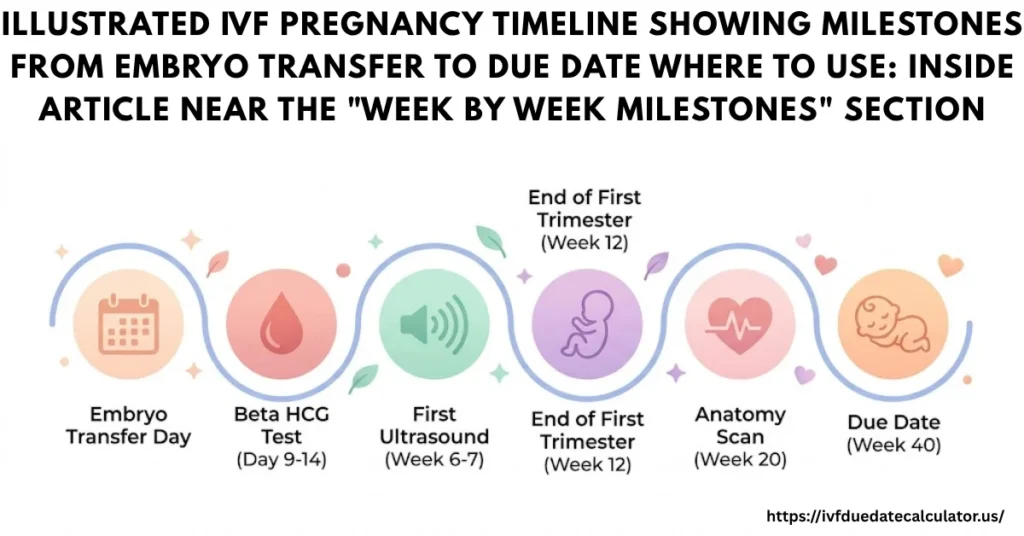
Transfer Day (approximately 2 weeks 5 days gestational age for a Day 5 transfer): The embryo is placed in your uterus. You begin the two week wait. Continue all prescribed progesterone and estrogen support medications exactly as directed.
Days 6 to 10 Post Transfer: Implantation ideally occurring during this window. Light spotting may or may not be noticed. Either way is normal.
Days 9 to 14 Post Transfer (approximately 4 to 5 weeks gestational age): Your beta hCG blood test. Positive result confirms pregnancy. Second beta test follows in 48 to 72 hours.
If you had a positive pregnancy test following your FET, you would already be considered approximately four weeks pregnant at that point.
Weeks 6 to 7 of Pregnancy (approximately 3 to 5 weeks after transfer): First ultrasound. Heartbeat confirmation. One of the most emotional milestone appointments in the entire IVF journey.
Weeks 8 to 10 of Pregnancy: Early pregnancy symptoms including nausea, fatigue, and breast tenderness are common in this window. Early pregnancy symptoms such as these typically start between 6 and 8 weeks of pregnancy though this can vary significantly. Some people have very few symptoms. This does not mean anything is wrong.
Weeks 10 to 13 of Pregnancy: End of the first trimester. Nuchal translucency (NT) scan typically around 11 to 13 weeks. Non-invasive prenatal testing (NIPT) can also be done during this window to check for chromosomal conditions.
Week 20 of Pregnancy: The anatomy scan also called the 20-week ultrasound. This is typically when the baby’s sex can be confirmed if you choose to find out.
Week 24 of Pregnancy: Viability milestone. At this gestational age babies have a chance of surviving outside the womb with medical support.
Week 37 of Pregnancy: Beginning of the full-term window. Babies born from 37 weeks onward are considered term.
Week 40 of Pregnancy: Your estimated due date. The center of your birth window, not a deadline.
Our IVF Due Date Calculator shows you all of these milestone dates automatically when you enter your transfer date. You do not need to count them out manually.
How Accurate Are IVF Due Dates?
This is one of the most common questions couples ask: are IVF due dates actually more accurate than natural pregnancy due dates?
The answer is yes, they are generally more precise, but they are still estimates.
In IVF your doctor knows the exact date of fertilization and the exact date and stage of embryo transfer. This removes the uncertainty that exists in natural conception where sperm can survive for several days inside the body and the exact moment of fertilization is never truly known. IVF calculators also adjust based on whether you had a 3-day or 5-day transfer which sharpens the prediction further.
However babies rarely arrive exactly on their due date whether the pregnancy was conceived naturally or through IVF. Many IVF parents report their babies were born a week earlier or later than the calculated date. This is completely normal. Every pregnancy is unique and ultimately the baby determines the final arrival time.
Key takeaway: IVF due dates are more precise starting points than LMP-based natural conception dates but they are still estimates within a natural biological range.
Factors That Can Affect Your IVF Due Date and Delivery Timing
Even though the IVF due date calculator gives a highly accurate initial estimate, several factors can influence when your baby actually arrives.
Your health conditions: Conditions such as gestational diabetes, high blood pressure, or thyroid issues may influence delivery timing. In some cases doctors recommend early delivery for the safety of mother and baby.
Type of transfer: Fresh versus frozen transfers can sometimes influence early pregnancy hormone levels and implantation dynamics though the due date formula itself does not change.
Multiple pregnancies: IVF has a higher chance of resulting in twins or higher-order multiples. Multiple pregnancies are typically managed toward delivery at 37 to 38 weeks rather than the full 40-week date. If you are expecting twins your IVF due date calculator result is your gestational reference anchor but your actual delivery target will be earlier as directed by your care team.
Baby’s growth and development: If your baby is growing faster or slower than expected based on ultrasound measurements your doctor may adjust the due date or recommend earlier delivery.
Lifestyle and prenatal care: Regular prenatal checkups, a balanced diet, appropriate rest, prenatal vitamins, and managing stress all contribute to reaching as close to your estimated due date as possible in a healthy way.
IVF Pregnancy vs Natural Pregnancy: Is the Experience Different?
Once you confirm your IVF pregnancy many people wonder whether the day-to-day experience is medically different from a naturally conceived pregnancy. The answer is mostly no.
After successful implantation an IVF pregnancy develops exactly the same way as any other pregnancy. The embryo grows, the placenta forms, and the baby develops through all the same stages and milestones. Being conceived through IVF does not affect how the baby develops once the pregnancy is established.
A few areas where your experience may differ slightly:
More frequent early monitoring: Because of the investment made in IVF and the natural anxiety that comes with it, fertility clinics and OBs tend to schedule more frequent monitoring in the first trimester. Most parents find this reassuring rather than burdensome.
Medication support in early pregnancy: After transfer you will be prescribed progesterone supplements (often via vaginal suppositories or injections) and sometimes estrogen. These support the uterine lining until the placenta takes over progesterone production on its own, typically around 8 to 10 weeks. Your doctor will tell you when it is safe to stop these medications.
IVF pregnancy symptoms: Most IVF parents report that pregnancy symptoms like nausea, fatigue, and breast tenderness appear at the same times as in natural pregnancies, usually in the first few weeks after the positive test. The symptoms themselves are not different; they are the result of the same hormonal changes regardless of how conception occurred.
Slightly higher statistical considerations: Research indicates IVF pregnancies carry a marginally elevated statistical risk for some complications including preterm birth. However this risk is often related to the underlying fertility factors that led to IVF rather than the IVF process itself. The large majority of IVF pregnancies result in healthy full-term babies and your care team monitors you closely throughout.
Are IVF Babies Usually Born Early or Late? ivf due date calculator
This is a question many IVF parents have and it is worth addressing directly.
Studies do show that IVF babies are statistically more likely to be born slightly early compared to the general population, especially in cases involving multiple pregnancies. However many IVF singleton pregnancies reach full term and even go past 40 weeks.
The tendency toward earlier delivery in IVF statistics is largely influenced by the higher rate of twins and multiples which are managed for earlier delivery by design, and by underlying maternal health conditions that may influence delivery timing independent of the IVF itself.
If you are carrying a single baby after IVF and your pregnancy progresses without complications, reaching full term is absolutely a realistic and common outcome.
Do IVF Babies Need to Be Induced?
Not always. Whether induction is recommended depends on your individual medical situation rather than the fact that conception occurred through IVF.
Some IVF pregnancies are induced if there are risk factors such as high blood pressure, prolonged elevated pregnancy beyond 41 to 42 weeks, or any signs of fetal distress. These are the same reasons induction is used in naturally conceived pregnancies. IVF itself does not automatically mean induction is necessary.
Your OB will make recommendations based on how your pregnancy is progressing, your health status, and the baby’s wellbeing as your due date approaches.
Donor Eggs and Gestational Surrogacy: Does the Calculation Change?
If you used donor eggs or are working with a gestational carrier you might wonder whether the due date calculation is different.
Donor eggs: The calculation works exactly the same way. The due date is based on the embryo’s age at transfer, not the source of the eggs. A Day 5 blastocyst transfer is a Day 5 blastocyst transfer regardless of whose eggs were used. You still add 261 days to your transfer date.
Gestational surrogacy: The same formula applies for the surrogate carrier. Gestational age counting and due date calculation are based on the embryo transfer date and embryo stage. For gestational surrogacy situations, an accurate due date is especially important because multiple people including intended parents may be coordinating travel, leave from work, and logistics around the birth. Precise due date calculation helps everyone plan with confidence.
Tips for Getting the Most Accurate IVF Due Date
Getting the right due date is important for tracking your pregnancy milestones and planning prenatal care. Here are the most important practices to follow.
Know your exact transfer date. Always confirm this with your clinic documentation. Even a one-day error shifts your due date so double-check rather than going from memory.
Select the correct embryo stage. Choosing between Day 3 and Day 5 in the calculator makes a real difference in your result. If you are unsure check your clinic paperwork or call and ask. Your embryology records have this information.
Use an early ultrasound for confirmation. Most doctors confirm or adjust the calculated due date with a 6 to 10 week ultrasound scan. The combination of calculator result plus ultrasound confirmation is the most reliable approach.
Do not use general natural conception apps for your IVF timeline. IVF pregnancies follow a different dating system than natural conception. Sticking to IVF-specific calculators prevents confusion and inaccurate milestone tracking.
Cross-check with your fertility specialist. While online calculators are accurate and helpful, always confirm your due date with your clinic. They may have additional clinical information about your specific cycle that they factor in.
What Is an IVF Pregnancy Calculator and Why Use One?
An IVF pregnancy calculator is a tool designed specifically for patients who conceived through in vitro fertilization or other assisted reproductive technologies like ICSI or frozen embryo transfer. It calculates your estimated due date and pregnancy milestones based on your embryo transfer details.
Unlike general pregnancy apps which are built around last menstrual period dating, an IVF pregnancy calculator accounts for the precise timing of fertilization and transfer that defines your conception. This makes it substantially more useful and accurate for your situation.
Why use one?
It removes the stress and confusion of manual calculation. It gives you an instant timeline to plan around. It helps you understand your current gestational age accurately. It shows you upcoming milestones so you know what to expect. It helps you communicate clearly with your fertility clinic and OB using the same gestational dating framework they use. And it simply gives you peace of mind at a time when clarity is genuinely comforting.
The IVF due date calculator on this site was built specifically because IVF parents deserve a tool that understands their journey, not a tool designed for natural conception that they have to awkwardly adapt to their situation.
Calculating Your Due Date Without IVF: How It Works for Natural Conception
If you are on this page doing research for someone else, or if you are curious how natural conception due date calculations compare, here is a quick explanation.
Last Menstrual Period (LMP) Method: The most common approach. Doctors add 280 days (40 weeks) to the first day of your last period. Example: last period started April 1st, estimated due date is around January 6th the following year.
Ovulation or Conception Date Method: If you know the approximate day you conceived, add 266 days (38 weeks) from that date. However most women cannot know this with certainty in natural conception because sperm can survive inside the body for several days.
Ultrasound Method: An early ultrasound between 6 and 10 weeks measures the baby’s size and provides a very accurate due date. This is especially important for women with irregular cycles who cannot rely on the LMP method.
Unlike IVF where timing is precisely documented, natural conception has inherent uncertainty because sperm can survive for several days and the exact fertilization moment is never known. This is why ultrasound confirmation is so commonly used in natural pregnancies.
For natural conception dating, visit our Pregnancy Due Date Calculator and our Baby Due Date Calculator.
If you are in the planning or monitoring phase of your cycle, our Ovulation Calculator and Fertile Window Tracker is also a useful resource.
After You Calculate Your Due Date: Next Steps
After getting your IVF due date the most natural question is: what do I do now? Here is a simple roadmap for what comes next.
Schedule your first ultrasound. Your fertility clinic will typically recommend this around 6 to 8 weeks of gestational age. It confirms the heartbeat and checks that everything is developing normally.
Plan your prenatal appointment schedule. IVF pregnancies typically involve close monitoring especially in the first trimester. Stay on top of your scheduled appointments and do not skip any.
Continue your prescribed medications. Progesterone and estrogen support are critical in early IVF pregnancy. Do not stop these without your doctor’s explicit instructions even if you feel fine.
Adjust your lifestyle for pregnancy. Focus on a balanced and nutritious diet, take your prenatal vitamins daily, prioritize rest, and manage stress where possible. These are not minor things. They genuinely support healthy pregnancy development.
Prepare for each trimester as it comes: In the first trimester focus on health monitoring and managing early symptoms. In the second trimester enjoy milestones like the anatomy scan and first baby movements. In the third trimester start practical preparation for labor, delivery, and bringing your baby home.
Stay informed and stay positive. IVF can feel overwhelming at many stages of the journey. Having a clear and accurate pregnancy timeline through your due date calculator helps reduce uncertainty and gives you something concrete to follow. Use our IVF Blog for articles covering the full journey from embryo grading to delivery preparation.
Common Questions About IVF Due Date Calculations
What if I do not know whether my transfer was Day 3 or Day 5?
Contact your fertility clinic directly. This information is in your medical records and embryology notes. If you genuinely cannot find out, Day 5 is the most common choice in modern IVF cycles and provides the most likely approximation.
My clinic gave me a slightly different due date than the calculator. Who is right?
Both may be using the same formula with minor rounding differences. A variation of one or two days is completely normal. Always use your clinic’s official date for medical purposes. Our calculator is here to help you understand and verify.
Does the time of day my transfer happened affect the result?
No. The formula uses calendar dates not hours or minutes. The time of day your transfer occurred does not affect the due date calculation.
Can I calculate my IVF due date from egg retrieval instead of transfer date?
Yes. Some calculators including ours allow calculation from egg retrieval date, accounting for the days between retrieval and transfer. However the transfer date method is considered more precise and is the recommended approach when your transfer date is known.
Do IVF calculators work for twins or multiples?
Yes. The due date calculation is the same for twins and singletons. The gestational reference date does not change. What changes is the clinical management plan. Your doctor will likely target delivery before 40 weeks for a twin or multiple pregnancy.
Are these calculators only for IVF patients?
Our IVF-specific calculators are designed for patients who underwent assisted conception. However we also offer general pregnancy due date tools for naturally conceived pregnancies. Visit our FAQs page for answers to many more questions.
Other Calculators and Resources on This Site
Your IVF pregnancy involves more than one date and our site has tools to support you at every stage.
- The Calculate Your Due Date With IVF page gives a full walkthrough of the IVF-specific calculation process with additional detail.
- The Baby Due Date Calculator IVF is a comprehensive tool covering the full journey from calculation to birth milestone planning.
- The Using an IVF Due Date Calculator: What to Expect page walks you through what the results mean and how to use them with your care team.
- Our Early Pregnancy Test Calculator helps IVF patients understand their hCG timeline and the best time to test after transfer.
- The Ovulation Calculator and Fertile Window Tracker is useful for anyone in the monitoring or planning phase of their fertility journey.
- And our IVF Category on the Blog has a full library of articles covering every aspect of IVF from preparation through pregnancy.
Summary: Your IVF Due Date At a Glance
Let me bring everything together clearly.
An IVF due date is your estimated delivery window based on your embryo transfer date and embryo stage. It is more precise than a natural conception due date because the exact timing of fertilization and transfer are known facts.
The formula is simple: add 263 days for a Day 3 transfer or 261 days for a Day 5 blastocyst transfer to your transfer date.
Fresh versus frozen does not change the calculation. Only embryo age at transfer matters.
At the moment of a Day 5 transfer you are already considered approximately 2 weeks and 5 days pregnant by standard obstetric counting.
Your first ultrasound, typically 3 to 5 weeks after transfer, will confirm your due date and check for a heartbeat.
IVF due dates are more accurate than LMP-based estimates but they are still estimates within a natural biological window. Babies arrive when they are ready and the normal birth window spans 38 to 42 weeks.
Our free IVF Due Date Calculator is here on this page ready to give you your number, your current gestational age, your trimester, and your full milestone timeline in seconds.
Use the IVF Due Date Calculator at the top of this page. Everything you need is right here.
This article is written for educational and informational purposes only. It is not a substitute for personalized medical advice from your fertility clinic, OB-GYN, or other qualified healthcare provider. Always consult with your medical team for guidance specific to your individual pregnancy and health situation.
Learn more about us: About Us | Contact Us | Privacy Policy | Terms and Conditions | Disclaimer | Site Map
Read More: While planning your pregnancy journey, it’s also important to think about long-term stability and a secure future for your growing family. If you are based in Pakistan and looking for reliable information about housing schemes and home financing options, Apni Chat Apna Ghar is a helpful platform. It provides detailed insights into government programs, loan opportunities, and step-by-step guidance to help you own a home. You can explore more here: https://apnichatapnagharr.pk/