
Donor Egg IVF Due Date Calculator: A Proven Complete Guide

By Emily Johnson, Content Writer & Fertility Advocate · Medically reviewed by Dr. Sarah Ahmed, Medical Content Advisor
- How the Donor Egg IVF Due Date Calculator Works
- Why Donor Eggs Do Not Change the Math
- Dating the Recipient Cycle: Your Theoretical LMP
- Frozen Donor Embryos
- What About the Donor’s Age and PGT?
- Frequently Asked Questions
- About the Author
- Medical Review
Using donor eggs raises one question early on: does the donor change how your due date is calculated? The short answer is no. A donor egg ivf due date calculator uses the exact same math as any other IVF pregnancy — transfer date plus 266 minus the embryo’s age in days. The donor’s identity, age, and cycle do not enter the formula at all.
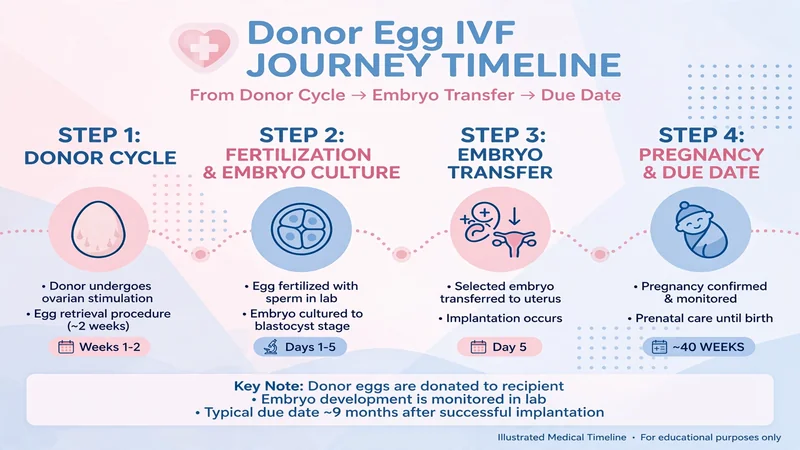
That surprises many recipients, because the donor cycle feels like a separate process. But once the embryo is created and transferred, the pregnancy is dated the same way as every other IVF pregnancy: from the embryo’s age on transfer day. The only dates that matter are your transfer date and the embryo’s age.
Donor eggs do not change the math: due date = transfer date + (266 − embryo age). Enter your transfer date and the embryo’s age at transfer.
Estimates only. Whether the egg came from you or a donor, the dating is identical — what matters is the transfer date and the embryo’s age. Your clinic confirms the official date at your first ultrasound. All calculations happen in your browser — nothing is stored or sent anywhere.
How the Donor Egg IVF Due Date Calculator Works
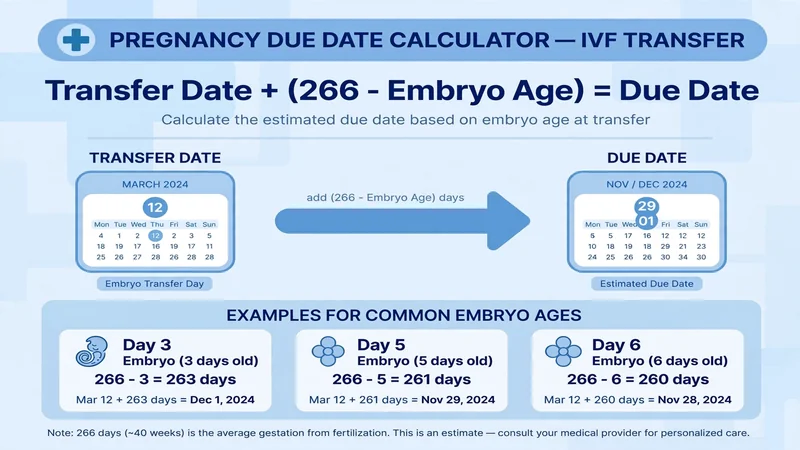
The donor egg ivf due date calculator uses the formula: due date = transfer date + (266 − embryo age). The embryo’s age is the number of days from fertilization to transfer — usually 3, 5, or 6. Subtract that age from 266, then add the result to your transfer date.
Worked out, the three common cases are:
| Embryo age on transfer day | Days added | Example: transfer October 15 |
|---|---|---|
| Day 3 | +263 days | Due date July 5 |
| Day 5 | +261 days | Due date July 3 |
| Day 6 | +260 days | Due date July 2 |
Check the Day 5 row against the standard IVF rule: transfer plus 261 days is the familiar Day 5 formula, and it appears here exactly as it should. Donor eggs change nothing about that arithmetic. Your clinic’s transfer report will state the embryo’s age — Day 3, Day 5, or Day 6 — and that is the only input you need beyond the transfer date. For the standard own-egg version of the same method, see our embryo transfer due date calculator.
Why Donor Eggs Do Not Change the Math
With a donor egg ivf due date calculator, pregnancy dating counts gestational age from a theoretical last menstrual period, and that theoretical date is derived from the embryo’s age — not from whose egg it was. A Day 5 embryo is five days past fertilization whether the egg came from the recipient or from a donor. The uterus, the timeline, and the 280-day scale are all the same.
The donor’s cycle is also irrelevant to the dating. The donor may have had stimulation and retrieval on a different schedule, and the recipient’s lining may have been prepared with medication over a different number of days. None of that shifts the embryo’s age, and the embryo’s age is the whole formula. If you ever see a due date calculator that asks for the donor’s age or retrieval date, it is asking for information the math does not need.
Dating the Recipient Cycle: Your Theoretical LMP
The calculator also gives you a theoretical last menstrual period, which is the transfer date minus (14 + embryo age) days. For a Day 5 transfer, that is transfer minus 19 days. For a Day 3 transfer, it is transfer minus 17 days. For a Day 6 transfer, transfer minus 20 days.
This theoretical LMP is what your records, ultrasound reports, and prenatal appointments use. It is a calculated reference date, not a period you actually had — in a medicated recipient cycle, there may not have been a real period at all. Do not substitute a real period date from your own cycle into the formula; it will give the wrong answer. The same convention applies in every IVF pregnancy, donor or not. If you are wondering how far along you are right now, our guide on how many weeks pregnant you are after embryo transfer explains the counting.
Frozen Donor Embryos
Many donor-egg cycles use frozen embryos, either from a frozen donor egg bank or from embryos frozen after a fresh donor cycle. Freezing does not change what the donor egg ivf due date calculator returns. A Day 5 embryo frozen in January and transferred in June is still a Day 5 embryo on transfer day, and the formula still adds 261 days to the June transfer date.
The storage time simply does not count. Embryos do not age while frozen, so a year in storage adds zero days to the pregnancy clock. General patient resources from ACOG explain the same 280-day dating convention used for all pregnancies. This is the same principle as a frozen own-egg cycle — see our frozen embryo transfer due date calculator for the frozen-cycle version. If your transfer used a frozen donor embryo, use the actual transfer date and the embryo’s age at freezing, and the calculator will handle the rest.
What About the Donor’s Age and PGT?
Two details come up often in donor-egg dating questions, and neither changes the due date.
The donor’s age. The donor’s age matters for embryo quality and for the odds of success, but it has no role in dating. A Day 5 embryo from a 25-year-old donor and a Day 5 embryo from a 32-year-old donor get the same +261 days. Age affects the embryo’s prospects, not its calendar.
PGT (preimplantation genetic testing). If the embryo was biopsied for PGT, the biopsy happens before freezing and does not add days to the embryo’s age. A biopsied Day 5 embryo is still a Day 5 embryo. The testing may delay the transfer by a cycle while results come back, but the transfer date you enter is the actual transfer date, so the delay is already accounted for.
What can change the timeline is a twin pregnancy. Donor-egg cycles sometimes transfer more than one embryo, and twins change the planning windows for delivery. Our twins calculator covers the twin-specific dates if that applies to you.
Frequently Asked Questions
Does the donor egg ivf due date calculator work for fresh and frozen donor eggs?
Yes. Fresh and frozen donor embryos use the same formula: transfer date plus 266 minus embryo age. Freezing pauses the embryo’s age, so storage time adds no days. Use the actual transfer date and the embryo’s age on that day.
Is my due date different because I used a donor egg?
No. A donor egg ivf due date calculator uses the same math because donor eggs do not change pregnancy dating. A Day 5 donor embryo and a Day 5 own-egg embryo transferred on the same date have the same due date. The donor’s age, cycle, and retrieval date do not enter the calculation.
What is my theoretical LMP with a donor egg transfer?
It is your transfer date minus (14 + the embryo’s age) days: minus 17 for a Day 3 transfer, minus 19 for Day 5, and minus 20 for Day 6. For example, an October 15 Day 5 donor transfer gives a theoretical LMP of September 26. This calculated date is what your records and ultrasound reports use.
Does PGT testing change my due date?
No. PGT biopsy does not add days to the embryo’s age, and the transfer date you enter already reflects any scheduling delay while results were pending. A biopsied Day 5 embryo still uses the +261-day formula.
What if I don’t know my embryo’s age?
Check your transfer report — it usually states Day 3, Day 5, or Day 6 explicitly. If the report is unclear, ask your clinic. The embryo’s age is the one input the calculator cannot do without, and guessing it can shift your due date by two or three days.
Can I use this calculator if I received a donor embryo, not a donor egg?
Yes. Whether the donated material was an egg fertilized for you or a complete donated embryo, the dating works the same way: transfer date plus 266 minus the embryo’s age on transfer day. The embryo’s age is what matters, not how it was created.
About the Author
Emily Johnson is a Content Writer & Fertility Advocate who covers IVF timelines, donor-egg and third-party reproduction topics, and early pregnancy planning. She writes practical guides that help patients make sense of donor-egg timelines and dates.
Medical Review
Dr. Sarah Ahmed, Medical Content Advisor, reviewed this article for clinical accuracy. She checks that the dating formulas, theoretical LMP derivation, and frozen-embryo guidance match standard fertility practice.
Disclaimer: This article is for educational purposes only and is not medical advice. Remember that due dates are estimates; only your clinic’s ultrasound-based dating counts as official. Confirm your due date, testing schedule, and care plan with your fertility clinic or healthcare team.