

Beta hCG Doubling Calculator: A Proven Complete Guide

By Emily Johnson, Content Writer & Fertility Advocate · Medically reviewed by Dr. Sarah Ahmed, Medical Content Advisor
Table of Contents
After a positive pregnancy test, the next question is usually “is it rising properly?” A beta hcg doubling calculator answers it by turning two blood-test results into one number: the time your hCG level takes to double. Enter the first result, the second result, and the hours between them, and the calculator does the rest.
Beta hCG is the hormone measured in the blood test your clinic orders after an embryo transfer or a positive home test. The name “beta” refers to the beta subunit of the hormone, which is what the lab measures. In early pregnancy, this level usually rises quickly — and the rate of rise tells your care team more than any single number.
Enter two beta hCG blood-test results and the hours between them. Doubling time = hours × ln(2) ÷ ln(second ÷ first).
Estimates only, and only the trend matters — a single hCG value cannot confirm a healthy pregnancy. In early pregnancy hCG typically doubles every 48–72 hours. If your level fell, plateaued, or is rising much slower than that, follow up with your clinic promptly. All calculations happen in your browser — nothing is stored or sent anywhere.
How the Beta hCG Doubling Calculator Works
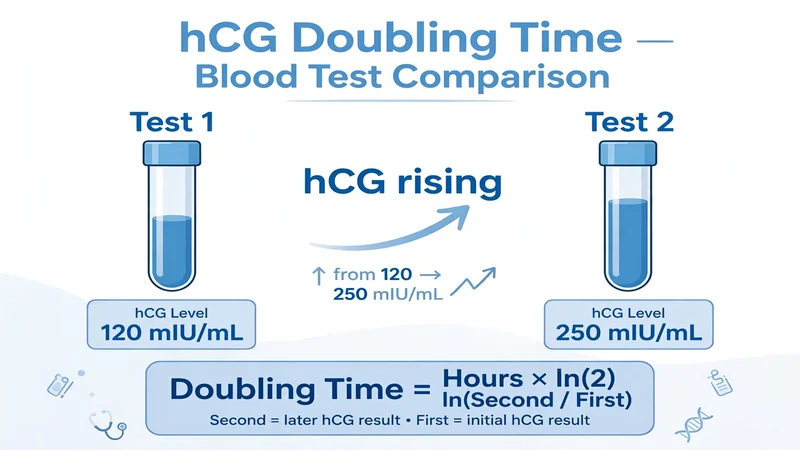
The beta hcg doubling calculator uses the formula: doubling time = hours × ln(2) ÷ ln(second ÷ first), where “ln” is the natural logarithm. You need not work it out by hand — the calculator handles the logarithm — but the formula shows why two results are required: doubling is a rate of change, and a rate always needs two points.
For a meaningful result, both tests should come from the same lab and be measured in the same units (mIU/mL) — different labs can report slightly different values for the same sample. Note the date and time of each draw, not just the date, because the hours between tests drive the calculation.
Worked Examples You Can Verify
Example 1: First result 120, second result 250, taken 48 hours apart. Doubling time = 48 × 0.693 ÷ ln(250 ÷ 120) = 48 × 0.693 ÷ 0.734 ≈ 45.3 hours — just below the typical 48–72 hour range, slightly on the faster side, which is still commonly seen in early pregnancy.
Example 2: First result 100, second result 200, taken 48 hours apart. The level exactly doubled, so the doubling time is exactly 48 hours — the cleanest textbook case.
Example 3: First result 150, second result 400, taken 72 hours apart. Doubling time = 72 × 0.693 ÷ ln(400 ÷ 150) = 72 × 0.693 ÷ 0.981 ≈ 50.9 hours. Even though the gap was three days, the doubling time is still close to two days, because the level more than doubled.
What the beta hcg doubling calculator shows across these examples is the same pattern: the raw numbers differ wildly, but the doubling times cluster in the same range. That is the whole point — it converts numbers that are hard to compare into one pattern that is easy to read. If you are also tracking your due date, our pregnancy due date calculator places these early results on your overall timeline.
What 48–72 Hours Means
In a typical early pregnancy, the beta hcg doubling calculator returns a doubling time of roughly 48 to 72 hours — a guideline, not a pass-or-fail line. Doubling times at the faster end are common in the first weeks, and the pace usually slows as levels climb into the thousands.
The 48–72 hour expectation applies best to the earliest weeks, when levels are still relatively low. Once hCG passes about 6,000 mIU/mL, doubling naturally slows to around 72 to 96 hours, then slows further. So a doubling time that looks slow at 8,000 may be ordinary, while the same number at 200 deserves a closer look. Context matters, which is why your clinic reads the trend alongside your ultrasound results. For patient guidance on early pregnancy monitoring, ACOG and ASRM publish resources on why clinics rely on trends rather than single values.

Faster, Slower, or Flat Patterns
Faster than 48 hours. A doubling time under 48 hours can still be normal, and it is commonly seen with twin pregnancies, where two sources produce the hormone. A fast rise alone does not confirm twins — only an ultrasound can — but it is one reason your clinic may schedule an early scan.
Slower than 72 hours. A doubling time above 72 hours does not automatically mean something is wrong, but it does need clinic follow-up. Sometimes the cause is a timing error in the blood draws; sometimes it signals a pregnancy that needs closer monitoring. Either way, do not wait for the next scheduled test — call your care team.
Flat or falling levels. If the second result is the same as or lower than the first, the level is not doubling at all, and the calculator will show the percentage change instead of a doubling time. A plateau or a drop needs prompt clinic follow-up: it can indicate a pregnancy that is not progressing or an ectopic pregnancy, which needs urgent care. With pain, heavy bleeding, or dizziness along with a falling level, seek care right away. For the bigger picture of early testing, see our early pregnancy test calculator.
Why a Single hCG Value Misleads
A single beta hCG number cannot confirm a healthy pregnancy, and it cannot rule one out — normal values span an enormous range at every stage. At four weeks, one healthy pregnancy might read 100 while another reads 800, and both can be fine. The number also depends on lab, assay, and timing.
This is why clinics order serial tests — two or more results spaced 48 hours apart — instead of relying on one draw. The trend is the information. Two results that rise on schedule are reassuring even when the starting number is low, while a single high number that then stalls is more concerning than a modest number that doubles on time. Forum comparisons usually compare incomparable things: different labs, timing, and pregnancies.
When to Call Your Clinic
Use this checklist after each pair of results:
- Rising on schedule (48–72 hours): follow your clinic’s testing plan.
- Slower than 72 hours: contact your clinic.
- Flat or falling: contact your clinic.
- Severe pain, heavy bleeding, dizziness, or shoulder pain: seek urgent care immediately.
Keep a simple log of each result with the date and time of the draw. That log makes the calculator’s job easy and gives your clinic exactly what it needs to interpret the trend. If your treatment involved an embryo transfer, you can also check where you are with our guide to how many weeks pregnant you are after embryo transfer.
Frequently Asked Questions
How do I use the beta hcg doubling calculator?
Enter your first beta hCG result, your second result, and the hours between the two blood draws into the beta hcg doubling calculator. It returns your doubling time in hours, plus whether it falls inside the typical 48–72 hour range. Use results from the same lab.
What is a normal hCG doubling time?
In early pregnancy, a typical doubling time is about 48 to 72 hours, and the pace slows as levels rise: above roughly 6,000 mIU/mL, doubling every 72 to 96 hours is common. One number outside the range is not a diagnosis — your clinic reads the full trend with your ultrasound.
Can a low hCG level still be a healthy pregnancy?
Yes. Healthy pregnancies start from a wide range of values, and a low starting number that doubles on schedule is reassuring. What matters is the trend across two tests, not the first number alone.
What does it mean if my hCG is not doubling?
A slower-than-expected rise, a plateau, or a fall needs prompt clinic follow-up. Possible explanations include timing errors, a pregnancy that needs closer monitoring, or an ectopic pregnancy. Your clinic may order repeat tests or an ultrasound.
Can I use a home pregnancy test instead of blood tests for doubling?
No. Home tests are qualitative — they show a line, not a number — and line darkness is not a reliable measure of hCG concentration. Doubling-time math needs two numeric blood results. Home tests are fine for a first yes-or-no answer, but not for tracking the trend.
Does a fast rise mean twins?
Not necessarily. A fast rise is more common with twins, but many singleton pregnancies also rise quickly, and some twin pregnancies rise at an average pace. Only an ultrasound can confirm it.
About the Author
Emily Johnson is a Content Writer & Fertility Advocate who covers IVF testing, early pregnancy monitoring, and the first weeks after a positive result, turning confusing lab numbers into clear explanations.
Medical Review
Dr. Sarah Ahmed, Medical Content Advisor, reviewed this article for clinical accuracy, checking that the doubling-time formula, typical ranges, and follow-up guidance match standard fertility practice.
Disclaimer: This article is for educational purposes only and is not medical advice. Beta hCG interpretation depends on your lab, timing, and clinical situation. Do not make decisions based on a single result — confirm your trend and next steps with your fertility clinic or healthcare provider.