

IVF Due Date Calculator 3 Day Transfer: A Proven Complete Guide

By Emily Johnson, Content Writer & Fertility Advocate · Medically reviewed by Dr. Sarah Ahmed, Medical Content Advisor
Table of Contents
If your clinic transferred a Day 3 embryo, an ivf due date calculator 3 day transfer gives you the most accurate estimate in seconds. Enter one date — the day the embryo was placed in your uterus — and the calculator adds 263 days to find your estimated due date. No guessing, no calendar math, and no confusion with your retrieval date.
Day 3 transfers are sometimes called cleavage-stage transfers because the embryo has divided into roughly six to eight cells by the third day after fertilization. Clinics often use them when there are fewer embryos or when an earlier transfer fits the treatment plan. The dating math differs slightly from Day 5 or Day 6 transfers, and that two- or three-day difference matters.
Enter your Day 3 embryo transfer date. Due date = transfer date + 263 days.
Use the date the embryo was placed in your uterus, not the retrieval date.
Estimates only. Your clinic confirms the official date at your first ultrasound. All calculations happen in your browser — nothing is stored or sent anywhere.
How the IVF Due Date Calculator 3 Day Transfer Works
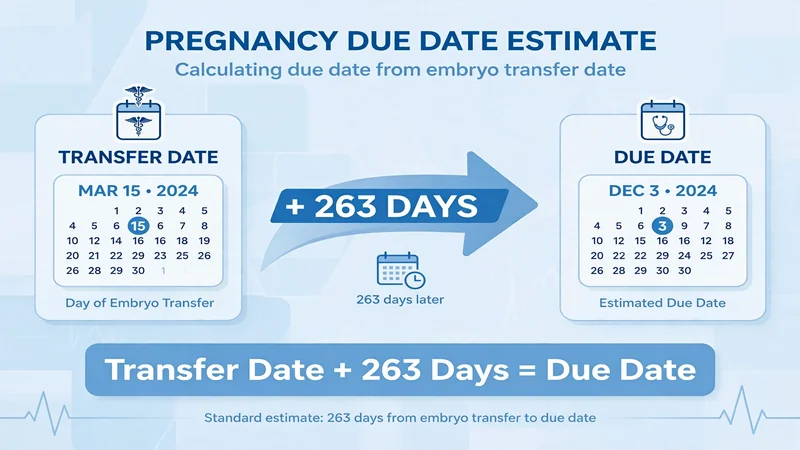
The ivf due date calculator 3 day transfer uses one simple formula: transfer date plus 263 days. The number 263 comes from the standard 280-day pregnancy counted from the last menstrual period, minus the 17 days that have already passed by the time a Day 3 embryo is transferred. On transfer day, you are already considered 2 weeks and 3 days pregnant, even though the embryo is only three days old.
The calculator also works out your theoretical last menstrual period — the transfer date minus 17 days — which is what ultrasound reports and prenatal records use. If your clinic gave you a different dating method, follow the clinic’s version. For general background on pregnancy dating, ACOG (https://www.acog.org/) explains that first-trimester ultrasound dating is the most accurate.
A Worked Example You Can Check
Suppose your Day 3 transfer happened on October 15. Add 263 days and you land on July 5 of the following year. Your theoretical last menstrual period would be September 28, 17 days before the transfer, and your gestational age on transfer day is 2 weeks and 3 days.
A second check with the ivf due date calculator 3 day transfer: a transfer on March 10 gives a due date of November 28. The same rule applies every time — 263 days forward, no exceptions for weekends, months, or leap years. If you want to double-check the result, you can also count backward: your due date minus 263 days should return your exact transfer date. For a full walkthrough of the most common transfer type, see our guide to the 5-day transfer calculator (https://ivfduedatecalculator.us/ivf-due-date-5-day-transfer/).
Day 3 vs Day 5 vs Day 6 Transfers
The only thing that changes between transfer stages is how many days are added. The embryo’s age on transfer day determines the offset, and each stage has its own well-established number.
| Transfer stage | Gestational age on transfer day | Days added | Theoretical LMP |
|---|---|---|---|
| Day 3 (cleavage) | 2 weeks, 3 days | +263 days | Transfer − 17 days |
| Day 5 (blastocyst) | 2 weeks, 5 days | +261 days | Transfer − 19 days |
| Day 6 (blastocyst) | 2 weeks, 6 days | +260 days | Transfer − 20 days |
A Day 3 and a Day 5 transfer on the same date give due dates only two days apart, which is exactly why using the right stage matters: a two-day error can shift appointment dates and screening windows. If your transfer was a frozen cycle, the same math applies — see our frozen embryo transfer due date calculator (https://ivfduedatecalculator.us/frozen-embryo-transfer-due-date-calculator/) for the frozen-cycle version.
Your Milestone Timeline After a Day 3 Transfer
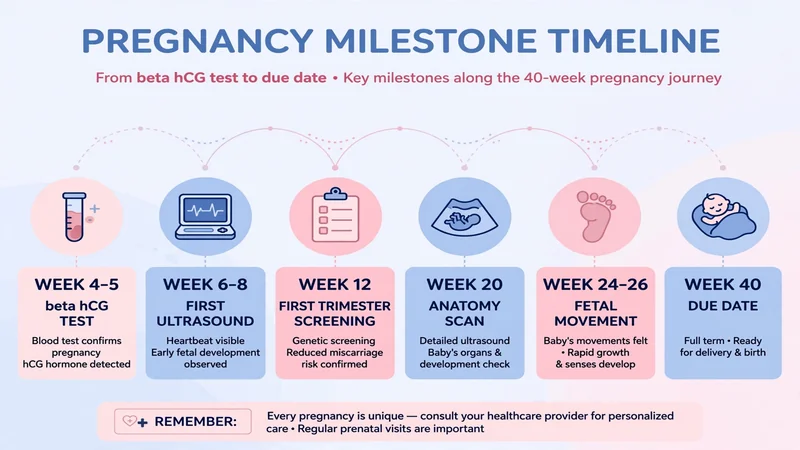
Once the ivf due date calculator 3 day transfer gives you the due date, the rest of the calendar falls into place. The dates below are counted from the transfer date.
| Milestone | After transfer | What happens |
|---|---|---|
| Beta hCG blood test | 9–14 days | Confirms the pregnancy with a blood test |
| First ultrasound | About 25 days | Confirms the gestational sac and location |
| Heartbeat usually visible | About 30 days | Transvaginal ultrasound may show the heartbeat |
| End of first trimester | About 80 days | Nausea often eases around this point |
| Anatomy scan | 109–137 days | Detailed check of the baby’s development |
| Third trimester begins | About 179 days | 28 weeks, the home stretch starts |
| Full term | About 242 days | 37 weeks, the baby is considered full term |
| Estimated due date | 263 days | 40 weeks from the theoretical LMP |
Use this table to plan time off, travel, and nursery prep — but treat each date as approximate. Ultrasounds can shift the official due date by a few days, especially in the first trimester. If you are carrying twins, the planning window changes; our twins calculator (https://ivfduedatecalculator.us/ivf-due-date-calculator-twins/) covers twin-specific timing.
3 Common Mistakes to Avoid
Using the retrieval date instead of the transfer date.
Retrieval and transfer are different events, usually three to six days apart, and the formula needs the transfer date. If you only know your retrieval date, add 266 days to it instead — that lands on the same due date.
Using the wrong embryo stage.
A Day 3 formula applied to a Day 5 embryo gives a due date two days too late. Check your transfer report or ask your clinic — it usually says “Day 3,” “Day 5,” or “Day 6” explicitly.
Mixing up the theoretical LMP with a real period.
In an IVF cycle, the theoretical last menstrual period is a calculated date, not a period you actually had. It exists so IVF pregnancies can be dated on the same 280-day scale as natural ones. Do not use a real period date from a medicated cycle — it will give the wrong answer.
What If Your Transfer Date Changes?
If a transfer is postponed, the rule of the ivf due date calculator 3 day transfer stays simple: use the date the embryo was actually transferred, and match the formula to the embryo’s age on that day. Frozen and fresh Day 3 embryos both use +263 days — only the embryo’s age on transfer day matters.
Frequently Asked Questions
How accurate is the ivf due date calculator 3 day transfer?
It is accurate as an estimate: the formula is the same one clinics use, and it is exact when the transfer date and embryo stage are correct. Your first ultrasound may still adjust the official date by a few days, because ultrasounds measure actual development.
Why does a Day 3 transfer add 263 days instead of 280?
A full pregnancy is counted as 280 days from the last menstrual period. By the time a Day 3 embryo is transferred, 17 of those days have already passed, so 280 minus 17 leaves 263. Day 5 transfers subtract 19 days and Day 6 subtract 20, which is why their numbers are smaller.
Can I use this calculator for a frozen Day 3 transfer?
Yes. Fresh and frozen Day 3 embryos use the same +263-day formula — the embryo’s age on transfer day is what matters, not whether it was frozen. If your frozen embryo was transferred on a different day than planned, use the actual transfer date.
What is my LMP if I had a Day 3 transfer?
Your theoretical last menstrual period is your transfer date minus 17 days — for example, an October 15 transfer gives September 28. This calculated date is what your records and ultrasound reports use.
How many weeks pregnant am I on the day of a Day 3 transfer?
You are 2 weeks and 3 days pregnant on transfer day. That follows the standard convention of counting from the last menstrual period rather than from fertilization: two weeks from the theoretical cycle, three days from the embryo’s age.
Does a Day 3 transfer change my beta hCG test date?
No, the beta test window stays the same: roughly 9 to 14 days after transfer. Your clinic will schedule the exact day, and testing earlier can mislead, so it is best to wait even though the wait is hard.
About the Author
Emily Johnson is a Content Writer & Fertility Advocate who covers IVF timelines, embryo transfer dating, and early pregnancy planning. She writes practical, research-based guides that help patients understand their own calendars.
Medical Review
Dr. Sarah Ahmed, Medical Content Advisor, reviewed this article for clinical accuracy. She checks that the dating formulas, milestone windows, and testing timelines match standard fertility practice.
Disclaimer: This article is for educational purposes only and is not medical advice. Due dates are estimates, and your clinic’s ultrasound-based dating is the official record. Confirm your due date, testing schedule, and care plan with your fertility clinic or healthcare provider.