

Donor Egg IVF Due Date Calculator: A Proven Complete Guide

By Emily Johnson, Content Writer & Fertility Advocate · Medically reviewed by Dr. Sarah Ahmed, Medical Content Advisor
- How the Donor Egg IVF Due Date Calculator Works
- Why Donor Eggs Do Not Change the Math
- Dating the Recipient Cycle: Your Theoretical LMP
- Frozen Donor Embryos
- What About the Donor’s Age and PGT?
- Fresh Donor Egg Cycles: Dating From the Retrieval Date
- Your Donor Egg Pregnancy Milestones
- Frequently Asked Questions
- A Worked Donor Egg Example
- How Accurate Is a Donor Egg IVF Due Date?
- About the Author
- Medical Review
Using donor eggs raises one question early on: does the donor change how your due date is calculated? The short answer is no. A donor egg ivf due date calculator uses the exact same math as any other IVF pregnancy — transfer date plus 266 minus the embryo’s age in days. The donor’s identity, age, and cycle do not enter the formula at all.
That surprises many recipients, because the donor cycle feels like a separate process. But once the embryo is created and transferred, the pregnancy is dated the same way as every other IVF pregnancy: from the embryo’s age on transfer day. The only dates that matter are your transfer date and the embryo’s age.
Donor eggs do not change the math: due date = transfer date + (266 − embryo age). Enter your transfer date and the embryo’s age at transfer.
Estimates only. Whether the egg came from you or a donor, the dating is identical — what matters is the transfer date and the embryo’s age. Your clinic confirms the official date at your first ultrasound. All calculations happen in your browser — nothing is stored or sent anywhere.
How the Donor Egg IVF Due Date Calculator Works
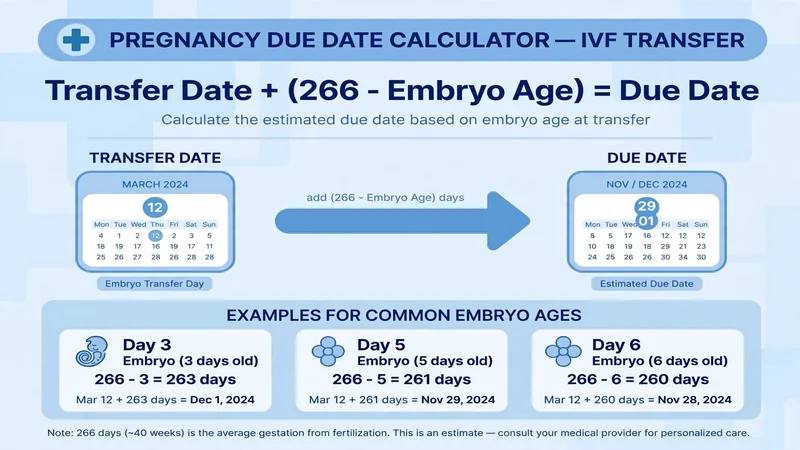
The donor egg ivf due date calculator uses the formula: due date = transfer date + (266 − embryo age). The embryo’s age is the number of days from fertilization to transfer — usually 3, 5, or 6. Subtract that age from 266, then add the result to your transfer date.
Worked out, the three common cases are:
| Embryo age on transfer day | Days added | Example: transfer October 15 |
|---|---|---|
| Day 3 | +263 days | Due date July 5 |
| Day 5 | +261 days | Due date July 3 |
| Day 6 | +260 days | Due date July 2 |
Check the Day 5 row against the standard IVF rule: transfer plus 261 days is the familiar Day 5 formula, and it appears here exactly as it should. Donor eggs change nothing about that arithmetic. Your clinic’s transfer report will state the embryo’s age — Day 3, Day 5, or Day 6 — and that is the only input you need beyond the transfer date. For the standard own-egg version of the same method, see our embryo transfer due date calculator.
Why Donor Eggs Do Not Change the Math
With a donor egg ivf due date calculator, pregnancy dating counts gestational age from a theoretical last menstrual period, and that theoretical date is derived from the embryo’s age — not from whose egg it was. A Day 5 embryo is five days past fertilization whether the egg came from the recipient or from a donor. The uterus, the timeline, and the 280-day scale are all the same.
The donor’s cycle is also irrelevant to the dating. The donor may have had stimulation and retrieval on a different schedule, and the recipient’s lining may have been prepared with medication over a different number of days. None of that shifts the embryo’s age, and the embryo’s age is the whole formula. If you ever see a due date calculator that asks for the donor’s age or retrieval date, it is asking for information the math does not need.
Dating the Recipient Cycle: Your Theoretical LMP
The calculator also gives you a theoretical last menstrual period, which is the transfer date minus (14 + embryo age) days. For a Day 5 transfer, that is transfer minus 19 days. For a Day 3 transfer, it is transfer minus 17 days. For a Day 6 transfer, transfer minus 20 days.
This theoretical LMP is what your records, ultrasound reports, and prenatal appointments use. It is a calculated reference date, not a period you actually had — in a medicated recipient cycle, there may not have been a real period at all. Do not substitute a real period date from your own cycle into the formula; it will give the wrong answer. The same convention applies in every IVF pregnancy, donor or not. If you are wondering how far along you are right now, our guide on how many weeks pregnant you are after embryo transfer explains the counting.
Frozen Donor Embryos
Many donor-egg cycles use frozen embryos, either from a frozen donor egg bank or from embryos frozen after a fresh donor cycle. Freezing does not change what the donor egg ivf due date calculator returns. A Day 5 embryo frozen in January and transferred in June is still a Day 5 embryo on transfer day, and the formula still adds 261 days to the June transfer date.
The storage time simply does not count. Embryos do not age while frozen, so a year in storage adds zero days to the pregnancy clock. General patient resources from ACOG explain the same 280-day dating convention used for all pregnancies. This is the same principle as a frozen own-egg cycle — see our frozen embryo transfer due date calculator for the frozen-cycle version. If your transfer used a frozen donor embryo, use the actual transfer date and the embryo’s age at freezing, and the calculator will handle the rest.
What About the Donor’s Age and PGT?
Two details come up often in donor-egg dating questions, and neither changes the due date.
The donor’s age. The donor’s age matters for embryo quality and for the odds of success, but it has no role in dating. A Day 5 embryo from a 25-year-old donor and a Day 5 embryo from a 32-year-old donor get the same +261 days. Age affects the embryo’s prospects, not its calendar.
PGT (preimplantation genetic testing). If the embryo was biopsied for PGT, the biopsy happens before freezing and does not add days to the embryo’s age. A biopsied Day 5 embryo is still a Day 5 embryo. The testing may delay the transfer by a cycle while results come back, but the transfer date you enter is the actual transfer date, so the delay is already accounted for.
What can change the timeline is a twin pregnancy. Donor-egg cycles sometimes transfer more than one embryo, and twins change the planning windows for delivery. Our twins calculator covers the twin-specific dates if that applies to you.
Fresh Donor Egg Cycles: Dating From the Retrieval Date
Some recipients take part in a fresh donor egg cycle, where the donor’s retrieval and the recipient’s transfer happen within days of each other. When the retrieval date is known, the pregnancy can be dated from it directly: due date = retrieval date + 266 days (38 weeks). A donor retrieval on March 3, for example, gives a tentative due date of November 24.
You should get the same answer from the transfer-date formula, as long as the embryo’s age is entered correctly: a Day 5 embryo transferred five days after retrieval gives the same due date through both formulas. If the two methods disagree, the embryo’s age was probably recorded incorrectly — check your transfer report and ask your clinic before relying on either date.
Our guide to dating from the retrieval date covers the retrieval method in full.
Your Donor Egg Pregnancy Milestones
Once you have your due date, the rest of the calendar follows from your theoretical LMP (transfer date minus 14 + embryo age days). These are the standard milestones your clinic and OB will use:
- On transfer day: you are already 2 weeks plus the embryo’s age — 2 weeks 3 days (Day 3), 2 weeks 5 days (Day 5), or 2 weeks 6 days (Day 6).
- First beta hCG test: usually 9–14 days after transfer.
- First ultrasound: typically around 6 weeks of gestational age — the gestational sac is usually visible, and a heartbeat is often seen.
- Viability: around 24 weeks.
- Full term: 37 weeks.
- Due date: 40 weeks.
Appointment timing varies by clinic, so confirm your scan schedule with your care team.
A Worked Donor Egg Example: From Transfer Day to Due Date
Here is a full worked example so you can see how every date falls out of the formula. (This is a fictional illustration; your dates will depend on your own transfer date and embryo age.) Say Maria, 41, used donor eggs and had a Day 5 blastocyst transferred on Tuesday, March 10, 2026.
Her donor egg ivf due date calculator result: March 10, 2026 + 261 days = Thursday, November 26, 2026. Her theoretical last menstrual period is February 19, 2026 (transfer minus 19 days), so on transfer day she is already 2 weeks and 5 days pregnant. From that one date, her whole care timeline follows:

| Milestone | Dates (Maria’s example) | Gestational age | What happens |
|---|---|---|---|
| Transfer day | March 10, 2026 | 2 weeks, 5 days | Gestational clock starts from theoretical LMP of February 19, 2026 |
| First beta hCG test | March 19–24, 2026 | ~4 weeks | Blood test confirms the pregnancy |
| First ultrasound | April 2–9, 2026 | 6–7 weeks | Gestational sac and heartbeat check |
| First-trimester screening | May 7–21, 2026 | 11–13 weeks | Nuchal translucency and blood screening window |
| Anatomy scan | June 25 – July 23, 2026 | 18–22 weeks | Detailed fetal anatomy survey |
| Viability milestone | August 6, 2026 | 24 weeks | Notable survival milestone for premature delivery |
| Full term | November 5, 2026 | 37 weeks | Pregnancy considered full term |
| Estimated due date | November 26, 2026 | 40 weeks | The calculator’s headline result |
Try the same inputs in the calculator above — March 10, 2026 with a Day 5 embryo — and you will land on November 26, 2026 with the same theoretical LMP. That match is the point: clinics date your pregnancy from this exact math, and your first-trimester ultrasound then confirms or fine-tunes it. If your cycle used a frozen donor embryo, the same table applies — only the transfer date matters, never the freezing date.
How Accurate Is a Donor Egg IVF Due Date?
A donor egg ivf due date calculator gives one of the most accurate starting estimates in obstetrics. The two inputs — transfer date and embryo age — are documented facts from the embryology lab, so there is no ovulation guesswork the way period-based dating has. This matters even more for donor-egg recipients, whose own cycles are often irregular or medically suppressed; with IVF, that uncertainty simply does not exist. Learn more about how accurate IVF due date calculators are.

In practice, transfer-based dating and first-trimester ultrasound dating (crown-rump length) usually agree within a few days. If the two differ by more than about a week, most providers adopt the ultrasound date — but that adjustment is uncommon. Keep perspective, though: a due date is an estimate, not an appointment. Only a small share of babies arrive exactly on the estimated date; most arrive within a week or two on either side. Implantation itself can take anywhere from 1 to 5 days after transfer, adding a small natural wobble, and donor-egg cycles that transfer two embryos carry a higher chance of twins — twin pregnancies average 36–38 weeks. Think of the calculator’s result as the most honest starting point available, then let your clinic confirm the official date.
Frequently Asked Questions
Does the donor egg ivf due date calculator work for fresh and frozen donor eggs?
Yes. Fresh and frozen donor embryos use the same formula: transfer date plus 266 minus embryo age. Freezing pauses the embryo’s age, so storage time adds no days. Use the actual transfer date and the embryo’s age on that day.
Is my due date different because I used a donor egg?
No. A donor egg ivf due date calculator uses the same math because donor eggs do not change pregnancy dating. A Day 5 donor embryo and a Day 5 own-egg embryo transferred on the same date have the same due date. The donor’s age, cycle, and retrieval date do not enter the calculation.
What is my theoretical LMP with a donor egg transfer?
It is your transfer date minus (14 + the embryo’s age) days: minus 17 for a Day 3 transfer, minus 19 for Day 5, and minus 20 for Day 6. For example, an October 15 Day 5 donor transfer gives a theoretical LMP of September 26. This calculated date is what your records and ultrasound reports use.
Does PGT testing change my due date?
No. PGT biopsy does not add days to the embryo’s age, and the transfer date you enter already reflects any scheduling delay while results were pending. A biopsied Day 5 embryo still uses the +261-day formula.
What if I don’t know my embryo’s age?
Check your transfer report — it usually states Day 3, Day 5, or Day 6 explicitly. If the report is unclear, ask your clinic. The embryo’s age is the one input the calculator cannot do without, and guessing it can shift your due date by two or three days.
Can I use this calculator if I received a donor embryo, not a donor egg?
Yes. Whether the donated material was an egg fertilized for you or a complete donated embryo, the dating works the same way: transfer date plus 266 minus the embryo’s age on transfer day. The embryo’s age is what matters, not how it was created.
Is a donor egg IVF due date more accurate than dating from my last period?
Yes. A donor egg ivf due date calculator uses documented facts — your transfer date and the embryo’s age — while period-based dating guesses at ovulation. For donor-egg recipients, whose own cycles are often irregular or suppressed by medication, the IVF date is the more reliable starting point.
What if my ultrasound gives a different due date than the calculator?
Small differences of a few days are normal and not a problem. A first-trimester ultrasound is the gold standard for dating, so if it disagrees with the calculator by more than about a week, most providers switch to the ultrasound date. Read our comparison of IVF due date vs ultrasound due date for the full picture.
Why is my clinic’s date a day or two different from the calculator?
A one- to two-day difference usually comes from counting conventions — some clinics count the transfer day as Day 0, others as Day 1 — or from rounding. It is not clinically meaningful. Keep the date your clinic puts on your official chart so every appointment lines up.
Can I calculate my due date from the donor’s retrieval date instead of the transfer date?
Yes — for a fresh donor egg cycle, add 266 days (38 weeks) to the donor’s retrieval date. The transfer-date formula (transfer date + 266 minus embryo age) should give the same answer when the embryo’s age is correct. If the two dates disagree, check your transfer report with your clinic.
How many weeks pregnant am I on donor egg transfer day?
You are 2 weeks plus the embryo’s age: 2 weeks 3 days for a Day 3 transfer, 2 weeks 5 days for a Day 5 transfer, and 2 weeks 6 days for a Day 6 transfer. The calculator above shows this automatically.
When is the first ultrasound after a donor egg transfer?
Usually around 6 weeks of gestational age, counted from your theoretical LMP. At that visit the gestational sac is typically visible and a heartbeat is often seen. Your clinic will confirm the timing for your cycle.
Is IVF dating more accurate than an early ultrasound?
IVF dating is considered highly accurate because the embryo’s age is known exactly — unlike natural conception, where ovulation has to be estimated. An early ultrasound can still be used to confirm the dates, and your OB makes the final call.
About the Author
Emily Johnson is a Content Writer & Fertility Advocate who covers IVF timelines, donor-egg and third-party reproduction topics, and early pregnancy planning. She writes practical guides that help patients make sense of donor-egg timelines and dates.
Medical Review
Dr. Sarah Ahmed, Medical Content Advisor, reviewed this article for clinical accuracy. She checks that the dating formulas, theoretical LMP derivation, and frozen-embryo guidance match standard fertility practice.
Disclaimer: This article is for educational purposes only and is not medical advice. Remember that due dates are estimates; only your clinic’s ultrasound-based dating counts as official. Confirm your due date, testing schedule, and care plan with your fertility clinic or healthcare team.