
IVF Trimester Calculator: A Proven Complete Guide

By Emily Johnson, Content Writer & Fertility Advocate · Medically reviewed by Dr. Sarah Ahmed, Medical Content Advisor
Table of Contents
“What trimester am I in?” is one of the first questions after a positive beta — and in an IVF pregnancy, the answer is not obvious, because gestational age starts before the embryo even existed. An ivf trimester calculator settles it: enter your transfer date and embryo age, and it tells you your current trimester, your exact weeks and days, and the dates your trimesters begin and end.
The tool is useful beyond curiosity: screening windows, scan schedules, travel advice, and work planning all key off your trimester. Knowing exactly where you stand keeps you from missing a window or worrying about a milestone that is still weeks away.
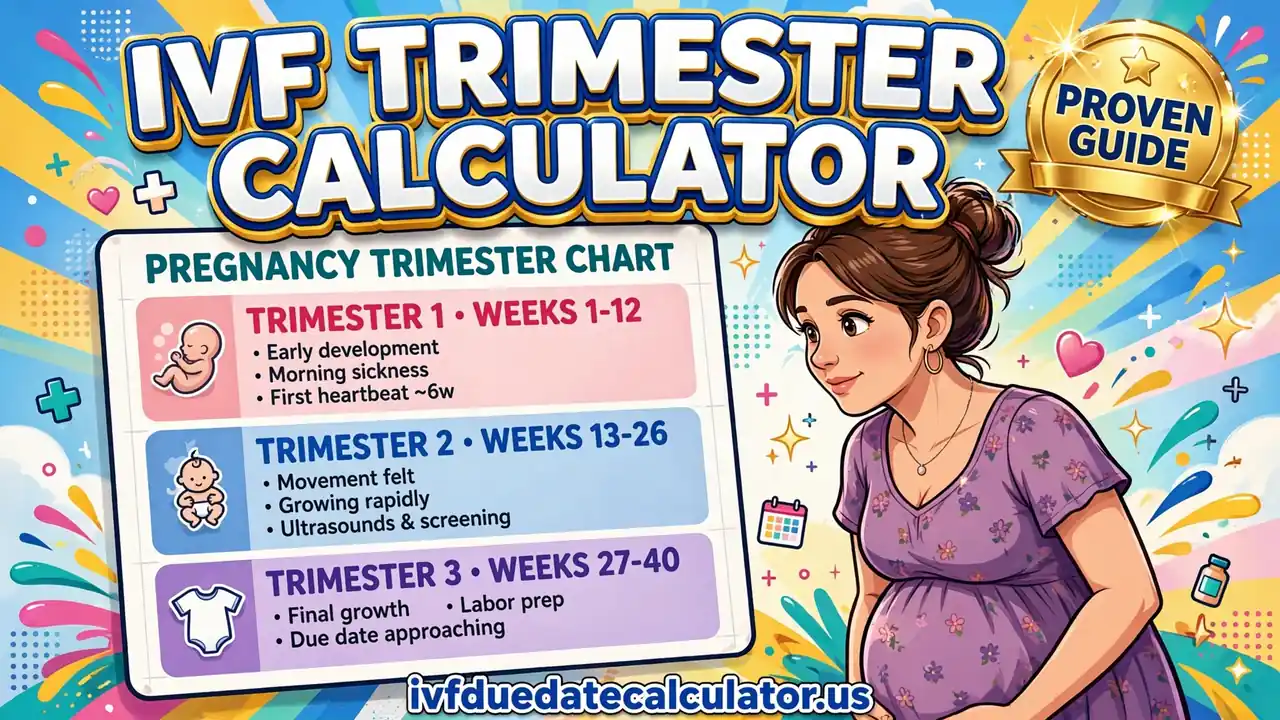
Enter your transfer date and embryo age to find your current trimester, weeks pregnant, and when each trimester starts and ends. First trimester: 0–13 weeks 6 days. Second: 14 weeks 0 days – 27 weeks 6 days. Third: 28 weeks 0 days – 40 weeks.
Estimates only. Your clinic confirms the official gestational age at your first ultrasound. All calculations happen in your browser — nothing is stored or sent anywhere.
How the IVF Trimester Calculator Works
The ivf trimester calculator works in two steps. First, it finds your gestational age: it counts forward from your theoretical last menstrual period — transfer date minus (14 + embryo age) days. Second, it places that gestational age inside the trimester boundaries below. If today is before your transfer date, it shows the trimester dates ahead of you instead.
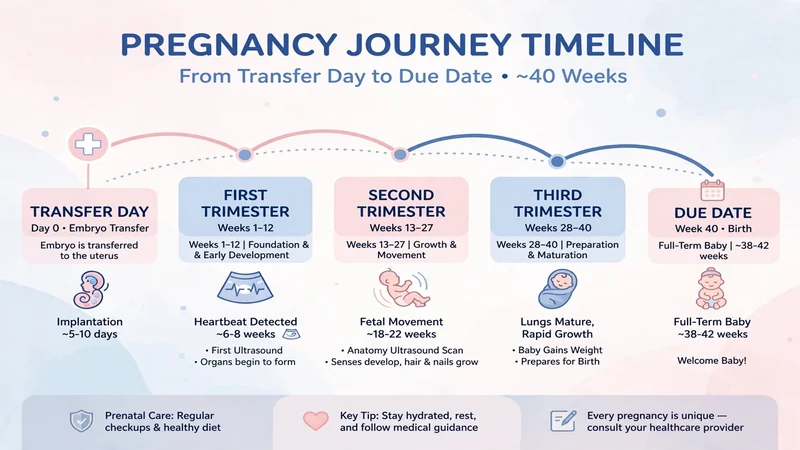
The only inputs are the transfer date and the embryo’s age on transfer day — Day 3, Day 5, or Day 6. A Day 5 transfer means you were already 2 weeks and 5 days pregnant on transfer day, and from there gestational age grows by one day per calendar day, exactly like any other pregnancy. If you are still waiting on your transfer, the same math runs from your planned date; your clinic will confirm the dating at your first ultrasound. For the due-date side of the same calculation, see our embryo transfer due date calculator.
Trimester Boundaries and Dates
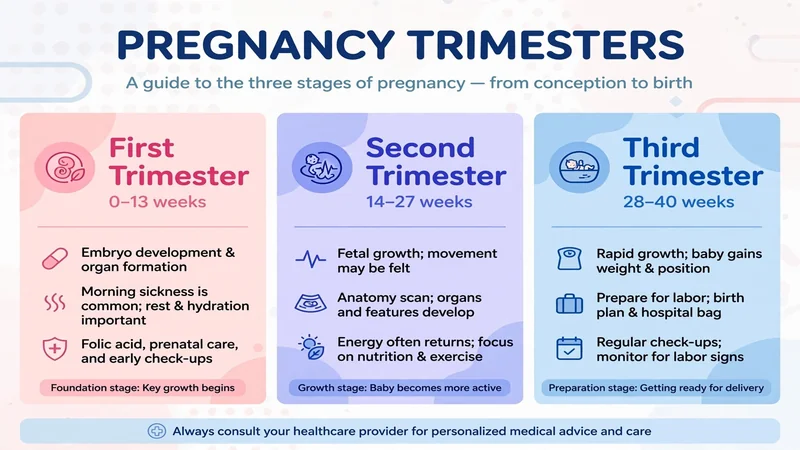
Pregnancy is divided into three trimesters by gestational age, not by calendar months:
| Trimester | Gestational age | Weeks of pregnancy |
|---|---|---|
| First trimester | 0 – 13 weeks, 6 days (0–13w6d) | Weeks 1–13 |
| Second trimester | 14 weeks, 0 days – 27 weeks, 6 days (14w0–27w6d) | Weeks 14–27 |
| Third trimester | 28 weeks, 0 days – 40 weeks (28w0–40w) | Weeks 28–40 |
A worked example makes the boundaries concrete. Suppose your Day 5 transfer was on October 15. Your theoretical last menstrual period is September 26, and your due date is July 3. Your first trimester runs September 26 to January 1, your second January 2 to April 9, and your third April 10 to July 3. If you are carrying twins, the trimester dates are the same, but delivery planning shifts earlier — our twins calculator covers that side of the timeline.
First Trimester: What Happens
The first trimester covers conception through week 13, and in an IVF pregnancy it includes the two-week wait, the beta test, and the first ultrasound. The beta hCG blood test usually falls 9 to 14 days after transfer, the first ultrasound follows around 6 weeks gestational age, and the heartbeat is usually visible around 6 to 7 weeks.
This trimester carries the highest miscarriage risk, which is why clinics monitor it closely. Most patients graduate from the fertility clinic to a regular obstetrician around 8 to 10 weeks. Nausea, fatigue, and breast tenderness are common; severe pain or heavy bleeding are reasons to contact your clinic promptly. Cell-free DNA screening typically opens near the end of this trimester, around week 10.
Second Trimester: What Happens
The ivf trimester calculator places weeks 14 through 27 in the second trimester, often the most comfortable stretch. Nausea usually eases, energy returns, and the anatomy scan — the detailed ultrasound that checks the baby’s development — is scheduled between 18 and 22 weeks. Many patients use this trimester for travel, nursery prep, and announcing more widely.
Screening continues here too: the anatomy scan is the centerpiece, and glucose screening for gestational diabetes usually happens between 24 and 28 weeks, near the trimester’s end. Patient resources from ACOG describe the same screening schedule used across all pregnancies. If you started pregnancy with a fertility clinic, you are firmly in regular obstetric care by now. Many patients first feel movement in the second trimester — usually between 18 and 22 weeks for a first pregnancy, sometimes earlier — while formal kick counts begin in the third.
Third Trimester: What Happens
The ivf trimester calculator places week 28 to delivery in the third trimester. Growth scans may check the baby’s size and position, and appointments become more frequent — every two weeks, then weekly near the end. Group B strep testing usually happens between 36 and 37 weeks, and your provider will discuss the birth plan, hospital registration, and signs of labor.
Full term begins at 37 weeks, and the estimated due date marks 40 weeks. Only a small share of babies arrive exactly on the due date — a few days early or late is ordinary. If you are planning around a twin delivery window or a scheduled induction or cesarean, your provider will set those dates from the same gestational-age count. For the week-by-week view, see our guide on how many weeks pregnant you are after embryo transfer.
How IVF Trimester Counting Differs From LMP Counting
In a natural pregnancy, gestational age is counted from the first day of the last menstrual period — a real date the patient remembers. In an IVF pregnancy, the LMP is theoretical: a calculated date that puts the pregnancy on the same 280-day scale. The counting convention is identical; only the source of the LMP differs.
That difference causes two common confusions. First, patients sometimes enter a real period date from a medicated cycle into a generic trimester calculator, which gives the wrong trimester — the theoretical LMP is the correct input, and the IVF calculator derives it from the transfer date automatically. Second, patients sometimes count from the transfer date as if it were day zero. It is not: on transfer day, you are already 2 weeks plus the embryo’s age pregnant, and the IVF calculator accounts for that head start. If your cycle used a frozen embryo, the same rules apply; see our frozen embryo transfer due date calculator for the frozen-cycle dates.
Frequently Asked Questions
What trimester am I in after IVF?
The ivf trimester calculator answers this from your gestational age, derived from your transfer date and embryo age. The first trimester runs 0–13w6d, the second 14w0–27w6d, and the third 28w0–40w. Enter your transfer date and embryo age to get your exact trimester and weeks and days.
How is gestational age counted in an IVF pregnancy?
Gestational age is counted from a theoretical last menstrual period: transfer date minus (14 + embryo age) days. For a Day 5 transfer, that is transfer minus 19 days. On transfer day, you are already 2 weeks and 5 days pregnant on this scale — the same convention as natural-pregnancy dating.
Does a frozen transfer change my trimester dates?
No. A frozen embryo does not age while stored, so the transfer date and the embryo’s age still determine the trimester dates. The theoretical LMP is calculated from the actual transfer date, regardless of storage time.
When does the second trimester start after IVF?
The second trimester starts at 14 weeks and 0 days of gestational age. For a Day 5 transfer on October 15, that is January 2. Your own start date depends on your transfer date and embryo age.
Is the third trimester the same length in IVF pregnancies?
Yes. The third trimester runs from 28 weeks and 0 days to 40 weeks in every pregnancy, IVF or natural. What can differ is the delivery plan — twin pregnancies and certain medical situations may lead to earlier scheduled delivery, but the boundaries do not change.
Why does my app disagree with the ivf trimester calculator?
Most general pregnancy apps count from a real last menstrual period you enter yourself. In a medicated IVF cycle, that real date is not the right anchor — the theoretical LMP is. An IVF-specific calculator uses transfer date and embryo age, which is why it can differ from a generic app by days or even weeks.
About the Author
Emily Johnson is a Content Writer & Fertility Advocate who covers IVF timelines, trimester planning, and early pregnancy milestones. She writes practical guides that help patients understand their own calendars.
Medical Review
Dr. Sarah Ahmed, Medical Content Advisor, reviewed this article for clinical accuracy, checking that the trimester boundaries, gestational-age derivation, and screening windows match standard fertility practice.
Disclaimer: This article is for educational purposes only and is not medical advice. Trimester dates are estimates, and your clinic’s ultrasound-based dating is the official record. Confirm your trimester dates, screening schedule, and care plan with your fertility clinic or provider.