

Due Date After IVF Transfer: How Your Transfer Date Sets Your Timeline

By Emily Johnson, Content Writer & Fertility Advocate · Medically reviewed by Dr. Sarah Ahmed, Medical Content Advisor
Your embryo transfer date is the single most important date of your IVF pregnancy. Unlike a naturally conceived pregnancy — where the due date is estimated from a last menstrual period and an assumed ovulation day — your due date after IVF transfer is calculated directly from your transfer date plus a fixed number of days based on your embryo’s age. This guide shows exactly how your transfer date sets your due date, your current week, and every milestone that follows.
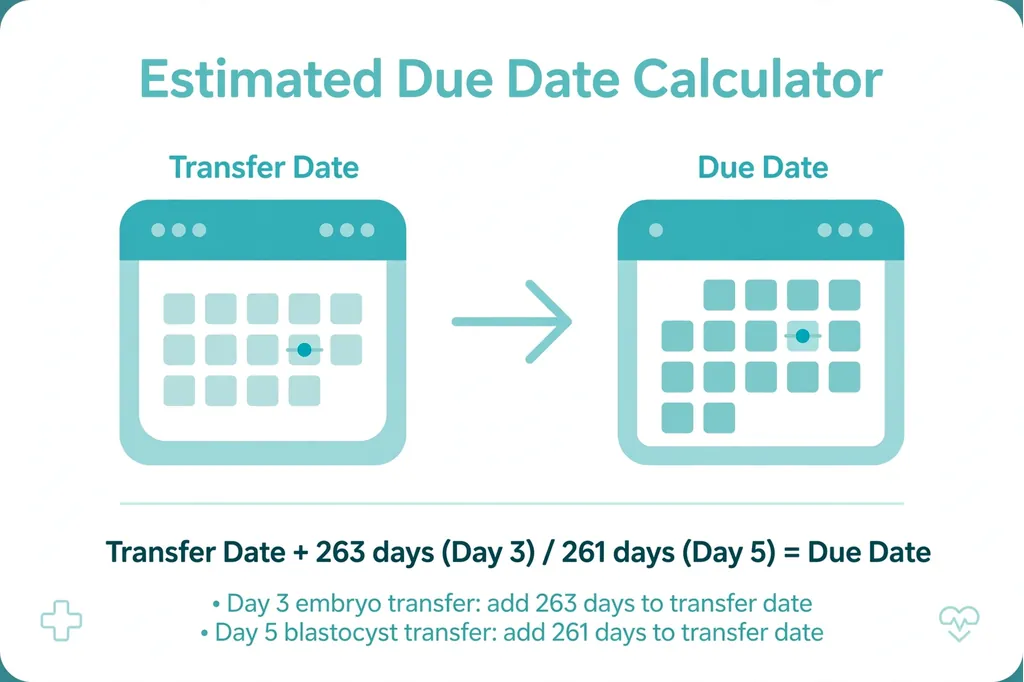
The short version: add 263 days to a Day 3 transfer date, or 261 days to a Day 5 transfer date. Below, you’ll find the full formula, worked examples, and everything your transfer date can tell you.
/table of contents
Why Your Embryo Transfer Date Is Your Anchor Date
In a natural pregnancy, dating starts from the first day of your last menstrual period (LMP) and assumes ovulation happened on day 14 — an assumption that is frequently wrong. IVF removes the guesswork entirely:
- Fertilization happened in the lab on a documented date — no estimated ovulation day.
- The embryo’s exact age is known — Day 3, Day 5, or Day 6 at transfer.
- The transfer itself is medically recorded to the day.
Because of this, reproductive specialists use a “back-calculation”: your known lab timeline is realigned with the standard 40-week obstetric system. Your transfer date becomes the anchor from which your due date after IVF transfer, gestational age, trimester boundaries, and test schedules are all derived. That’s why transfer-date dating is considered more accurate than LMP-based dating — a point reflected in guidance from the American College of Obstetricians and Gynecologists (ACOG).
How Your Transfer Date Sets Your Due Date
Every due date based on IVF transfer uses one formula:
Due date = Transfer date + (266 − embryo age in days)
The 266 is the average length of pregnancy from fertilization (38 weeks). The embryo’s age is subtracted because those days already passed in the laboratory:
- Day 3 transfer: transfer date + 263 days
- Day 5 transfer: transfer date + 261 days
- Day 6 transfer: transfer date + 260 days
Try it instantly with our IVF Due Date Calculator, or read our IVF Pregnancy Calculator guide for the full breakdown of what each result means.
Due Date After IVF Transfer: Worked Examples
Example 1 — Day 5 blastocyst transfer on March 10, 2026
March 10, 2026 + 261 days = November 26, 2026. On transfer day, gestational age is 2 weeks and 5 days; the beta hCG test falls around March 24.
Example 2 — Day 3 embryo transfer on June 1, 2026
June 1, 2026 + 263 days = February 19, 2027. On transfer day, gestational age is 2 weeks and 3 days.
Notice the two-day shift between Day 3 and Day 5 for nearby transfer dates — selecting the correct embryo stage is the most common source of error in manual calculations. See how many weeks pregnant you are after embryo transfer for the week-by-week math.
What Your Transfer Date Tells You Beyond the Due Date
Your transfer date doesn’t just set the due date — it anchors your entire pregnancy timeline:
- Beta hCG blood test: about 9–14 days after transfer.
- First ultrasound: about 3–5 weeks after transfer (5–7 weeks gestational age) — the dating scan that confirms the heartbeat.
- Trimester boundaries: weeks 1–13, 14–27, and 28–40 counted from your back-calculated start date. See our IVF Trimester Calculator.
- Anatomy scan: around week 20; screening windows are all scheduled by gestational age.

When the Transfer Date Alone Isn’t Enough
Frozen embryo transfers
The math for your due date after IVF transfer is identical for frozen transfers — only the embryo’s biological age at transfer matters. A frozen Day 5 blastocyst still counts as 5 days old.
Twins and multiples
The 40-week calculation for your due date after IVF transfer doesn’t change, but multiples are typically delivered earlier (around 37–38 weeks), so your clinic plans around an earlier target.
Ultrasound re-dating
If a first-trimester dating scan differs from your transfer-date calculation by more than about 5–7 days, providers usually adopt the ultrasound date for your due date after IVF transfer. After the first trimester, re-dating is uncommon.
Frequently Asked Questions (FAQs)
How do I calculate my due date from my embryo transfer date?
Add 263 days for a Day 3 embryo, 261 days for a Day 5 blastocyst, or 260 days for a Day 6 blastocyst. The general formula is: due date = transfer date + (266 − embryo age at transfer).
Does a Day 3 or Day 5 transfer change my due date?
Yes, by about two days. A Day 5 transfer gives a due date two days earlier than a Day 3 transfer on the same calendar date, because the embryo is two days older.
What if I only know my egg retrieval date?
Add 266 days to your retrieval date — fertilization happens on retrieval day. Our IVF due date calculator by retrieval date handles this method.
Can I use my transfer date if it was a frozen embryo transfer?
Yes. Fresh and frozen transfers use identical math — only the embryo’s age at transfer matters.
Why does my clinic’s due date differ from my calculation?
The most common reasons are a wrong embryo stage selected in the calculator, or ultrasound re-dating: if a first-trimester scan differs by more than about 5–7 days, clinics adopt the scan date.
What is my gestational age on transfer day?
About 2 weeks and 3 days for a Day 3 transfer, or 2 weeks and 5 days for a Day 5 transfer. This is standard obstetric dating, not an error.
How accurate is transfer-date dating compared to LMP dating?
More accurate, because it starts from documented facts (transfer date + embryo age) instead of an assumed ovulation day. ACOG notes that IVF dating reduces the errors common with LMP-based methods.
Which date should I use for maternity paperwork?
Use the clinic-confirmed estimated due date — usually your transfer-date calculation, updated if an early ultrasound revised it.
About the author
Emily Johnson is a Content Writer & Fertility Advocate who covers IVF and fertility treatment topics. Meet the team
Medical review
This article was medically reviewed by Dr. Sarah Ahmed, Medical Content Advisor, for clinical accuracy. Meet the team
Medical disclaimer
This article is for informational purposes only and is not medical advice, diagnosis, or treatment. Due dates are estimates, and every pregnancy is different. Always confirm your due date and any testing or treatment decisions with your clinic or healthcare provider.
