
Day 3 vs Day 5 Transfer: How It Changes Your Due Date

By Emily Johnson, Content Writer & Fertility Advocate · Medically reviewed by Dr. Sarah Ahmed, Medical Content Advisor
One of the first things patients notice after an embryo transfer is that the day of the transfer changes the due date. A Day 3 and a Day 5 transfer on the very same calendar date produce due dates two days apart — and that two-day shift ripples through your entire pregnancy timeline. This guide to the day 3 vs day 5 transfer due date compares Day 3 vs Day 5 transfer side by side: what each stage means, exactly how each changes your due date, and which details actually matter for your pregnancy.
Table of Contents
Day 3 vs Day 5 Transfer Due Date: At a Glance
| Day 3 Transfer | Day 5 Transfer | |
|---|---|---|
| Embryo stage | Cleavage stage (6–8 cells) | Blastocyst stage |
| Days to add to transfer date | 263 days | 261 days |
| Gestational age on transfer day | 2 weeks, 3 days | 2 weeks, 5 days |
| Typical use | Fewer embryos, or when extended culture isn’t advised | Most common today — allows better embryo selection |
Why the Two-Day Difference Exists
Every day 3 vs day 5 transfer due date follows one formula:
Due date = Transfer date + (266 − embryo age in days)
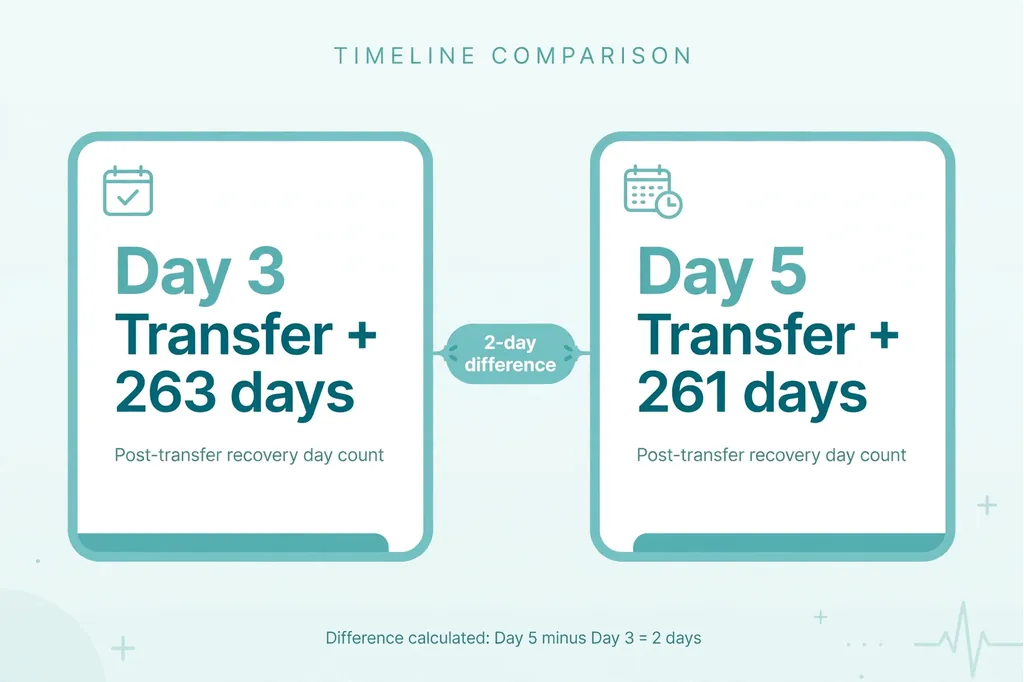
The 266 is the average pregnancy length from fertilization. Because a Day 5 embryo has already spent two extra days developing in the lab compared to a Day 3 embryo, two fewer days are added after transfer:
- Day 3: 266 − 3 = 263 days added to the transfer date
- Day 5: 266 − 5 = 261 days added to the transfer date
That’s the entire difference — the embryo’s age at transfer, not the calendar. See our 3-day transfer calculator page and 5-day transfer guide for each method in detail.
Worked Example: Same Transfer Date, Two Due Dates
Suppose the transfer happens on September 1, 2026:
- Day 3 transfer: September 1 + 263 days = May 22, 2027
- Day 5 transfer: September 1 + 261 days = May 20, 2027
The Day 5 due date lands two days earlier — exactly the two extra days the embryo spent in the lab. Run your own dates with our IVF Due Date Calculator to see your day 3 vs day 5 transfer due date.
Does the Transfer Day Change Anything Besides the Due Date?
Your milestone dates shift too
Because gestational age on transfer day differs (2 weeks 3 days vs 2 weeks 5 days), derived milestones shift by the same two days — beta hCG timing, first-ultrasound windows, and trimester boundaries all move together. The clinical schedule itself doesn’t change.
Why clinics choose one over the other
Day 5 (blastocyst) transfer is now the most common approach because extended culture allows better embryo selection. Day 3 transfer may be recommended when fewer embryos are available or extended culture isn’t advised. The choice is medical — made with your fertility specialist based on embryo quality and your history — not a dating preference. For the full picture, read our IVF Pregnancy Calculator guide.

Which Transfer Day Is More Accurate for Dating?
Both are equally accurate — as long as you select the correct embryo stage in the calculator. Accuracy comes from the documented transfer date and known embryo age, not from which day was chosen. If a first-trimester ultrasound differs by more than about 5–7 days, providers adopt the scan date, per ACOG guidance — regardless of transfer day.
Frequently Asked Questions (FAQs)
What is the due date difference between Day 3 and Day 5 transfer?
About two days. For the same transfer date, a Day 5 transfer gives a due date two days earlier than a Day 3 transfer (transfer + 261 days vs transfer + 263 days). This two-day gap is the heart of the day 3 vs day 5 transfer due date calculation.
How do I calculate my due date for a Day 3 transfer?
Add 263 days to your transfer date. Formula: due date = transfer date + (266 − 3).
How do I calculate my due date for a Day 5 transfer?
Add 261 days to your transfer date. Formula: due date = transfer date + (266 − 5).
Does a Day 6 transfer change the calculation?
Yes — add 260 days (266 − 6). The same logic applies to any embryo age.
Is a Day 5 transfer better than Day 3?
Day 5 allows better embryo selection and is more common, but the right choice depends on your embryos and medical history — discuss it with your fertility specialist. For dating purposes, both are equally accurate.
Can I use the wrong transfer day by mistake?
It’s the most common manual error: selecting Day 3 when you had a Day 5 transfer (or vice versa) shifts your due date by two days. Always confirm the embryo stage with your clinic.
Does frozen vs fresh change the Day 3 vs Day 5 math?
No. A frozen Day 5 blastocyst uses the same 261-day addition as a fresh Day 5 transfer — only the embryo’s age at transfer matters.
Will my doctor’s due date match my calculation?
Usually yes. If an early ultrasound differs by more than about 5–7 days, your provider will update the date to match the scan — this is routine.
About the author
Emily Johnson is a Content Writer & Fertility Advocate who covers IVF and fertility treatment topics. Meet the team
Medical review
This article was medically reviewed by Dr. Sarah Ahmed, Medical Content Advisor, for clinical accuracy. Meet the team
Medical disclaimer
This article is for informational purposes only and is not medical advice, diagnosis, or treatment. Due dates are estimates, and every pregnancy is different. Always confirm your due date and any testing or treatment decisions with your clinic or healthcare provider.
