
Pregnancy Weight Gain Calculator: How Much Should You Gain?

By Emily Johnson, Content Writer & Fertility Advocate · Medically reviewed by Dr. Sarah Ahmed, Medical Content Advisor
Table of Contents
How much weight should you gain in pregnancy? It depends on your weight before pregnancy. The Institute of Medicine (IOM) — now part of the National Academies — recommends 25–35 lb (11.5–16 kg) for a healthy-weight singleton pregnancy, 28–40 lb if you were underweight, 15–25 lb if you were overweight, and 11–20 lb if you were obese. For twins the ranges are higher: 37–54 lb for healthy weight, 31–50 lb for overweight, and 25–42 lb for obesity. Use the pregnancy weight gain calculator above with your pre-pregnancy weight, height, current week, and (optionally) current weight, and it will show your personal range, how much you should have gained by now, and whether your gain so far is on track.
How to Use the Pregnancy Weight Gain Calculator
Pregnancy Weight Gain Calculator
Enter your pre-pregnancy weight and height to see your IOM recommended gain — for one baby or twins.
IOM-based estimates only — not medical advice. Your clinic’s guidance always overrides this calculator.
Choose pounds/inches or kilograms/centimetres, then choose one baby or twins. Enter your weight before pregnancy and your height — those two numbers set your pre-pregnancy BMI, which sets your whole range — then your current week. If you also enter your current weight, the calculator compares your actual gain with the expected gain for your week and tells you whether you are below, within, or above the range. Leave current weight blank if you only want your target range. If you are not sure of your week, find it first with our pregnancy week calculator.
How the Calculator Works: Pre-Pregnancy BMI First
Every recommendation on this page starts from one number: your pre-pregnancy body mass index (BMI).
- In metric units: BMI = weight in kilograms ÷ (height in metres)².
- In imperial units: BMI = 703 × weight in pounds ÷ (height in inches)².
Your BMI then puts you in one of four categories: underweight (below 18.5), healthy weight (18.5–24.9), overweight (25.0–29.9), or obesity (30 or higher). That category — not your current weight, and not an average for all pregnant women — decides your recommended range. This is why two women at the same week of pregnancy can have very different targets, and why “eating for two” is misleading advice: the lower your starting BMI, the more you are advised to gain, because your body needs the extra reserves.
IOM Recommended Weight Gain for One Baby
The table below is the IOM 2009 guidance for singleton pregnancies, still widely used by prenatal providers. Weekly rates apply to the second and third trimesters; the first trimester is different (see the next section). These figures come from the Institute of Medicine / National Academies, Weight Gain During Pregnancy: Reexamining the Guidelines (2009).
| Pre-pregnancy BMI | Category | Total gain | Weekly gain (2nd/3rd trimester) |
|---|---|---|---|
| Below 18.5 | Underweight | 28–40 lb (12.5–18 kg) | 1.0–1.3 lb/week (0.45–0.6 kg/week) |
| 18.5–24.9 | Healthy weight | 25–35 lb (11.5–16 kg) | 0.8–1.0 lb/week (0.35–0.45 kg/week) |
| 25.0–29.9 | Overweight | 15–25 lb (7–11.5 kg) | 0.5–0.7 lb/week (0.23–0.33 kg/week) |
| 30 or higher | Obesity | 11–20 lb (5–9 kg) | 0.4–0.6 lb/week (0.17–0.27 kg/week) |
These are ranges, not exact targets. Landing anywhere inside your range is the goal — you do not need to hit the middle, and a single weigh-in slightly outside it is not a failure.
IOM Recommended Weight Gain for Twins
Twin pregnancies need substantially more gain, because there are two babies, two placentas’ worth of support, and more fluid and blood volume. The IOM’s provisional twin ranges are:
| Pre-pregnancy BMI | Category | Total gain for twins |
|---|---|---|
| Below 18.5 | Underweight | No IOM range — not enough evidence |
| 18.5–24.9 | Healthy weight | 37–54 lb (16.8–24.5 kg) |
| 25.0–29.9 | Overweight | 31–50 lb (14.1–22.7 kg) |
| 30 or higher | Obesity | 25–42 lb (11.3–19.1 kg) |
If you were underweight before a twin pregnancy, do not borrow another category’s range — ask your clinic for a personalised target. The calculator above says exactly this instead of inventing a number.
How Much Should You Have Gained by Your Current Week?
Gain is not spread evenly across pregnancy. The IOM model used by this calculator assumes only a small gain in the first trimester — about 1.1–4.4 lb (0.5–2 kg) across weeks 1–13 combined — and then a steadier weekly gain in the second and third trimesters at your category’s weekly rate. For twins, where the IOM publishes no weekly rate, the calculator spreads the remaining range evenly from week 14 to week 40. That is a transparent approximation, not a clinical formula: real gain often accelerates somewhat in the third trimester, and it varies from week to week. Use the “expected gain by week” figure as a guide to the trend, not as a pass/fail line for any single week.
Worked Examples (all arithmetic verified)
- Healthy weight, one baby: pre-pregnancy 140 lb, height 5 ft 5 in → BMI 703 × 140 ÷ 65² = 23.3 (healthy weight). Total recommended gain 25–35 lb, so target delivery weight 165–175 lb. At week 20, expected gain is 1.1 + (7 × 0.8) = 6.7 lb to 4.4 + (7 × 1.0) = 11.4 lb. At 149 lb she has gained 9 lb — within the expected range.
- Obesity, one baby: pre-pregnancy 180 lb, height 5 ft 4 in → BMI 703 × 180 ÷ 64² = 30.9 (obesity). Total recommended gain 11–20 lb, so target delivery weight 191–200 lb. At week 28, expected gain is 1.1 + (15 × 0.4) = 7.1 lb to 4.4 + (15 × 0.6) = 13.4 lb, so a weight of 187.1–193.4 lb would be on track.
- Healthy weight, twins: pre-pregnancy 130 lb, height 5 ft 6 in → BMI 703 × 130 ÷ 66² = 21.0 (healthy weight). Total recommended gain for twins 37–54 lb. At week 24, expected gain is 1.1 + (37 − 1.1) × 11 ÷ 27 = 15.7 lb to 4.4 + (54 − 4.4) × 11 ÷ 27 = 24.6 lb.
What Is the Gained Weight Actually Made Of?
At term, a typical 25–35 lb gain is not mostly fat. Roughly, it breaks down as the baby (about 7–8 lb), the placenta (about 1–2 lb), amniotic fluid (about 2 lb), increased blood volume (about 3–4 lb), increased fluid in tissues (about 3–4 lb), breast growth (about 2 lb), the enlarged uterus (about 2 lb), and maternal fat stores (about 5–9 lb). Those proportions shift with your starting BMI and with twins, but the point stands: gaining weight in pregnancy is not “just getting bigger” — most of it is the pregnancy itself, and some of it is deliberately stored energy for breastfeeding.
Gaining Too Little or Too Much — What It Can Mean
Gaining well below your range is associated in the research with smaller babies and preterm birth; gaining well above it is associated with larger babies, gestational diabetes, high blood pressure in pregnancy, and more weight retained after birth. Those are population-level associations, not predictions about any one person — and a single out-of-range weigh-in means very little on its own. What matters is the trend, and what your provider sees alongside it: your blood pressure, glucose screening, fundal height, and scan growth. If your gain stays well outside your range for several visits, if you gain suddenly (for example, several pounds in one week with swelling), or if you are losing weight, contact your clinic promptly rather than trying to correct it with a diet on your own. Never try to lose weight during pregnancy unless your provider specifically advises it.
Healthy Ways to Stay on Track
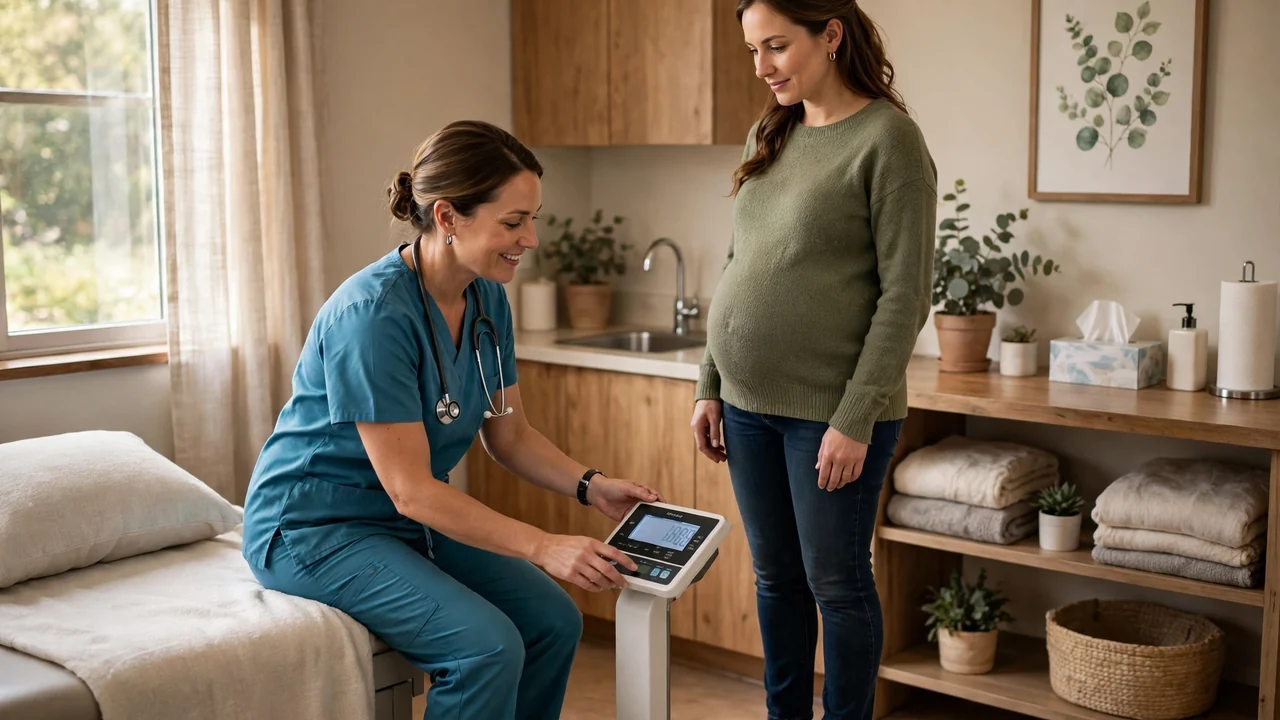
You do not need to double your food intake. In the second trimester most women need roughly 300 extra calories a day, and somewhat more in the third trimester and with twins — roughly one extra balanced snack or small meal, not a second dinner. Focus on nutrient-dense foods: vegetables, fruit, whole grains, lean protein, dairy or calcium-rich alternatives, and healthy fats. Keep moving as your provider allows — walking and prenatal-appropriate activity help with energy, sleep, and glucose control, and they do not require “burning off” the gain. Weigh yourself the same way each time (same scale, same time of day, similar clothing) so the trend is meaningful, and bring your readings to your appointments.

Pregnancy Weight Gain After IVF
The IOM ranges on this page apply the same way after IVF as after spontaneous conception — IVF does not change how much weight you should gain. What IVF does change is the context: twin pregnancies are more common after IVF (especially after double embryo transfer), so the twin ranges above matter to more IVF patients, and IVF patients often have more frequent early scans and weigh-ins, so trends show up sooner. Your clinic’s own target overrides this calculator if it differs — for example after a high-risk pregnancy, a multiple pregnancy beyond twins, or a medical condition such as diabetes or thyroid disease. For dating your pregnancy after transfer, see our IVF pregnancy calculator and our IVF pregnancy week by week guide.
Frequently Asked Questions (FAQs)
How much weight should I gain during pregnancy?
It depends on your pre-pregnancy BMI. For one baby, the IOM recommends 25–35 lb if you were healthy weight, 28–40 lb if underweight, 15–25 lb if overweight, and 11–20 lb if obese. Enter your numbers in the calculator above for your personal range.
How do I calculate my pregnancy weight gain?
First find your pre-pregnancy BMI from your pre-pregnancy weight and height, then look up your IOM category range, then compare your current weight with your pre-pregnancy weight. The calculator above does all three steps at once.
How much weight should I have gained by 20 weeks?
For a healthy-weight singleton pregnancy, about 6.7–11.4 lb by week 20 (a small first-trimester gain plus about 0.8–1.0 lb per week since week 14). Your exact figure depends on your BMI category — use the calculator with your own numbers.
How much weight should I gain with twins?
For twins, the IOM recommends 37–54 lb for healthy weight, 31–50 lb for overweight, and 25–42 lb for obesity. There is no IOM range for underweight twin pregnancies — ask your clinic for a personalised target.
Is it normal to gain very little weight in the first trimester?
Yes. The IOM model assumes only about 1.1–4.4 lb across the whole first trimester, and some women gain nothing or lose a little with nausea. Gain normally picks up in the second trimester.
What if I am gaining too much weight in pregnancy?
Look at the trend over several visits, not one weigh-in, and talk to your provider. They will check blood pressure, glucose, and scan growth before deciding whether anything needs to change. Do not start a weight-loss diet in pregnancy on your own.
Does IVF change how much weight I should gain?
No. The same IOM ranges apply after IVF. Twin pregnancies are more common after IVF, so check the twin ranges if relevant, and follow your clinic’s target if it differs from the calculator.
How many extra calories do I need in pregnancy?
Roughly 300 extra calories a day in the second trimester and somewhat more in the third trimester and with twins — about one extra balanced snack or small meal, not double portions. Your provider can personalise this.
About the Author
Emily Johnson is a Content Writer & Fertility Advocate who covers IVF and fertility treatment topics. Meet the team: https://ivfduedatecalculator.us/our-team-ivf-due-date-calculator/
Medical Review
This article was medically reviewed by Dr. Sarah Ahmed, Medical Content Advisor, for clinical accuracy. Meet the team: https://ivfduedatecalculator.us/our-team-ivf-due-date-calculator/
Medical disclaimer: This article is for informational purposes only and is not medical advice, diagnosis, or treatment. Due dates are estimates, and every pregnancy is different. Always confirm your due date and any testing or treatment decisions with your clinic or healthcare provider.