

Ultrasound Due Date Calculator: Due Date From Your Scan

By Emily Johnson, Content Writer & Fertility Advocate · Medically reviewed by Dr. Sarah Ahmed, Medical Content Advisor
An ultrasound due date calculator finds your estimated due date from your scan: take the date of your ultrasound, add the days remaining until 40 weeks (280 days minus the gestational age the scan reported), and you get your due date. For example, a scan on March 15 showing 10 weeks, 0 days gives a due date of October 11, 2026. A first-trimester ultrasound is the most accurate way to date a pregnancy — more reliable than a remembered last period — and this guide explains the formula, how to read your scan report, how accurate each trimester’s scan is, and when your provider would actually change your due date.
Table of Contents
How to Use the Ultrasound Due Date Calculator
Ultrasound Due Date Calculator
Find your due date from your scan date and the gestational age on your report.
Estimates only — not medical advice. Confirm your due date with your clinic or healthcare provider.
Enter two things from your scan report: (1) the date of the ultrasound, and (2) the gestational age it reported, in weeks and days (for example, 10 weeks, 0 days). Tap Calculate and you will see your estimated due date, the equivalent first day of your last period (LMP), and how far along you are today. If you also know your LMP, enter it too — the tool runs the ACOG redating check and tells you whether your provider would usually switch to the scan-based date or keep the LMP-based one.
How an Ultrasound Due Date Is Calculated
Pregnancy is dated from the first day of your last menstrual period, and a typical pregnancy lasts 280 days (40 weeks) from that date. An ultrasound gives you a different starting point: the scan date plus the gestational age measured that day. The formula is simple:
Due date = scan date + (280 days − gestational age at scan, in days).
The equivalent LMP is just the scan date minus the gestational age. Example: a scan on March 15 at 10 weeks, 0 days (70 days) means the equivalent LMP is January 4, and January 4 plus 280 days is October 11, 2026 — your due date. This is the same arithmetic behind Naegele’s rule (LMP + 280 days); the ultrasound method simply replaces a remembered period date with a measured one.
Reading Your Scan Report: Which Number Do I Enter?
Your report usually prints gestational age directly, for example “GA 10w0d” — enter those two numbers and you are done. Behind that number, the sonographer measured one or more of these:
- CRL (crown-rump length): the head-to-bottom length of the embryo, used in the first trimester. This is the most accurate dating measurement available, accurate to about ±5–7 days.
- BPD (biparietal diameter): the width of the baby’s head, used from the second trimester onward.
- HC (head circumference), AC (abdominal circumference), FL (femur length): additional measurements combined into an estimated gestational age on later scans — but these measure growth, which varies between babies, so they date a pregnancy less precisely.
If your report shows several measurements but no single gestational age, use the GA printed at the top of the report — that is the figure your clinic uses for dating. If you are unsure, ask your clinic; do not guess from a single measurement.

How Accurate Is Ultrasound Dating?
Accuracy depends on when the scan was done, not on the calculator:
| Scan timing | Dating accuracy | Why |
|---|---|---|
| First trimester (up to 13 weeks, 6 days) | About ±5–7 days | CRL grows at a very consistent rate and barely varies between babies |
| Second trimester (14–27 weeks, 6 days) | About ±7–14 days | Head and bone measurements vary more between babies |
| Third trimester (28 weeks onward) | About ±21 days or more | Growth differences dominate; the scan measures size, not age |
That is why the earliest scan is the one that counts for dating. A later scan can still be useful, but your provider will rarely change a due date set by a first-trimester scan based on a third-trimester measurement.
ACOG Redating Rules: When Your Provider Changes Your Due Date
The American College of Obstetricians and Gynecologists (ACOG), Methods for Estimating the Due Date publishes cutoffs: if the scan-based due date differs from the LMP-based due date by more than the cutoff for that stage, the scan date replaces the LMP date. Otherwise the LMP date stays.
| Gestational age at scan | Redating cutoff |
|---|---|
| Up to 8 weeks, 6 days | More than 5 days apart |
| 9 weeks, 0 days – 13 weeks, 6 days | More than 7 days apart |
| 14 weeks, 0 days – 15 weeks, 6 days | More than 7 days apart |
| 16 weeks, 0 days – 21 weeks, 6 days | More than 10 days apart |
| 22 weeks, 0 days – 27 weeks, 6 days | More than 14 days apart |
| 28 weeks, 0 days onward | More than 21 days apart |
Example: a scan on June 13 at 8 weeks, 3 days gives a due date of January 20, 2027. If your LMP-based due date was January 13, 2027, the gap is 7 days — more than the 5-day cutoff at that stage — so your provider would usually switch to the scan-based date. Try it in the tool above with your own dates: enter your LMP in the optional field and the redating check does this comparison for you.
Ultrasound Due Date vs LMP Due Date: Which One Counts?
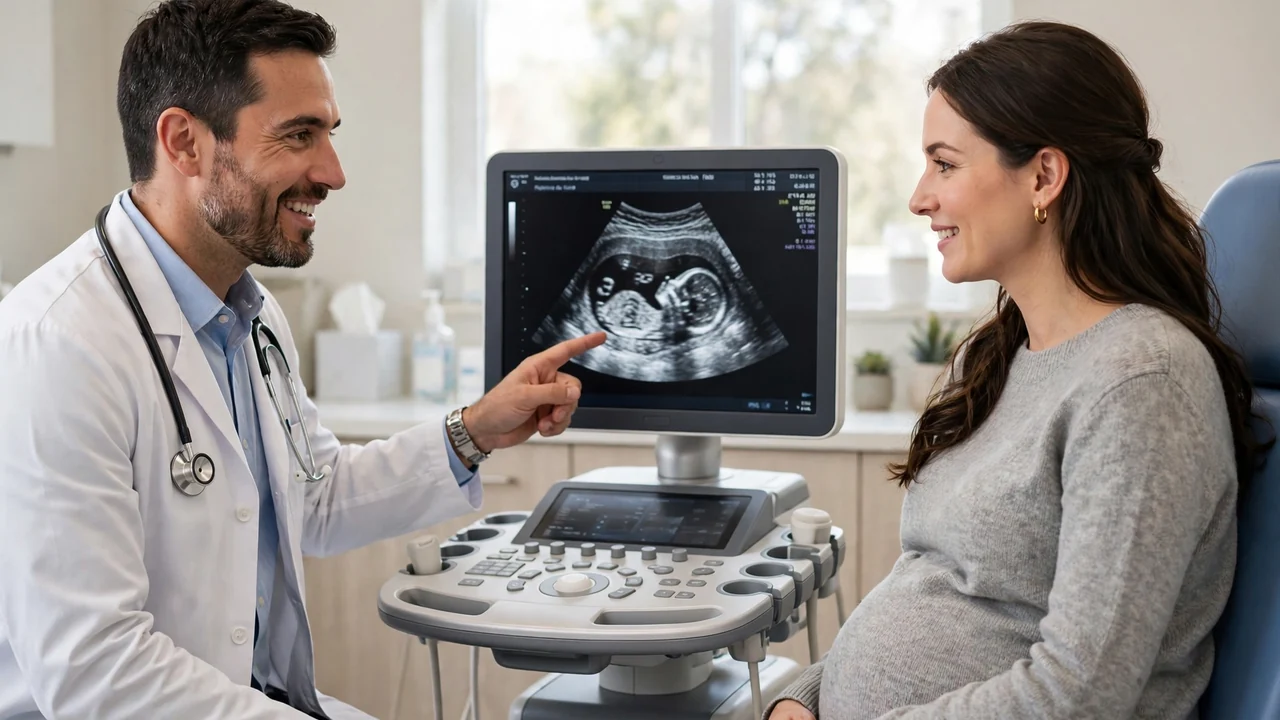
If the two dates agree within the ACOG cutoff, your provider keeps the LMP-based date — the difference is within normal measurement error. If they disagree beyond the cutoff, the ultrasound date wins, because it is measured rather than remembered: periods can be irregular, ovulation can fall earlier or later than day 14, and the exact date of a last period is easy to misremember. Once a first-trimester scan has set the date, later scans do not normally move it again. Our full comparison is in IVF due date vs ultrasound due date: which one counts?, and if your period date is the problem, see what’s your LMP after IVF.
What If You Conceived Through IVF?
With IVF, dating does not depend on a period or a scan at all: ACOG assigns the due date from the embryo age and transfer date — 261 days after a day-5 transfer, 263 days after a day-3 transfer. An early scan after IVF usually confirms that date rather than changing it, and if the scan and transfer dates disagree, your clinic will generally trust the transfer date, because fertilisation day is known exactly. For the full IVF dating picture, use our IVF pregnancy calculator and read first ultrasound after IVF: when it happens & what to expect.
What If Your Scan Is Later in Pregnancy?
A second- or third-trimester scan still gives a due date through the same formula, but treat it as a rougher estimate: ±7–14 days in the second trimester and ±21 days or more in the third. Growth scans in late pregnancy are designed to check that the baby is growing well, not to re-date the pregnancy — a baby measuring a week “behind” late in pregnancy is usually just a smaller baby, not a younger one. If you have no first-trimester scan and no reliable LMP, your provider combines the later scan with clinical findings and may still revise the date, but with wider uncertainty.
Worked Examples
- Scan March 15 at 10 weeks, 0 days → equivalent LMP January 4; due date October 11, 2026.
- Scan June 13 at 8 weeks, 3 days → equivalent LMP April 15, 2026; due date January 20, 2027.
- Same scan with LMP April 8, 2026 → LMP-based due date January 13, 2027; gap 7 days, over the 5-day cutoff at 8 weeks, 3 days → provider would usually adopt the scan-based date, January 20, 2027.
Notice how the tool and the guide agree: run any of these examples in the calculator above to check.
Frequently Asked Questions (FAQs)
How do I calculate my due date from an ultrasound?
Take the scan date and add the days remaining to 40 weeks: due date = scan date + (280 days − gestational age at scan in in days). A scan on March 15 at 10 weeks, 0 days gives October 11, 2026.
What gestational age do I enter — the one on my report?
Yes. Enter the gestational age printed on your report (for example, 10 weeks, 0 days). It is usually based on CRL in the first trimester or combined measurements later.
Is an ultrasound due date more accurate than an LMP due date?
In the first trimester, yes: CRL dating is accurate to about ±5–7 days, while LMP dating depends on regular cycles and an accurately remembered period date.
When will my doctor change my due date after an ultrasound?
When the scan-based date differs from the LMP-based date by more than ACOG’s cutoff for that stage — more than 5 days up to 8 weeks, 6 days, more than 7 days at 9–13 weeks, 6 days, and larger cutoffs later.
Can a later ultrasound change my due date?
Rarely, once a first-trimester scan has set it. Later scans measure growth, which varies between babies, so providers do not normally re-date from them.
What if my ultrasound due date and LMP due date are a few days apart?
Small gaps within the ACOG cutoff are normal measurement error; your provider will usually keep the LMP-based date.
How is an ultrasound due date calculated after IVF?
IVF dating uses the transfer date and embryo age (261 days after a day-5 transfer), not the scan. An early scan after IVF normally confirms that date.
How accurate is the due date itself?
It is an estimate: only about 4–5% of babies arrive on their exact due date, and most arrive between 39 and 41 weeks. The scan gives you the best estimate, not a guaranteed day.
About the author
Emily Johnson is a Content Writer & Fertility Advocate who covers IVF and fertility treatment topics. Meet the team.
Medical review
This article was medically reviewed by Dr. Sarah Ahmed, Medical Content Advisor, for clinical accuracy. Meet the team.
Medical disclaimer
This article is for informational purposes only and is not medical advice, diagnosis, or treatment. Due dates are estimates, and every pregnancy is different. Always confirm your due date and any testing or treatment decisions with your clinic or healthcare provider.