
First Ultrasound After IVF: When It Happens & What to Expect

By Emily Johnson, Content Writer & Fertility Advocate · Medically reviewed by Dr. Sarah Ahmed, Medical Content Advisor
The short answer: most clinics schedule your first ultrasound after IVF about two weeks after your positive beta test, which is roughly 6–7 weeks of pregnancy. That first scan — often called the viability scan — checks that the pregnancy is inside the uterus, counts gestational sacs, and looks for the embryo’s heartbeat. This guide covers the exact timing, what each part of the scan means, what it feels like, what happens if they can’t see everything yet, and how to get through the wait without losing your mind.
Table of Contents
When Is the First Ultrasound After IVF?
For most patients, the first ultrasound after IVF happens around 6–7 weeks of gestational age — roughly 3–4 weeks after embryo transfer and about two weeks after the positive beta hCG blood test. IVF clinics schedule it a little differently depending on your protocol, but this window is standard practice in the United States because it is the earliest point at which the key structures are reliably visible.
Because gestational age in IVF is counted from the egg retrieval date (plus 14 days, the equivalent of a last menstrual period), your clinic already knows your dating precisely. Here is what the timing typically looks like for a day-5 blastocyst transfer:
| Days after transfer | Gestational age | What the scan usually shows |
|---|---|---|
| 14–21 | ~4–5 weeks | Too early for reliable imaging; nothing conclusive expected |
| 21–28 | ~5–6 weeks | Gestational sac usually visible; yolk sac may appear |
| 28–35 | ~6–7 weeks | Fetal pole and heartbeat typically detectable; sac count confirmed |
| 35+ | 7+ weeks | Clear fetal pole with cardiac activity; measurements for dating |
The scan is deliberately timed: too early and there is nothing to see, which only creates more anxiety; a little later and the heartbeat should be clearly visible. If your transfer was on day 3, the same gestational-age targets apply — your clinic simply adjusts the calendar by the two-day difference.
What Happens Before Your First Scan
The first ultrasound does not happen in isolation. Before it, your clinic will have confirmed the pregnancy with serial beta hCG blood tests — usually two or three draws a few days apart, starting about 9–14 days after transfer. A beta of 5 mIU/mL or higher is considered positive, and rising levels roughly doubling every 48–72 hours suggest the pregnancy is progressing normally.
The gap between the positive beta and the first ultrasound is a strange, limbo-like stretch. Home pregnancy tests become unreliable narrators, symptoms (or the lack of them) get over-analyzed, and time moves slowly. Our guide to beta hCG levels after IVF transfer explains how to read your own results, and the two-week wait day by day walks through the emotional side of this period. If your betas are rising appropriately, the ultrasound is the next milestone — not a verdict on a single number.
What the First Ultrasound Checks
Your doctor or sonographer is looking for several specific things at this scan, and each one answers a different question about the pregnancy:
1. The gestational sac — is the pregnancy in the right place?
The gestational sac is the first structure visible on an early ultrasound. Seeing it inside the uterus confirms an intrauterine pregnancy and rules out an ectopic pregnancy (one developing outside the uterus, which needs urgent treatment). This single finding is the biggest source of relief at the first scan.
2. The yolk sac — is development on track?
The yolk sac is a small round structure inside the gestational sac that nourishes the embryo before the placenta takes over. It typically becomes visible around 5–6 weeks. Its presence at the right size is an early reassuring sign of normal development.
3. The fetal pole — the embryo itself
The fetal pole is the first visible sign of the developing embryo, usually appearing around 6 weeks. It is tiny at this stage — a few millimeters — but it is the structure that will grow into the fetus.
4. The heartbeat — the milestone everyone waits for
Cardiac activity is typically detectable from around 6 weeks of gestational age. Hearing or seeing the heartbeat is the most emotionally significant moment of the scan, and it substantially improves the outlook for the pregnancy continuing. If you are exactly 6 weeks or the dating is slightly uncertain, the heartbeat may not be visible yet — which does not necessarily mean anything is wrong (more on that below).
5. The number of gestational sacs
The scan counts how many sacs are developing. Because multiple embryos are sometimes transferred, twin or higher-order pregnancies are more common after IVF than after natural conception, and this scan is when that becomes known.
6. Measurements and dating
The sonographer measures the sac and the fetal pole. These measurements confirm that growth matches your known transfer date — one of the advantages of IVF dating, which is far more precise than dating by last menstrual period.
How the Scan Is Done: What It Feels Like
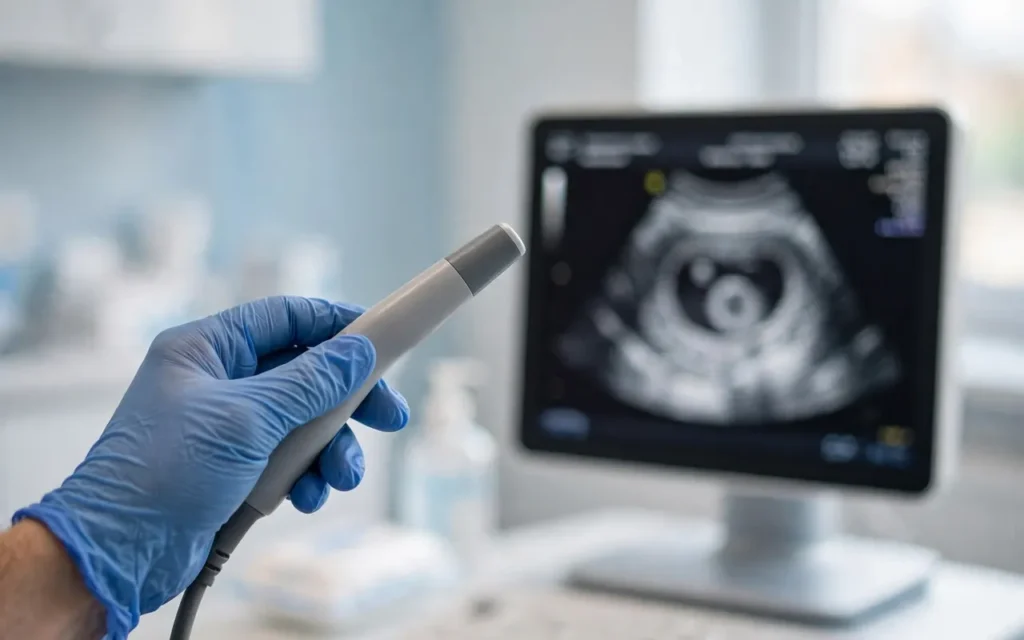
The first ultrasound after IVF is almost always a transvaginal ultrasound. At 6–7 weeks, the embryo is still very small, and a vaginal probe placed close to the uterus produces far clearer images than an abdominal scan could.
Here is what to expect:
- The procedure: you undress from the waist down and lie on the exam table with a sheet over you. A slim probe, covered with a protective sheath and lubricant, is gently inserted into the vagina. The sonographer moves it slightly to capture images from different angles.
- Does it hurt? Most patients describe pressure or mild discomfort rather than pain. If it is painful or feels wrong, tell the sonographer — they can adjust. Mild spotting afterward is possible and usually nothing to worry about, though you should mention it to your clinic.
- How long it takes: typically 15–30 minutes.
- Preparation: follow your clinic’s instructions. Unlike later abdominal scans, early transvaginal scans usually do not require a full bladder. Wear comfortable clothing, bring your medication list, and bring a list of questions.
- Who does it: a sonographer or your fertility doctor, depending on the clinic. Your partner is usually welcome in the room — ask your clinic’s policy when you book.
What If They Can’t See Everything Yet?
Sometimes the first scan is inconclusive — the sac is there but the heartbeat is not yet visible, or the measurements are a day or two behind. This is common and often completely normal, especially if you are at exactly 6 weeks or your implantation was on the later side.
- No heartbeat yet at 6 weeks: if the gestational sac and yolk sac look appropriate but cardiac activity is not visible, your clinic will usually schedule a repeat scan in 7–10 days. The follow-up scan, not the first one, is the meaningful check.
- Empty gestational sac: a sac with no yolk sac or fetal pole at the expected time needs follow-up imaging before any conclusions are drawn. Dating uncertainty alone can explain this, so clinics re-scan before diagnosing a non-viable pregnancy.
- Measurements slightly behind: a difference of a few days can reflect late implantation rather than a problem. The trend across scans matters more than any single measurement.
- What you can do: ask what specifically was seen and what the follow-up plan is, in plain language. Write it down. Avoid comparing your scan images to strangers’ images online — angle and timing differences make them meaningless.
Twins and Multiple Pregnancies: What’s Different at the First Scan
Because more than one embryo may be transferred, the first ultrasound after IVF is also when a multiple pregnancy is identified — by counting gestational sacs (and later, heartbeats). Twin pregnancies are more common after IVF, and they change the care plan: more frequent monitoring, additional ultrasounds, and a closer eye on growth and cervical length.
If two sacs are seen, your clinic will explain what that means for your appointments and delivery planning. For a deeper look at how due dates and timelines work with multiples, see our IVF twins due date guide. One important note: early scans can occasionally miss a second sac that appears on the follow-up, so the count is confirmed over more than one visit.

What Happens After the First Ultrasound
A reassuring first ultrasound after IVF does not mean the clinic hands you off immediately. The typical path after the viability scan:
- More scans: most clinics do at least one more ultrasound around 7–8 weeks to confirm the heartbeat and continued growth.
- Continued monitoring: hormone support (usually progesterone, sometimes estrogen) continues exactly as prescribed — never stop fertility medications based on scan results without your clinic’s instruction.
- Graduation: most fertility clinics discharge patients to regular obstetric care around 8–10 weeks, once the pregnancy looks stable on ultrasound.
- Your timeline: if you want to map transfer date to gestational age and due date, our IVF pregnancy calculator and due date after transfer guide lay out the full timeline.
Is an Early Ultrasound Safe?
Yes. Diagnostic ultrasound has been used in pregnancy for decades, and no harmful effects on the embryo or fetus have been demonstrated from standard diagnostic ultrasound. The American College of Obstetricians and Gynecologists advises that ultrasound exams be performed when clinically indicated, using the lowest exposure settings needed to get the diagnostic information — which is exactly how fertility clinics use them. A medically indicated early scan is not a risk to the pregnancy; it is one of the safest and most informative tools in early prenatal care. See ACOG’s patient FAQ on ultrasound exams in pregnancy.
Coping With “Scanxiety”
The fear before your first ultrasound after IVF has a name in the fertility community — scanxiety — and it is completely normal. After everything IVF has put you through, guarded hope is a rational response, not a character flaw. A few things that genuinely help:
- Bring your person. A partner, friend, or family member in the room makes the wait and the results easier to carry.
- Write your questions down. Anxiety erases memory; a short list (“What did you see? What should we expect next? When is the follow-up?”) keeps you grounded.
- Ask for narration. Most sonographers will talk you through what they are seeing on the screen. Knowing what each shape is makes the silence less terrifying.
- Let yourself feel both things. Hope and fear can coexist. You are allowed to celebrate a good scan and still feel nervous about the next one.
- Limit the forums for 24 hours. Other people’s scan stories, good or bad, are not data about your pregnancy.
Frequently Asked Questions (FAQs)
When will I have my first ultrasound after IVF?
Most clinics schedule it around 6–7 weeks of gestational age — roughly 3–4 weeks after embryo transfer and about two weeks after your positive beta hCG test. This timing is deliberate: it is the earliest point at which the gestational sac, fetal pole, and heartbeat are reliably visible.
How many weeks pregnant am I at the first IVF ultrasound?
Usually 6–7 weeks. In IVF, gestational age is counted from the egg retrieval date plus 14 days, so your dating is precise — more reliable than dating by last menstrual period. A day-5 transfer day is already 2 weeks and 5 days of gestational age.
Will I see a heartbeat at my first ultrasound?
Often yes, from around 6 weeks — but not always. If you are at the early edge of the window or implantation was slightly later, the heartbeat may not be visible yet. Clinics then repeat the scan in 7–10 days; the follow-up is the meaningful check.
Is the transvaginal ultrasound painful?
Most patients feel pressure or mild discomfort rather than pain. The probe is slim, and the exam takes 15–30 minutes. If it hurts, tell the sonographer so they can adjust. Light spotting afterward is possible and usually not a concern, but mention it to your clinic.
What does it mean if they only see a gestational sac?
A gestational sac without a visible yolk sac or fetal pole can be completely normal if the scan is early — it may simply mean implantation happened a little later. Your clinic will schedule a follow-up scan in about a week before drawing any conclusions. An empty sac at the expected developmental point needs re-evaluation, not panic.
Can the ultrasound detect twins this early?
Yes — the first ultrasound counts gestational sacs, which is how twin (or higher-order) pregnancies are identified. Occasionally a second sac is only confirmed on the follow-up scan, so the count is verified over more than one visit.
Is an early ultrasound safe for the embryo?
Yes. No harmful effects from standard diagnostic ultrasound have been demonstrated, and ACOG advises ultrasound when clinically indicated using the lowest exposure settings needed. Your clinic’s viability scan follows exactly that approach.
What should I bring or do to prepare for the first scan?
Follow your clinic’s instructions (a full bladder is usually not needed for early transvaginal scans), wear comfortable clothes, bring your medication list and ID, and bring a written list of questions. Having your partner or a support person with you helps.
About the author
Emily Johnson is a Content Writer & Fertility Advocate who covers IVF and fertility treatment topics. Meet the team
Medical review
This article was medically reviewed by Dr. Sarah Ahmed, Medical Content Advisor, for clinical accuracy. Meet the team
Medical disclaimer
This article is for informational purposes only and is not medical advice, diagnosis, or treatment. Due dates are estimates, and every pregnancy is different. Always confirm your due date and any testing or treatment decisions with your clinic or healthcare provider.
