
Pregnancy Tests: Types, Accuracy & When They Work

Few objects carry as much hope — or as much anxiety — as a pregnancy test. Yet most people use one without ever learning what it actually measures, why one type costs more than another, or what that “99% accurate” claim on the box really means. The short version: every pregnancy test works by detecting hCG, the hormone your body produces after an embryo implants. Home urine tests come in several formats that all use the same basic technology, blood tests at a clinic can detect pregnancy earlier and measure the exact hormone level, and the 99% accuracy figure only applies when a test is used correctly from the day of a missed period. Test too early, and even a genuinely pregnant woman can get a negative. This guide explains how each type of test works, what “sensitivity” numbers mean, why false negatives are common and false positives are rare — and the one cause of false positives that matters enormously if you are in fertility treatment: the hCG trigger shot.
Table of Contents
How Pregnancy Tests Work: It Is All About hCG
Every pregnancy test — from the cheapest strip to a clinic blood draw — looks for the same thing: human chorionic gonadotropin (hCG), a hormone produced by the cells that go on to form the placenta. Those cells only start releasing hCG after a fertilized egg implants in the lining of the uterus, which happens about 6 to 12 days after ovulation (you can estimate your own window with our implantation date calculator). Before implantation, there is no hCG in your body at all — which is why no test, however expensive, can detect a pregnancy in the first days after ovulation.
Once implantation happens, hCG rises fast. In a healthy early pregnancy it roughly doubles every 2 to 3 days, first appearing in the blood and then in urine. Home tests are qualitative: they simply answer “yes, hCG is above this test’s threshold” or “no, it isn’t.” They are built with antibodies that react to hCG and trigger a visible signal — a line, a plus sign, or a digital readout. Because hCG in urine is most concentrated after several hours without drinking, first-morning urine gives any test its best chance of detecting low levels.
The Main Types of Pregnancy Tests
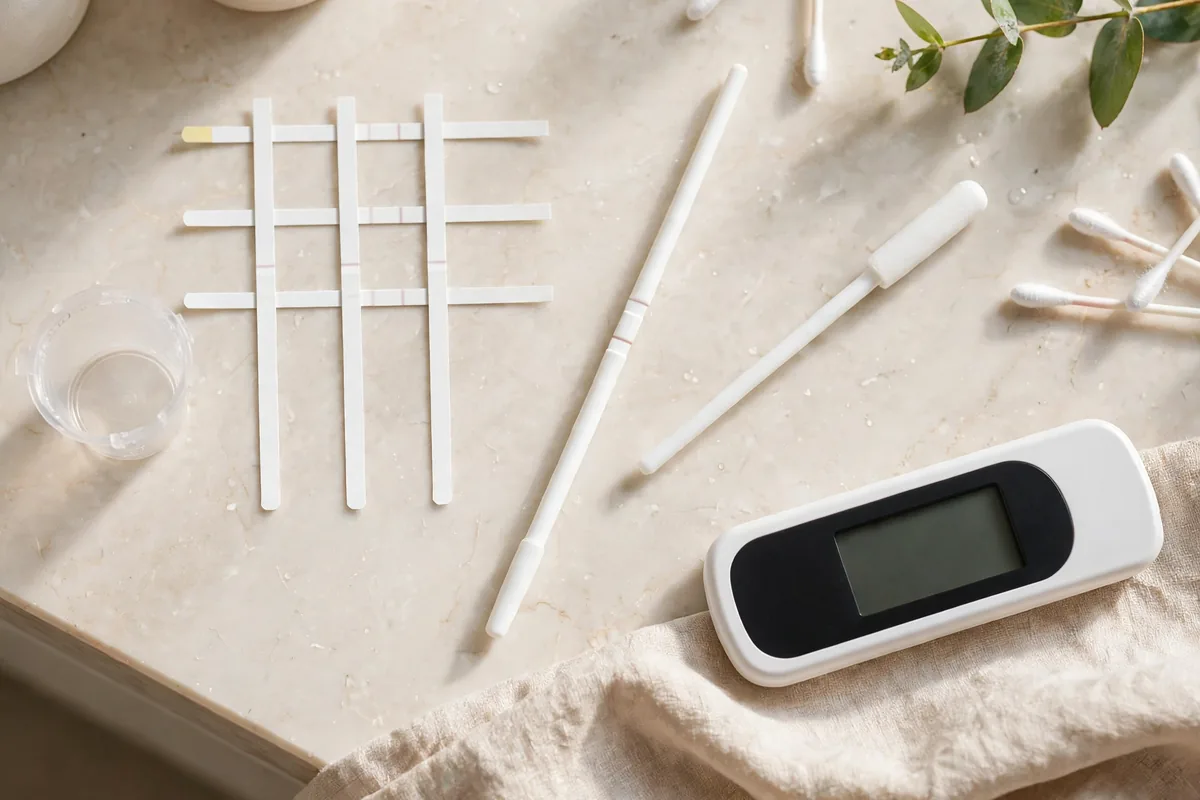
Home tests differ mainly in format and sensitivity, not in the underlying science. Clinic testing adds one format you cannot buy over the counter: the blood test.
- Test strips (dip strips). The simplest and cheapest format: a thin paper strip you dip into a cup of collected urine. Strips are sold in bulk, which is why they are popular with people testing frequently — including fertility patients “testing out” a trigger shot. Reading them takes a little practice because the lines can be faint.
- Midstream tests. A plastic wand with an absorbent tip that you hold directly in the urine stream (or dip). This is the classic pharmacy format — easy to use, with a window showing a test line and a control line.
- Digital tests. Same chemistry as a midstream test, but a sensor reads the result and displays the words “Pregnant” or “Not Pregnant.” Digitals remove the guesswork of interpreting faint lines; they are not inherently more accurate, and they usually cost more per test.
- Cassette/cup tests. Common in clinics and some home kits: urine is collected in a cup and a few drops are placed into a cassette well with a dropper. Many clinics use this format for their point-of-care urine tests.
- Clinic urine tests. Functionally the same qualitative technology as a home test. As the FDA notes, the main difference is that clinic staff run them every day and are experienced at reading them — the test itself is not dramatically more powerful.
- Blood tests (serum hCG). A blood draw analyzed in a lab. These come in two forms: a qualitative blood test, which gives a yes/no answer, and a quantitative blood test — the famous beta hCG — which measures the exact amount of hCG in your blood. Blood tests can detect hCG earlier than urine tests and at much lower levels, which is why fertility clinics rely on them.
| Test type | Sample | Result style | Typical sensitivity | Detects pregnancy from | Best for |
|---|---|---|---|---|---|
| Dip strips | Urine (cup) | Lines | ~25 mIU/mL (early versions ~10) | Day of missed period; early versions a few days before | Frequent, low-cost testing |
| Midstream | Urine (stream or dip) | Lines or symbols | ~25 mIU/mL | Day of missed period | Simple, one-off testing |
| Digital | Urine (stream or dip) | Words on a screen | ~25 mIU/mL | Day of missed period | An unambiguous read — no faint-line guessing |
| Cassette (clinic/home) | Urine (drops) | Lines | ~25 mIU/mL | Day of missed period | Clinic point-of-care testing |
| Qualitative blood test | Blood | Yes / no | Lower than urine tests | A few days before a urine test | Confirming pregnancy at a clinic |
| Quantitative blood test (beta hCG) | Blood | Exact number (mIU/mL) | A few mIU/mL | Earliest of all — roughly 6–8 days after ovulation | Fertility treatment, tracking hCG rise, investigating symptoms |
Sensitivity Explained: What “mIU/mL” Actually Means
A test’s sensitivity is the lowest concentration of hCG it can reliably detect, measured in milli-international units per millilitre (mIU/mL). The lower the number, the more sensitive the test — a 10 mIU/mL test can find pregnancy earlier than a 25 mIU/mL test because it needs less hormone to react.
Most standard home tests have a sensitivity of about 25 mIU/mL, and FDA clearance documents for typical home tests confirm thresholds in this range. Tests marketed for early detection are more sensitive — around 10 mIU/mL, in a few cases lower — which is what allows them to work a few days before a missed period. Two cautions come with that. First, right at its threshold a test is at its least reliable: FDA review data for early tests shows detection becomes inconsistent at the very lowest hCG levels. Second, sensitivity only helps if implantation has already happened — a 10 mIU/mL test used before implantation will still be negative, because there is no hCG to find.
How Accurate Are Pregnancy Tests? Decoding the “99% Accurate” Claim
So, how accurate are pregnancy tests really? The honest answer is: very — under the right conditions. The “over 99% accurate” claim printed on most boxes means the test correctly detected pregnancy in more than 99% of cases when used on or after the day of the missed period, by users who followed the instructions exactly. In other words, the 99% figure describes the test’s performance in its ideal scenario, not a guarantee for every real-world test.
The gap between the claim and real life is mostly about timing. The U.S. FDA points out that even on the first day of a missed period, 10 to 20 out of every 100 pregnant women will not get a positive result — because ovulation and implantation timing vary, and many simply have not produced enough hCG yet. Test several days before the missed period and the detection rate drops further still; a negative then is close to meaningless. Mayo Clinic gives the practical rule that follows from all of this: if you test negative but your period does not arrive, retest about a week after your missed period (or contact your doctor), because hCG doubles every 2 to 3 days and a test that was negative on Monday can be clearly positive a few days later. Used from the missed period onward, with first-morning urine and the instructions followed, a home test is a genuinely reliable tool.
False Negatives: When the Test Says No but You Are Pregnant
False negatives are by far the most common testing error, and almost all of them trace back to one problem: not enough hCG in the urine yet.
- Testing too early. The leading cause. If implantation happened at the later end of the window — day 11 or 12 after ovulation — hCG may still be below your test’s threshold on the day your period is due.
- Diluted urine. Drinking a lot of fluid before testing dilutes urinary hCG. Testing later in the day, after several drinks, makes an early positive easier to miss — hence the first-morning-urine advice.
- Misreading or rushing the test. Checking before the stated development time can show a negative that would have turned positive; the FDA and Mayo Clinic both stress setting a timer and following the package timing exactly.
- An expired or damaged test. Tests have expiry dates because the reactive antibodies degrade. An expired test can fail to react even when hCG is present.
- The hook effect (rare). Very late in the game — when hCG is extremely high, as can happen with some multiple or molar pregnancies — the sheer volume of hormone can overwhelm a test’s chemistry and produce a false negative. This is uncommon, but it is one reason a blood test is better when symptoms and urine results disagree.
False Positives: Rare — but One Cause Matters Hugely in Fertility Treatment
A true false positive is rare: if a test shows positive, there is almost always hCG in your body. The important question is where that hCG came from — because pregnancy is only one possible source.
- Chemical pregnancy. The test detected a real pregnancy that was lost very shortly after implantation, often before or around the missed period. Strictly speaking the test was right — hCG was present — but the pregnancy did not continue. After IVF this is a well-recognized outcome, and we explain it in depth in our guide to chemical pregnancy after IVF.
- The hCG trigger shot — the big one for fertility patients. Trigger injections used in IVF and IUI cycles (the medications that mature and release the egg) contain hCG itself — typically 5,000 or 10,000 IU of it. A home test cannot distinguish injected hCG from pregnancy hCG, so testing too soon after a trigger can produce a positive that is nothing more than leftover medication. The shot clears gradually — roughly 1,000 IU per day as a rule of thumb — so a 10,000 IU trigger can keep home tests positive for up to about 10–14 days. This is why clinics tell you not to test early, why some patients “test out the trigger” with cheap strips to watch the line fade to negative first, and why your clinic’s scheduled beta is the result that counts.
- Evaporation lines. If you read a test after the instructed time window, the urine drying on the strip can leave a faint, colourless “evap” line where the test line sits. It is not a positive — it is an artifact of a test read too late. Read the result at the stated time, and treat anything that appears afterwards as invalid.
- Recent pregnancy or pregnancy loss. hCG takes weeks to leave your system after a birth, miscarriage or termination, so a test taken during that window can be positive from the previous pregnancy.
- Certain medications and medical conditions. Fertility medicines containing hCG are the main medication cause (see above); per Mayo Clinic, most other medicines — including antibiotics and birth control pills — do not affect results. Rarely, a positive can come from pituitary hCG around menopause, some ovarian problems, or very rare hCG-producing tumours — one more reason an unexpected positive deserves a confirmatory blood test.
When Is a Blood Test the Better Choice?

A home test is enough for most people. A quantitative beta hCG blood test earns its place when the number matters, not just the yes or no:
- During fertility treatment. Clinics schedule the beta around two weeks after transfer or insemination precisely because blood testing detects hCG earlier, measures it exactly, and sidesteps most trigger-shot confusion. If you are mid-treatment, our guide to when to test after an IVF transfer walks through the day-by-day picture.
- Tracking whether hCG is rising properly. Two beta results about 48 hours apart show whether levels are roughly doubling as expected — central to early monitoring, and the subject of our beta hCG levels after IVF transfer guide and beta hCG doubling calculator.
- Pain, bleeding, or a history of ectopic pregnancy. A positive home test plus one-sided pelvic pain or bleeding needs prompt medical assessment; serial beta measurements (with ultrasound) are how clinicians investigate.
- Conflicting or confusing home results. Faint lines, a positive followed by negatives, or symptoms that don’t match the strip — a blood test settles it.
- Monitoring after a miscarriage, to confirm hCG has returned to zero.
A Quick Word on Timing (the Short Version)
This guide is about test types and accuracy; the full timing playbook gets its own article. The one-paragraph version: for a natural cycle, the most reliable moment to test is from the day of your missed period, using first-morning urine — earlier testing trades reliability for speed. If you want your personal earliest sensible test date, our early pregnancy test calculator works it out from your cycle or treatment dates. In an IVF or IUI cycle, follow your clinic’s beta date rather than home-test guesswork — especially if you had a trigger shot.
How do home pregnancy tests work?
They detect hCG (human chorionic gonadotropin), a hormone your body produces after a fertilized egg implants in the uterus. Antibodies on the test strip react to hCG in your urine and produce a visible line, symbol or digital result. Because hCG only appears after implantation — about 6 to 12 days after ovulation — no test can work before that point.
How accurate are pregnancy tests?
Very accurate when used correctly from the day of your missed period — that is the scenario behind the “99% accurate” claim on the box. Used earlier, accuracy falls because hCG may not have built up yet: the FDA notes that 10 to 20 out of every 100 pregnant women will not get a positive result even on the first day of a missed period. A negative result followed by no period is a reason to retest in a few days, not proof you are not pregnant.
What is the most sensitive type of pregnancy test?
A quantitative blood test (beta hCG) is the most sensitive test of all — it can measure hCG down to just a few mIU/mL and gives an exact number. Among home tests, early-detection urine tests with a sensitivity around 10 mIU/mL are more sensitive than standard tests at about 25 mIU/mL. The lower the mIU/mL figure, the less hCG the test needs to turn positive.
Can a pregnancy test be wrong?
Yes, though the two errors are not equally likely. False negatives are fairly common and usually mean you tested too early or with diluted urine. False positives are rare — a positive almost always means hCG is present — but the hCG can come from something other than an ongoing pregnancy, such as a chemical pregnancy, a recent loss, or an hCG trigger shot during fertility treatment.
Why was my test negative when I still feel pregnant?
Most likely your hCG level was still below the test’s detection threshold: implantation may have happened later than you think, or your urine was diluted. Wait 2 to 3 days — hCG roughly doubles in that time — and retest with first-morning urine. If your period still doesn’t arrive and tests stay negative, ask your doctor for a blood test, which can detect much lower levels.
Is an evaporation line a positive result?
No. An evaporation line is a faint, usually colourless mark that appears as urine dries on the strip when a test is read after the time window stated in the instructions. A true positive appears within the reading window and has colour to it. If you are unsure, discard the old test and take a fresh one, reading it exactly at the stated time.
Can an hCG trigger shot cause a false positive pregnancy test?
Yes — this is the most common cause of misleading results during fertility treatment. Trigger shots contain hCG, the very hormone tests detect, and a typical 5,000–10,000 IU dose can keep home tests positive for up to about 10–14 days while it clears. A positive during that window may be leftover medication rather than pregnancy, which is why clinics rely on a scheduled beta hCG blood test instead.
When should I get a blood pregnancy test instead of a home test?
Choose a blood test when the exact level matters: during IVF or IUI treatment, when home results conflict with each other or with your symptoms, if you have pain or bleeding with a positive test or a history of ectopic pregnancy, or to monitor hCG falling after a miscarriage. A quantitative beta hCG, often repeated 48 hours later, shows not just whether hCG is present but whether it is rising as expected.
This article is educational information only and is not a substitute for medical advice. Pregnancy tests cannot confirm that a pregnancy is healthy or located in the uterus. If you have a positive test with severe pain, heavy bleeding, dizziness or shoulder-tip pain, seek urgent medical care. If you are unsure about a result, contact your doctor or fertility clinic for a blood test.
By Emily Johnson, Content Writer & Fertility Advocate • Medically reviewed by Dr. Sarah Ahmed, Medical Content Advisor
