
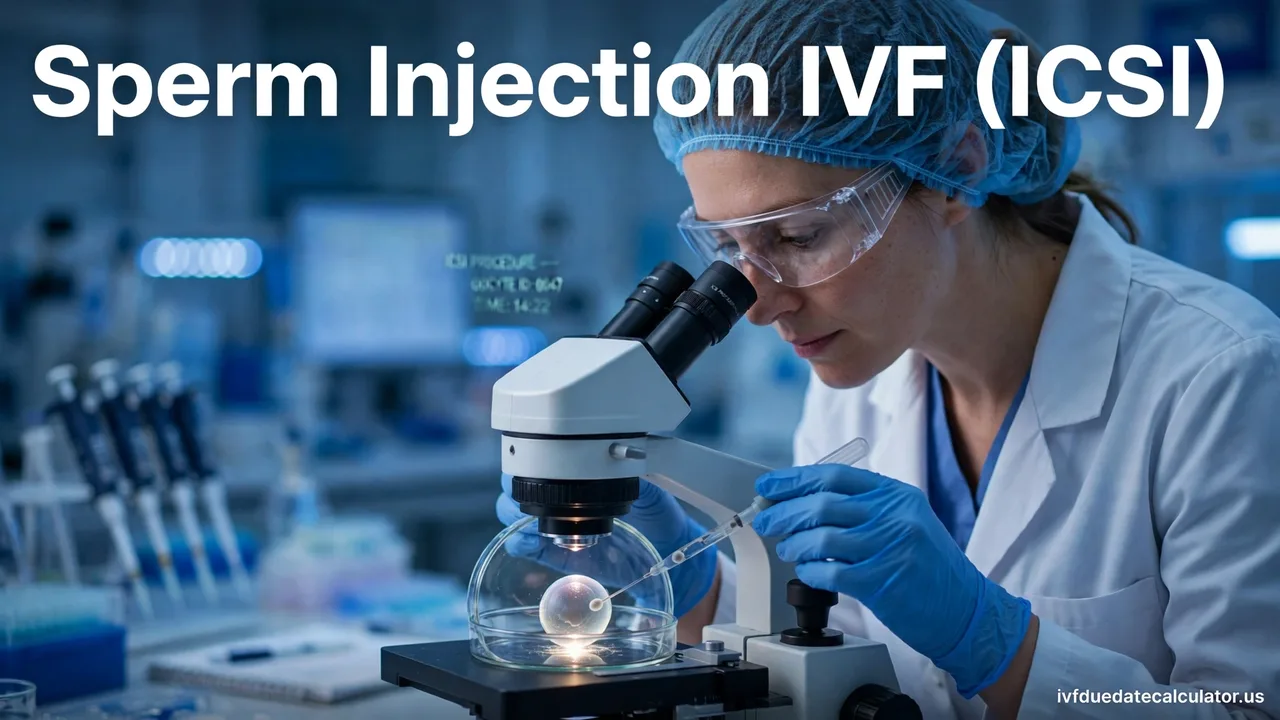
Sperm Injection IVF (ICSI): How It Works, Success Rates & Who Needs It

Sperm injection IVF — known medically as intracytoplasmic sperm injection, or ICSI — is a laboratory technique in which an embryologist injects a single sperm directly into a mature egg. It is not a separate treatment from IVF: it is the fertilization step inside an IVF cycle, done differently. In conventional IVF, thousands of sperm are placed next to each egg and fertilization is left to happen on its own. With ICSI, that chance meeting is replaced by a precise injection under a microscope.
ICSI was first reported in 1992 and changed what was possible for couples facing severe male factor infertility. Today, about 6 in 10 IVF procedures in the United States use ICSI. But it is not needed in every cycle — and when sperm is normal, the evidence shows it does not improve your chances of a baby. This guide explains what sperm injection IVF is, how it differs from conventional IVF, who actually needs it, how the procedure works step by step, what the success rates really are, and what it costs.
Table of Contents
What Is Sperm Injection IVF (ICSI)?
Sperm injection IVF, or ICSI (pronounced “ick-see”), is a form of IVF in which a single live sperm is injected directly into the cytoplasm — the gel-like inner contents — of a mature egg. The name describes exactly what happens: intra (inside) the cytoplasm, a single sperm is injected.
The rest of the IVF cycle is the same as conventional IVF. The woman still goes through ovarian stimulation and egg retrieval, the eggs are still cultured in the laboratory, and the resulting embryos are still transferred to the uterus in the same way. ICSI replaces only one step: the moment the egg and sperm are brought together.
ICSI was developed to solve a specific problem. In conventional IVF, a sperm has to swim to the egg, bind to its outer layer (the zona pellucida), and push its way inside. When sperm count is very low, when sperm barely move, or when they cannot penetrate the egg’s outer layer, that step fails — and the cycle produces no embryos at all. ICSI bypasses every one of those barriers by placing the sperm where it needs to be. It was first reported in 1992 by Palermo and colleagues in Brussels, and it gave couples with severe male factor infertility a chance to have a biological child for the first time.
One thing ICSI does not do is guarantee fertilization. Even with a sperm injected directly into the egg, not every egg fertilizes — the egg itself has to be mature and healthy, and the sperm has to be viable. The American Society for Reproductive Medicine (ASRM) reports that ICSI fertilizes 50% to 80% of eggs. If you are wondering whether your sperm results point toward ICSI, our semen analysis guide explains what each test result means.
Learn more: MedlinePlus — Intracytoplasmic sperm injection.
How Is Sperm Injection IVF Different From Conventional IVF?
Both methods lead to the same thing — a fertilized egg that is cultured and transferred in the same way. The difference is only in how fertilization happens in the laboratory, and in what the laboratory needs before it can begin.
| Feature | Conventional IVF | Sperm injection IVF (ICSI) |
|---|---|---|
| How fertilization happens | Eggs are incubated with prepared sperm; a sperm penetrates the egg by itself | One sperm is injected directly into each egg’s cytoplasm |
| How many sperm are needed | Tens of thousands of motile sperm per egg (about 50,000 or more placed next to each egg) | One viable sperm per egg |
| Who does the work | The sperm does it | A skilled embryologist, using a microscope and a fine glass needle (micropipette) |
| When it is used | When sperm parameters are normal or only mildly reduced | Severe male factor, surgically retrieved sperm, previous fertilization failure, frozen eggs, or PGT |
| Laboratory skill needed | Standard embryology | Advanced micromanipulation — more training, more time per egg |
| Cost | Base IVF price | Extra fee on top of the base IVF price (see cost section below) |
There is one more practical difference. In conventional IVF, the embryologist does not know until the next day whether fertilization happened, and the same is true with ICSI — but with ICSI, the laboratory can confirm which eggs were mature enough to inject, because each egg is examined individually before the procedure. That information can be useful when your clinic plans the next steps.
For the woman, an ICSI cycle feels identical to a conventional IVF cycle. The stimulation drugs, the egg retrieval, the waiting, and the embryo transfer are all the same. The difference happens entirely in the laboratory, under a microscope, after the eggs have been collected. Our guide on how long IVF takes walks through the full cycle timeline.
Who Needs Sperm Injection IVF?
ICSI is most helpful when the problem sits with the sperm. Your clinic may recommend it if any of the following apply:
- Severe low sperm count (severe oligozoospermia). When very few sperm are available, there may not be enough for conventional IVF at all — but a single viable sperm per egg is enough for ICSI.
- Poor sperm motility (asthenozoospermia). If sperm barely move, they cannot reach or penetrate the egg on their own. ICSI injects even a non-motile but viable sperm directly into the egg.
- Abnormal sperm shape (teratozoospermia). Sperm with unusual shapes often struggle to penetrate the egg’s outer layer.
- No sperm in the ejaculate (azoospermia). When sperm must be retrieved surgically — by TESE (testicular sperm extraction), micro-TESE, or MESA — only a small number of sperm are usually obtained, and they are often immotile. ICSI is the only way to use them.
- Previous fertilization failure. If a prior conventional IVF cycle produced no fertilization, or very low fertilization, ICSI is the standard next step.
- Frozen eggs or frozen sperm. Freezing can harden the egg’s outer layer and reduce sperm motility after thawing, so clinics often use ICSI with frozen material.
- Preimplantation genetic testing (PGT). When embryos will be tested with PGT-A, clinics prefer ICSI because it avoids extra sperm sticking to the egg’s surface and contaminating the genetic test. See our PGT-A testing guide for what the test can and cannot tell you.
- Unexplained infertility with poor prior IVF outcomes. As a second-line approach when a previous cycle went badly for unclear reasons.
ICSI is also sometimes considered when the egg provider is over 35, or when only a small number of eggs were retrieved — because with few eggs, a clinic may want to maximize the chance that each one fertilizes. But age alone, or a low egg number alone, is not by itself a strong reason for ICSI. The decision should be based on the sperm results and your treatment history, not on a blanket clinic policy. If your sperm count or motility is low, our guides on how to increase sperm count and how to raise sperm motility explain what can realistically be improved before a cycle.
How Does Sperm Injection IVF Work? Step by Step
An ICSI cycle follows the same path as a conventional IVF cycle until the laboratory stage. Here is what happens, in order:
- Ovarian stimulation. The woman takes fertility medication for about 8 to 14 days to help several eggs mature at once. Blood tests and ultrasounds track the follicles.
- Trigger shot. When the follicles are ready, a trigger injection matures the eggs for retrieval. Our trigger shot guide explains the timing and what to expect.
- Egg retrieval. The eggs are collected in a short procedure under sedation, usually 34 to 36 hours after the trigger shot. Our egg retrieval day guide walks through the day itself.
- Sperm collection and preparation. On the morning of retrieval, the man provides a semen sample, which the laboratory washes and prepares. If sperm must be retrieved surgically (TESE or micro-TESE), that procedure is done separately, and the retrieved sperm are prepared the same way.
- Egg maturity check. The embryologist removes the cells around each egg and checks which eggs are mature (metaphase II). Only mature eggs can be injected.
- Sperm selection. Under high magnification, the embryologist picks one live sperm per egg, choosing the best-looking and best-moving sperm available. A single sperm is drawn into a very fine glass needle called a micropipette, and its tail is gently immobilized so it cannot swim away.
- The injection. The egg is held steady with a holding pipette. The micropipette pierces the egg’s outer layer and membrane, and the sperm is released into the cytoplasm. The needle is withdrawn. The whole injection takes only a few minutes per egg.
- Fertilization check. The eggs are placed in culture and examined the next day — about 16 to 18 hours later — for signs of normal fertilization (two pronuclei). This is the first moment anyone knows whether ICSI worked.
- Embryo culture. Fertilized eggs are watched for 3 to 6 days as they develop, usually to the blastocyst stage (day 5 or 6). Our embryo grading guide explains what the grades mean.
- Embryo transfer or freezing. A healthy embryo is transferred to the uterus on day 3, 5, or 6 — or frozen for a later frozen embryo transfer cycle. The two-week wait then begins.
The injection itself is painless for the woman — it happens in a dish, not in her body — and it adds no extra appointments to the cycle. The only visible difference from conventional IVF is on the laboratory bill and in the fertilization report the next morning.

Sperm Injection IVF Success Rates: What the Numbers Say
The numbers that matter are different at each stage, and it helps to keep them separate:
- Fertilization rate. ICSI fertilizes about 50% to 80% of injected mature eggs, according to both ASRM and Cleveland Clinic. That is similar to the fertilization rate of conventional IVF with normal sperm — ICSI does not fertilize more eggs than conventional IVF does when sperm is normal; it fertilizes eggs that conventional IVF could not fertilize at all.
- Pregnancy and live birth rates. Once an embryo is created, pregnancy rates with ICSI are generally similar to those with traditional IVF. The overall chance of a baby depends mainly on the woman’s age and egg quality, not on whether ICSI or conventional IVF was used. Our IVF success rates by age guide breaks down the CDC data by age group.
- How common it is. About 6 in 10 IVF procedures in the United States now use ICSI, according to Cleveland Clinic — a share that has grown well beyond the cases of severe male factor infertility it was designed for.
- ICSI does not fix egg problems. If the eggs are the limiting factor — low egg number, poor egg quality, or age-related chromosome errors — ICSI cannot improve the outcome. It solves a sperm problem, not an egg problem. That is why your clinic should explain which side of the equation ICSI is addressing in your case.
- ICSI does not guarantee a baby. It promotes fertilization; it does not guarantee fertilization, embryo development, implantation, or pregnancy. A cycle can still fail at any of those later steps, for the same reasons a conventional IVF cycle can fail.
Sperm Injection IVF When Sperm Is Normal: Does It Help?
This is the question most couples do not think to ask — and the evidence answer is no.
A 2024 systematic review and meta-analysis of 18 randomized trials (3,249 cycles) found that ICSI did not improve live birth rates compared with conventional IVF when there was no male factor infertility. A 2025 multicentre randomized controlled trial of 824 women, published in Nature Medicine, confirmed the finding: the cumulative live birth rate was 43.2% with ICSI versus 47.3% with conventional IVF — no significant difference. The same trial found that ICSI may actually reduce the chance of a live birth in younger women (aged 32 or under).
That is why major fertility organizations recommend ICSI only when there is a clear indication — severe male factor, surgically retrieved sperm, previous fertilization failure, frozen eggs, or PGT. When sperm is normal, conventional IVF fertilizes just as well, costs less, and avoids an unnecessary micromanipulation step.
If your clinic recommends ICSI and your semen analysis is normal, it is reasonable to ask why. A good answer names a specific indication from your history or your test results. “We use ICSI for everyone” is a clinic policy, not a medical reason — and it is worth a second opinion. Before your cycle, a full fertility evaluation can confirm whether a male factor is actually present.
Risks and Limitations of Sperm Injection IVF
ICSI is a well-established technique with more than 30 years of use, and large studies have found it broadly safe. But it has real limitations and small risks worth knowing about:
- Slightly higher birth defect risk. If a woman gets pregnant naturally, there is a 1.5% to 3% chance the baby will have a major birth defect. The chance with ICSI is similar to IVF, but slightly higher than in natural conception, according to ASRM. Certain conditions have been associated with ICSI use, including Beckwith-Wiedemann syndrome, Angelman syndrome, hypospadias, and sex chromosome abnormalities — though these remain rare.
- Egg damage. The injection needle can occasionally damage an egg, and a small number of injected eggs do not survive the procedure.
- No guarantee of fertilization. Even with direct injection, 20% to 50% of eggs may not fertilize, and some fertilized eggs stop developing before transfer.
- It can mask an underlying problem. ICSI can produce a pregnancy with sperm that carry genetic problems — for example, a Y-chromosome microdeletion that causes azoospermia can be passed to a son. Your clinic may recommend genetic screening of the male partner before ICSI, especially when sperm count is extremely low or zero.
- It does not improve outcomes without a male factor. As the evidence above shows, adding ICSI to a cycle with normal sperm does not raise live birth rates, and may slightly lower them in younger women.
- Extra cost and laboratory time. ICSI requires advanced embryology skills and adds a fee to every cycle (see below).
None of these risks is a reason to avoid ICSI when it is genuinely needed — for severe male factor infertility, it is often the only route to a biological child. They are reasons to use it only when it is needed.
Sperm Injection IVF Cost in the US
ICSI is charged as an add-on to a base IVF cycle, not as a standalone treatment. In the United States, clinics commonly charge an additional $1,000 to $2,500 per cycle for ICSI, on top of the base IVF fee — so the total cost of an IVF cycle with ICSI is higher than the same cycle without it. The exact amount varies by clinic and by region, and some clinics include ICSI in a package price while others itemize it.
That extra fee is worth weighing against the evidence. When ICSI is medically indicated — severe male factor, surgical sperm retrieval, previous fertilization failure — the added cost buys a real chance of fertilization that conventional IVF could not offer. When sperm is normal, the same fee buys no improvement in live birth rates.
For the full picture of what an IVF cycle costs in the US — base fees, medication, and the add-ons that clinics commonly charge — see our IVF cost guide.
ICSI vs IMSI: What Is the Difference?
You may also hear about IMSI — intracytoplasmic morphologically selected sperm injection. It is a variation of ICSI, not a different treatment.
In IMSI, the embryologist examines the sperm under much higher magnification (around 6,000×, versus about 400× for standard ICSI) before choosing which sperm to inject, looking for subtle defects in the sperm head such as vacuoles. The idea is that better-selected sperm produce better embryos.
The evidence for IMSI is weaker than for ICSI itself. Some small studies suggest it may help in cases of repeated ICSI failure or severe teratozoospermia, but large randomized trials have not shown a clear live birth advantage over standard ICSI, and it adds cost and laboratory time. Most clinics use standard ICSI, and IMSI is usually offered only after repeated failures or when sperm morphology is severely abnormal. If your clinic suggests IMSI, ask what evidence it is basing that on for your specific situation.
What Happens After Sperm Injection IVF?
Once the eggs are injected, the cycle continues exactly like a conventional IVF cycle:
- Day 1: fertilization check. The laboratory confirms which eggs fertilized normally. You will usually get a call the morning after retrieval with the fertilization count.
- Days 3–6: embryo culture and grading. Embryos are watched as they divide and develop, ideally to the blastocyst stage on day 5 or 6. Not every fertilized egg makes it — a drop-off at this stage is normal.
- PGT-A, if planned. If you are doing genetic testing, a few cells are biopsied from each blastocyst (usually day 5 or 6) and the embryos are frozen while the results come back. ICSI is preferred here because it keeps stray sperm off the egg’s surface.
- Embryo transfer. A fresh transfer happens on day 3, 5, or 6, or a frozen embryo transfer is scheduled for a later cycle. Our frozen embryo transfer timeline explains the FET cycle day by day.
- The two-week wait and beta hCG test. About 9 to 14 days after transfer, a blood test checks for pregnancy. Our beta hCG guide explains the levels and doubling timeline.
- Due date. If the cycle works, your due date is calculated from the transfer date — the same as any IVF pregnancy. Our IVF due date calculator can work it out from your transfer date and embryo age.
If fertilization fails even with ICSI, your clinic will review the cycle — egg maturity, sperm source, and laboratory factors — before recommending the next step. Options can include donor sperm, donor eggs, or a different stimulation protocol, depending on what the review finds. Our donor egg due date calculator covers how due dates work when donor eggs are used.
Myths About Sperm Injection IVF
- “ICSI guarantees fertilization.” No. It fertilizes 50% to 80% of mature eggs — better than zero in severe male factor cases, but never a guarantee.
- “ICSI gives you a better chance of a baby than normal IVF.” Only when there is a male factor problem. With normal sperm, live birth rates are the same — or slightly lower in younger women.
- “ICSI is a separate treatment from IVF.” No. ICSI is one step inside an IVF cycle. You still go through stimulation, retrieval, and transfer.
- “ICSI babies are less healthy.” Large studies show children conceived by ICSI are generally healthy. The birth defect risk is slightly higher than with natural conception, but similar to conventional IVF, and the absolute risk remains low.
- “ICSI can fix poor egg quality.” It cannot. ICSI solves a sperm problem. Egg quality, age, and chromosome errors are unaffected by how the sperm gets in.
- “If one sperm is enough, any sperm will do.” No. The sperm still has to be alive and viable, and the embryologist selects the best available sperm. Dead or severely damaged sperm cannot fertilize an egg even by injection.
- “Every clinic does ICSI the same way.” ICSI is a skilled manual technique, and results vary with the embryologist’s experience. It is fair to ask a clinic about its fertilization rates with ICSI.
Questions to Ask Your Clinic About Sperm Injection IVF
Bring these to your consultation — the answers will tell you whether ICSI is right for your cycle:
- Is ICSI recommended for us, and what is the specific indication in our case?
- What were our semen analysis results, and how do they compare with the thresholds for ICSI?
- What is your clinic’s fertilization rate with ICSI, and how does it compare with conventional IVF?
- Will ICSI be used for all our eggs, or split — some eggs by ICSI and some by conventional IVF?
- Is ICSI included in our package price, or charged separately — and how much?
- If we are doing PGT-A, is ICSI required for the testing to be accurate?
- If fertilization fails with ICSI, what would you recommend next?
- Do we need genetic screening (such as Y-chromosome microdeletion testing) before ICSI?

Frequently Asked Questions (FAQs)
What is sperm injection IVF?
Sperm injection IVF, or ICSI (intracytoplasmic sperm injection), is a form of IVF in which an embryologist injects a single live sperm directly into the cytoplasm of a mature egg in the laboratory. It is the fertilization step inside an IVF cycle, used mainly when sperm count, motility, or shape make natural fertilization unlikely.
Who needs sperm injection IVF?
ICSI is most often needed for severe male factor infertility — very low sperm count, poor motility, or abnormal shape — as well as when sperm must be retrieved surgically, when a previous IVF cycle had no fertilization, when frozen eggs or sperm are used, or when embryos will undergo genetic testing (PGT).
What is the success rate of sperm injection IVF?
ICSI fertilizes about 50% to 80% of mature eggs. Once an embryo is created, pregnancy and live birth rates are generally similar to conventional IVF, and the overall chance of a baby depends mainly on the woman’s age and egg quality.
Is sperm injection IVF better than normal IVF?
Only when there is a male factor problem. When sperm is normal, randomized trials show ICSI does not improve live birth rates compared with conventional IVF — and in younger women it may slightly reduce them. It is a targeted tool, not an upgrade.
Does sperm injection IVF hurt?
No. The injection happens in a laboratory dish, not in the body, so the woman feels nothing from the ICSI step itself. The rest of the cycle — stimulation, egg retrieval, and transfer — is the same as conventional IVF.
How much does sperm injection IVF cost?
In the US, clinics commonly add $1,000 to $2,500 per cycle for ICSI on top of the base IVF fee. The exact amount varies by clinic; some include it in a package price and others charge it separately.
Can sperm injection IVF cause birth defects?
The chance of a major birth defect after natural conception is 1.5% to 3%. With ICSI, the chance is similar to conventional IVF but slightly higher than with natural conception. Certain rare conditions, such as Beckwith-Wiedemann syndrome and sex chromosome abnormalities, have been associated with ICSI, but they remain uncommon.
What happens if sperm injection IVF fails to fertilize the eggs?
Your clinic will review the cycle — egg maturity, sperm source, and laboratory factors — and discuss next steps. Options can include a different stimulation protocol, surgically retrieved sperm, donor sperm, or donor eggs, depending on what the review finds.
By Emily Johnson, Content Writer & Fertility Advocate · Medically reviewed by Dr. Sarah Ahmed, Medical Content Advisor
About the author: Emily Johnson is a Content Writer & Fertility Advocate who covers IVF and fertility treatment topics. Meet the team.
Medical review: This article was medically reviewed by Dr. Sarah Ahmed, Medical Content Advisor, for clinical accuracy. Meet the team.
Medical disclaimer: This article is for informational purposes only and is not medical advice, diagnosis, or treatment. Due dates are estimates, and every pregnancy is different. Always confirm your due date and any testing or treatment decisions with your clinic or healthcare provider.
