
How to Increase Progesterone Production: What Works, What Doesn’t & What the Evidence Says

By Emily Johnson, Content Writer & Fertility Advocate · Medically reviewed by Dr. Sarah Ahmed, Medical Content Advisor
If your progesterone is low, you have probably already seen a long list of foods, supplements, and “hormone-balancing” tricks online — and wondered which of them actually do anything. The short answer is that you cannot force your body to make more progesterone, but you can remove the things that suppress it and give it the raw materials it needs to produce it properly. That means regular ovulation, enough healthy fats and key nutrients, good sleep, lower stress, and a healthy weight — plus, when those are not enough, medical help. This guide explains how to increase progesterone production step by step: how the hormone is made, what low progesterone looks like, which foods and nutrients genuinely help, which supplements have real evidence behind them, what does not work at all, and when it is time to talk to a doctor.
Table of Contents
The Short Answer
Progesterone is made by the corpus luteum — the temporary gland left behind in the ovary after ovulation — so the single most important factor in progesterone production is ovulating regularly. No ovulation means no corpus luteum, and no corpus luteum means very little progesterone. The best-supported ways to increase progesterone production are: eat enough healthy fats and the nutrients your body uses to build hormones (vitamin B6, vitamin C, zinc, magnesium, and selenium); sleep 7–9 hours a night; manage chronic stress; keep a healthy weight; and treat any condition that stops ovulation, such as PCOS or a thyroid problem. Supplements such as chasteberry have modest evidence. No food actually contains progesterone, and wild yam creams do not raise it either. If your levels stay low despite these steps, a blood test and prescribed progesterone are the next move — not a stronger supplement.
What Progesterone Is and How Your Body Makes It
Progesterone is a steroid hormone made mainly by the ovaries, and during pregnancy by the placenta. Its main job is to prepare the lining of the uterus (the endometrium) for a fertilised egg and then keep that lining stable so a pregnancy can continue. It also raises body temperature slightly after ovulation, which is why basal body temperature tracking works, and it plays a role in mood, sleep, and breast tissue changes across the cycle.
Production follows a simple chain. Each cycle, a follicle in the ovary matures and releases an egg — ovulation. The empty follicle then transforms into the corpus luteum, which starts producing progesterone. Levels rise through the second half of the cycle (the luteal phase), peak about a week after ovulation, and then fall if no pregnancy occurs, which triggers your period. If pregnancy does occur, the corpus luteum keeps producing progesterone until the placenta takes over, around 8–12 weeks.
Two facts follow from this that explain almost everything else in this article:
- Progesterone is built from cholesterol. Like all steroid hormones, it starts from cholesterol, which is why very low-fat diets and very low body weight can disrupt hormone production. Your body needs dietary fat as raw material.
- Without ovulation, there is almost no progesterone. Any condition that stops or disrupts ovulation — PCOS, thyroid disorders, high prolactin, extreme stress, or perimenopause — will lower progesterone, no matter how many “progesterone-boosting” foods you eat. Fixing ovulation is fixing progesterone.
The Cleveland Clinic’s progesterone overview explains this production chain and the hormone’s roles in plain language.
Progesterone Levels: What’s Normal?
Progesterone is measured with a blood test, usually in nanograms per millilitre (ng/mL). What counts as “normal” depends on where you are in your cycle — and ranges vary between laboratories, so always read your result against your own lab’s reference range:
| When | Typical progesterone range |
|---|---|
| Before ovulation (follicular phase) | 0.1–0.7 ng/mL |
| After ovulation (luteal phase) | 2–25 ng/mL |
| First trimester of pregnancy | 10–44 ng/mL |
| Second trimester of pregnancy | 19.5–82.5 ng/mL |
| Third trimester of pregnancy | 65–290 ng/mL |
A single low reading does not always mean a problem. Progesterone is released in pulses, so levels rise and fall through the day, and a test taken too early or too late in the cycle can mislead. The most useful test is a mid-luteal blood draw — about 7 days after ovulation, or day 21 of a regular 28-day cycle — when levels should be at their peak. Your doctor may also repeat the test across more than one cycle before drawing conclusions. MedlinePlus explains the progesterone blood test, including when it is ordered and how to read the result.
Signs of Low Progesterone
Low progesterone rarely announces itself with one clear symptom. The signs are usually a pattern across your cycles:
- Irregular or very long cycles, or cycles where ovulation seems not to happen at all
- A short luteal phase — less than about 10 days between ovulation and your period
- Spotting before your period starts, or bleeding between periods
- Difficulty getting pregnant, or early miscarriages
- Worse PMS — mood swings, anxiety, breast tenderness, bloating, and headaches in the days before your period
- Trouble sleeping, low mood, or hot flashes, especially in perimenopause
- Low libido or vaginal dryness
None of these symptoms on their own proves low progesterone — they overlap with thyroid problems, low oestrogen, and other conditions. The only way to know your level is a blood test, ideally timed to the mid-luteal phase. If you recognise several of these signs, that is a reason to get tested, not a diagnosis.
What Causes Low Progesterone?
Low progesterone almost always has a cause, and finding it matters more than any supplement. The most common causes are:
- Not ovulating (anovulation). The most common reason by far. If no egg is released, no corpus luteum forms, and progesterone stays low. PCOS is the leading cause of anovulation in women of reproductive age. Our guide to getting pregnant with PCOS explains how ovulation can be restored.
- A short or weak luteal phase. Sometimes ovulation happens but the corpus luteum is weak or short-lived, so progesterone rises late or falls early. This is called luteal phase defect.
- Thyroid disorders. Both an underactive and an overactive thyroid can disrupt ovulation and lower progesterone.
- High prolactin. Prolactin, the hormone that drives milk production, suppresses ovulation when it is too high — sometimes because of stress, sometimes because of a small benign pituitary tumour.
- Chronic stress. Stress raises cortisol and disrupts the brain signals that trigger ovulation. It does not “steal” progesterone directly, despite what many blogs claim — it works by interfering with ovulation itself.
- Very low body weight or very low body fat. The body needs a minimum amount of energy and fat to ovulate. Athletes and people with eating disorders often stop ovulating for this reason.
- Perimenopause. As the ovaries age, ovulation becomes irregular, and progesterone is usually the first hormone to fall — often years before oestrogen drops.
- Certain medications. Some hormonal contraceptives suppress ovulation by design, which is why progesterone is low while taking them — that is expected, not a problem to fix.
Because the cause decides the treatment, a low result should lead to a conversation with your doctor about ovulation, thyroid, and prolactin testing — not straight to a supplement shelf.
How to Increase Progesterone Production Through Diet
No food contains progesterone. What food can do is supply the building blocks and co-factors your body needs to make it, and remove the dietary patterns that get in the way. The pattern that helps most is a whole-foods, anti-inflammatory diet with enough healthy fat — Mediterranean-style eating is the closest well-studied version of it.
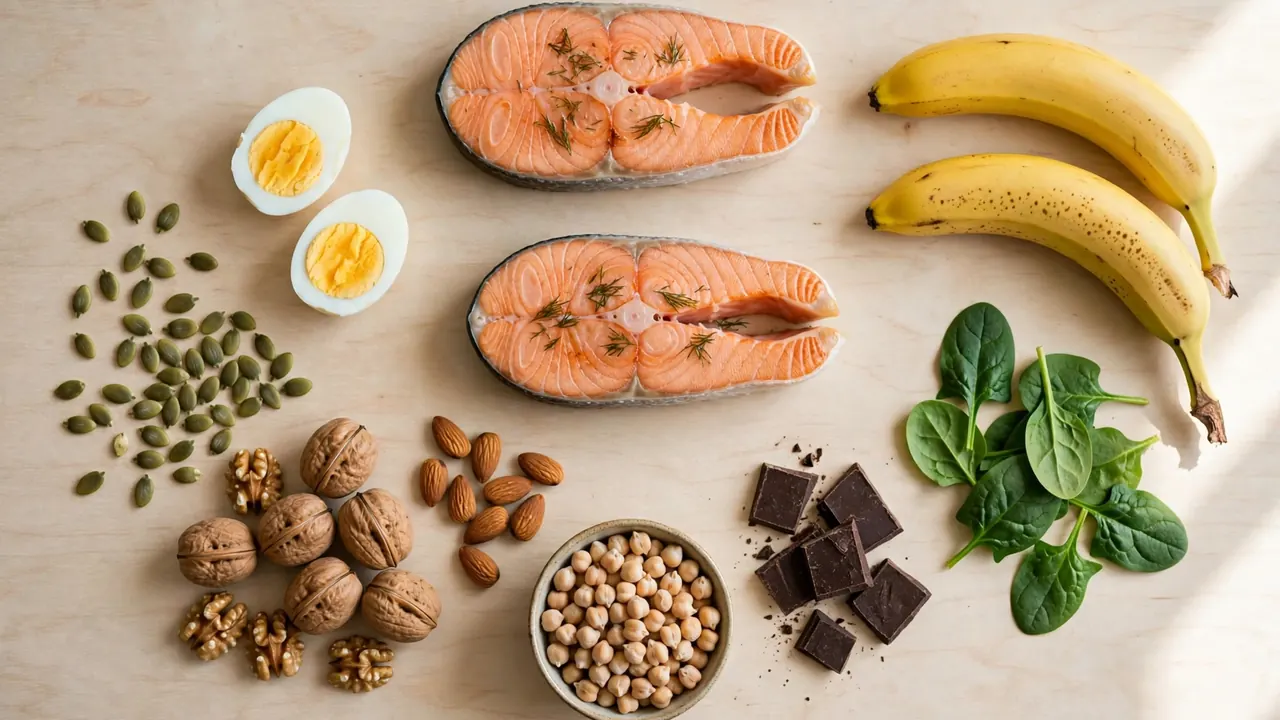
The nutrients that matter most
| Nutrient | What it does | Best food sources |
|---|---|---|
| Vitamin B6 | Supports progesterone production and helps the liver process oestrogen, keeping the two hormones in balance | Poultry, fish, potatoes, bananas, chickpeas, fortified cereals |
| Vitamin C | Supports ovarian function; in one small study, 750 mg a day raised progesterone in women with luteal-phase defect | Citrus fruit, bell peppers, strawberries, broccoli, kiwi |
| Zinc | Supports the enzymes involved in hormone production and healthy ovulation | Oysters, beef, chickpeas, cashews, pumpkin seeds |
| Magnesium | Helps convert cholesterol into progesterone and supports healthy ovulation | Dark chocolate, pumpkin seeds, spinach, almonds, black beans |
| Selenium | Supports thyroid function, which in turn supports ovulation | Brazil nuts (just 1–2 a day), seafood, eggs |
| Healthy fats | Cholesterol is the raw material for progesterone — too little fat can impair production | Olive oil, salmon, avocado, nuts, seeds, eggs |
Foods to include
Build meals around these: oily fish such as salmon and sardines two or three times a week; eggs; a handful of nuts and seeds daily; leafy greens and colourful vegetables; whole grains such as oats and quinoa; beans and lentils; and fruit, especially berries and citrus. Fermented foods such as yoghurt and kimchi support gut health, which helps the body clear excess oestrogen — and excess oestrogen relative to progesterone is part of the imbalance many women feel.
Foods and habits to limit
- Sugar and refined carbohydrates. Frequent blood-sugar spikes contribute to insulin resistance, which worsens PCOS and disrupts ovulation.
- Excess alcohol. Alcohol interferes with liver function and hormone metabolism, and heavy drinking is linked to cycle disruption.
- Too much caffeine. Moderate caffeine (one or two cups of coffee a day) is fine for most people, but very high intake has been linked to cycle irregularity in some studies.
- Very low-fat or crash diets. Cutting fat too hard removes the raw material for hormone production and can stop ovulation altogether.
Diet changes do not work overnight. Hormone production responds over weeks to months, and the clearest sign it is working is a more regular cycle — not a single blood test the following week.
Supplements and Herbs That Support Progesterone
Supplements can help in some situations, but the evidence is much weaker than the marketing suggests. Treat them as support for a healthy lifestyle, not a replacement for it, and always tell your doctor what you are taking — especially if you are trying to conceive or are already pregnant.
- Chasteberry (Vitex agnus-castus). The best-studied herbal option. It works through the pituitary gland, lowering prolactin and raising luteinising hormone, which can support progesterone production. The evidence is modest — it helps some women with PMS and irregular cycles — and it takes 2–3 months to show an effect. It is not safe to take alongside fertility medication without medical advice.
- Vitamin B6. A B-complex or B6 supplement may help if your diet is low in it, and it is sometimes used for PMS. Do not exceed the recommended dose — very high doses over time can cause nerve tingling.
- Vitamin C. The most interesting single study here: in a small trial of women with luteal-phase defect, 750 mg of vitamin C a day was linked to a significant rise in progesterone. It is promising, not proven — one small study is not a prescription.
- Magnesium. Worth supplementing if your diet is low in it, and it also helps sleep and muscle relaxation. Magnesium glycinate is usually the gentlest form.
- Zinc. Only helps if you are deficient — most people eating a varied diet get enough, and excess zinc can interfere with copper absorption.
- Rhodiola and adaptogens. Marketed for stress and hormone balance, but the evidence for progesterone specifically is thin. Stress reduction itself helps; an adaptogen is not a shortcut to it.
- Seed cycling. Eating flax and pumpkin seeds in the first half of the cycle and sunflower and sesame seeds in the second half is popular online, but there are no good clinical trials showing it raises progesterone. The seeds themselves are nutritious — the “cycling” schedule is not proven.
A note on quality: supplements are not regulated like medicines in the US. Choose products that have been third-party tested (look for USP or NSF marks), and be sceptical of any product that promises to “balance your hormones in 30 days”.
Lifestyle: Sleep, Stress and Exercise
Progesterone production is sensitive to how you live, because the brain signals that trigger ovulation are sensitive to it. Three lifestyle factors matter most.

Sleep. Aim for 7–9 hours a night, on a regular schedule. Sleep disruption is associated with altered progesterone levels, and the hormone itself is involved in sleep quality — low progesterone can make sleep worse, which makes the problem worse. Keep the bedroom dark and cool, and avoid screens for the last hour before bed.
Stress. Chronic stress raises cortisol, and high cortisol disrupts the hypothalamic signals that drive ovulation. You do not need to eliminate stress — that is impossible — but a daily practice that lowers it helps: 10 minutes of meditation or breathing exercises, a walk outside, yoga, or time with friends. Studies of women suggest social connection itself is linked to healthier progesterone levels. If stress is constant and overwhelming, therapy is a legitimate medical step, not a luxury.
Exercise. Moderate exercise supports ovulation and hormone balance — walking, swimming, cycling, and strength training a few times a week. But very intense exercise combined with low energy intake can stop ovulation, especially in athletes. If your cycles stopped after you increased training or lost weight quickly, that is a clue worth acting on: eat more, train a little less, and see whether your cycle returns.
Weight. Both extremes hurt progesterone: very low body fat stops ovulation, and excess body fat — especially with insulin resistance — disrupts it too. The goal is a healthy weight for your body, reached gradually, not a crash diet in either direction.
What Doesn’t Work: Progesterone Myths
Some popular “progesterone boosters” have no evidence at all, and a few are actively misleading:
- “Foods that contain progesterone.” None exist. Plants and animals do not contain human progesterone, and no food can deliver it directly. Foods can only support your body’s own production.
- Wild yam creams. Wild yam contains diosgenin, a compound that can be converted into progesterone in a laboratory — but the human body cannot make that conversion. Wild yam cream does not raise progesterone levels.
- Over-the-counter progesterone creams. These do contain real progesterone, but absorption through the skin is unreliable, doses are unstandardised, and there is little good evidence they raise blood levels meaningfully or improve fertility. They are not a substitute for prescribed progesterone, and they can interfere with fertility testing by masking symptoms.
- “Detoxes” and cleanses. There is no evidence that any detox product raises progesterone. Your liver and kidneys already do that job.
- Oestrogen-blocking supplements sold as “progesterone boosters”. Lowering oestrogen is not the same as raising progesterone, and indiscriminate use can disrupt your cycle further.
If something sounds too easy — a cream, a tea, a 30-day reset — it almost certainly is.
Medical Options When Natural Methods Aren’t Enough
When diet, sleep, stress, and supplements have not moved the needle — or when the cause is a condition that lifestyle cannot fix — medicine has effective options. These are prescribed, not bought off the shelf:
- Prescribed progesterone. Available as vaginal suppositories or gel, oral capsules, or injections. It is the standard treatment after embryo transfer in IVF, and it is also used for luteal-phase support, threatened miscarriage, and hormone therapy in perimenopause. Our guide to progesterone after embryo transfer explains the types, the levels doctors look for, and when it is stopped.
- Treating the underlying cause. Thyroid medication for hypothyroidism, medication to lower prolactin, or ovulation-inducing drugs such as letrozole or clomiphene for PCOS — these fix progesterone by restoring ovulation, which is the root of the problem.
- Testing and monitoring. Your doctor may order a mid-luteal progesterone blood test, thyroid function tests, and a prolactin level, and repeat them over a couple of cycles before deciding on treatment. The ASRM’s progesterone fact sheet explains when progesterone supplementation is used in fertility treatment and what the evidence shows.
Do not self-prescribe progesterone, and do not take a friend’s leftover medication. The dose, the form, and the timing all matter, and the wrong approach can delay a pregnancy or hide a problem that needs a different treatment.
Progesterone and Fertility: Trying to Conceive
If you are trying to conceive, progesterone is the hormone that makes implantation possible. After ovulation, it thickens and stabilises the uterine lining so an embryo can attach, and it quiets uterine contractions that could disturb implantation. A short luteal phase — under about 10 days — can mean the lining sheds before an embryo has time to implant, which is one reason low progesterone is linked to difficulty conceiving and early loss.
What helps most when you are trying to conceive:
- Confirm you are ovulating. Ovulation predictor kits, basal body temperature, or a mid-luteal blood test can confirm it. Our ovulation calculator can estimate your fertile window, and our luteal phase guide explains the second half of the cycle in detail.
- Track your luteal phase length. If it is consistently under 10 days, mention it to your doctor — it is a concrete, useful piece of information.
- Give lifestyle changes 2–3 cycles. That is roughly how long it takes for diet, sleep, and stress changes to show up in your cycles.
- Do not delay medical help. If you are under 35 and have been trying for 12 months, or over 35 and have been trying for 6 months, book a fertility evaluation for both partners. The ACOG Evaluating Infertility FAQ explains which tests are ordered and when.
Our guides to how to get pregnant, improving egg quality, and increasing AMH levels cover the wider fertility picture alongside progesterone.
How Long Does It Take to See a Change?
This is the question almost everyone asks, and the honest answer is: longer than a week, shorter than a year. Diet, sleep, and stress changes typically need 2–3 full menstrual cycles before you can judge whether they helped, because each cycle’s egg and corpus luteum develop over months. Signs of improvement usually appear in this order: more regular cycles first, then a longer luteal phase, then better PMS symptoms, and only then a clearly higher mid-luteal blood level. Supplements such as chasteberry also need 2–3 months. If nothing has changed after three cycles of consistent effort, that is useful information — it points toward a medical cause that needs testing rather than more supplements.
When to See a Doctor
Book an appointment — for both partners if you are trying to conceive — if any of these apply:
- You have had irregular cycles, very short luteal phases, or no period for more than 3 months
- You have been trying to conceive for 12 months (or 6 months if you are over 35) without success
- You have had two or more early miscarriages
- You have symptoms of a thyroid problem (fatigue, weight change, feeling cold) or high prolactin (milky nipple discharge, headaches, vision changes)
- You are in perimenopause and symptoms such as heavy bleeding, severe insomnia, or hot flashes are affecting your daily life
- You are considering progesterone supplements or creams and want to know whether they are safe for you
Bring your cycle history and any test results you already have. A doctor can order the right tests, find the actual cause, and — when it is needed — prescribe progesterone in the form and dose that fits your situation.
Frequently Asked Questions (FAQs)
How can I increase progesterone production naturally?
The best-supported natural ways to increase progesterone production are to ovulate regularly, eat enough healthy fats and the nutrients your body uses to build hormones (vitamin B6, vitamin C, zinc, magnesium, and selenium), sleep 7–9 hours a night, manage chronic stress, keep a healthy weight, and treat any condition that stops ovulation, such as PCOS or a thyroid problem. These steps support production over 2–3 cycles — no single food or supplement raises progesterone overnight.
What foods increase progesterone?
No food contains progesterone, but certain foods support your body’s production of it: oily fish such as salmon, eggs, nuts and seeds (especially pumpkin seeds and Brazil nuts), leafy greens, citrus fruit, bell peppers, poultry, chickpeas, and whole grains. These supply healthy fats plus vitamin B6, vitamin C, zinc, magnesium, and selenium — the nutrients involved in making progesterone. Limit sugar, excess alcohol, and very low-fat crash diets, which can disrupt ovulation.
Does chasteberry increase progesterone?
Chasteberry (Vitex agnus-castus) has modest evidence behind it. It works through the pituitary gland, lowering prolactin and supporting the hormones that drive ovulation, which can raise progesterone in some women. It takes 2–3 months to show an effect, and the evidence is limited — it is not a guaranteed fix, and it should not be taken alongside fertility medication without medical advice.
What is a normal progesterone level?
It depends on where you are in your cycle. Typical ranges are 0.1–0.7 ng/mL before ovulation, 2–25 ng/mL in the luteal phase after ovulation, and 10–44 ng/mL in the first trimester of pregnancy — but ranges vary between laboratories. The most useful test is a mid-luteal blood draw about 7 days after ovulation, when levels peak.
Can low progesterone cause infertility?
Yes, it can contribute to it. Progesterone prepares the uterine lining for implantation and keeps it stable in early pregnancy, so low progesterone — especially with a short luteal phase — can make implantation harder and raise the risk of early loss. The underlying cause is usually irregular or absent ovulation, which is why testing and treating the cause matters more than any single supplement.
Does stress lower progesterone?
Chronic stress can lower progesterone indirectly: high cortisol disrupts the brain signals that trigger ovulation, and without ovulation there is little progesterone production. Stress management — sleep, regular exercise, meditation, and social connection — supports healthier cycles. Stress does not steal progesterone directly, despite what many blogs claim.
How long does it take to raise progesterone levels?
Expect 2–3 full menstrual cycles before you can judge whether diet, sleep, and stress changes have helped, because each cycle’s egg and corpus luteum develop over months. Supplements such as chasteberry also need 2–3 months. Prescribed progesterone raises blood levels within days, but that is supplementation, not increased production — the two are different things.
Should I take progesterone supplements or creams?
Only on medical advice. Prescribed progesterone — vaginal, oral, or injected — is effective and is the standard treatment after embryo transfer in IVF and for luteal-phase support. Over-the-counter progesterone creams have unreliable absorption, unstandardised doses, and little good evidence that they raise blood levels or improve fertility. If your levels are low, get tested first and let your doctor decide the form and dose.
About the author: Emily Johnson is a Content Writer & Fertility Advocate who covers IVF and fertility treatment topics. Meet the team.
Medical review: This article was medically reviewed by Dr. Sarah Ahmed, Medical Content Advisor, for clinical accuracy. Meet the team.
Medical disclaimer: This article is for informational purposes only and is not medical advice, diagnosis, or treatment. Due dates are estimates, and every pregnancy is different. Always confirm your due date and any testing or treatment decisions with your clinic or healthcare provider.
