

How to Get Pregnant: A Complete, Honest Guide

Table of Contents
If you have just started trying for a baby, you probably have one big question — how to get pregnant — and a hundred smaller ones underneath it. Which days actually matter? How long will this take? Are you doing something wrong? This guide answers all of it honestly, from what fertility specialists and the research actually say — not folklore.
The short version: pregnancy can only happen during a window of about six days in each cycle, ending on the day of ovulation, and sex every one to two days in that window gives you the best odds. Even with perfect timing, a healthy young couple has roughly a one-in-four chance per cycle — which is why doctors measure this process in months, not weeks. Most couples who keep trying do conceive: about 80 out of 100 young, fertile couples are pregnant within a year.
How Conception Actually Works
Conception is a chain of events, and every link has to hold in the same cycle:
- Ovulation. One ovary releases a mature egg. The egg survives for only about 12 to 24 hours.
- Sperm have to be waiting, or arrive in time. Sperm can live inside the female reproductive tract for up to five days in fertile cervical mucus. This asymmetry — a long-lived sperm, a short-lived egg — is what creates the fertile window.
- Fertilisation. A sperm meets the egg, usually in the fallopian tube.
- Implantation. The fertilised egg divides as it travels to the uterus and implants in the lining roughly 6 to 12 days after ovulation (most often around days 8 to 10). Only then does the body start producing hCG, the hormone pregnancy tests detect.
Because sperm can wait but the egg cannot, the fertile window is the six days ending on the day of ovulation — the five days before it, plus ovulation day itself. The landmark study behind almost everything doctors say about timing (Wilcox and colleagues, published in the New England Journal of Medicine in 1995) found that conception occurred only when intercourse happened during that six-day window, and that the chance of conceiving from a single act rose from about 10% five days before ovulation to about one in three on the two to three days right around ovulation itself.
Two consequences follow from this, and both are reassuring:
- You cannot get pregnant on most days of the cycle. Sex outside the fertile window — however frequent — cannot lead to pregnancy, because there is no egg to fertilise and sperm cannot survive until the next one.
- You do not need to hit one perfect day. A six-day window, covered by sex every day or two, captures nearly all of the possible benefit. Precision is optional; presence is what counts.
One more piece of honesty: fertilisation is not the finish line. A meaningful share of fertilised eggs — estimates commonly run around a third or more — never implant or are lost very early, often before a period is even late. This is a normal part of human reproduction, not something you caused, and it is one reason even perfect timing does not produce a baby every single month.
Finding Your Fertile Window: Four Tracking Methods Compared
Everything above depends on knowing roughly when you ovulate. Ovulation happens about 14 days before your next period — around day 14 of a 28-day cycle, but day 21 of a 35-day cycle and day 11 of a 25-day cycle. And even in regular cycles, the day moves around: Wilcox, Dunson and Baird (BMJ, 2000) found the fertile window falls entirely within the “textbook” days 10 to 17 in only about 30% of women. Calendar math is a rough guide, not a verdict. Here is how the main methods stack up:
| Method | What it tells you | Predicts or confirms? | Reliability | Cost & effort |
|---|---|---|---|---|
| Calendar / cycle-tracking apps | Estimates your fertile window from past cycle lengths | Predicts (roughly) | Weakest of the four — assumes your next cycle matches your last, and ovulation day varies even in regular cycles | Free; almost no effort |
| Cervical mucus monitoring | Stretchy, clear, egg-white-like mucus signals the most fertile days; mucus builds 5–6 days before ovulation and peaks 2–3 days before | Predicts, in real time | Surprisingly strong — research cited by ASRM found mucus observations predict the best conception days as well as or better than BBT or LH kits | Free; takes a cycle or two of practice |
| Ovulation predictor kits (OPKs) | A urine test detects the LH surge that triggers ovulation, roughly 24–36 hours before the egg is released | Predicts, 1–2 days ahead | Good at detecting the surge in women who ovulate regularly; can mislead in PCOS, where LH may run high or surge without ovulation following | Low cost per cycle; a few minutes daily near mid-cycle |
| Basal body temperature (BBT) | A small temperature rise (about 0.2–0.5 °C / 0.5–1 °F) sustained after ovulation | Confirms — only after ovulation has happened | Reliable for confirming a pattern over several cycles; useless for timing the current cycle on its own | Cheap thermometer; daily waking measurement |
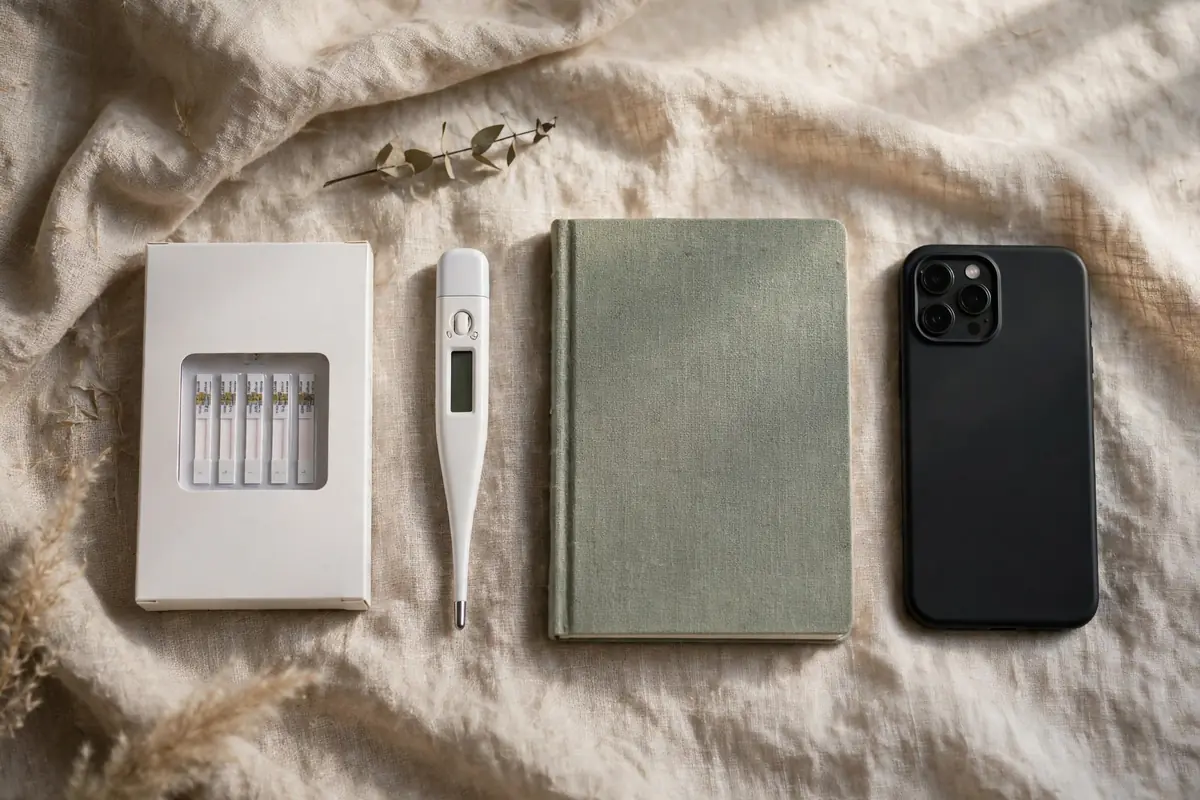
The practical takeaway: you do not need all four. Most couples do well with one predictive method — mucus checks or an ovulation kit — layered over a simple awareness of their usual cycle length. If you want personalised dates, our Ovulation Calculator turns your cycle dates into an estimated fertile window in seconds; treat the result as a zone to cover, not a single day to hit. And once a test turns positive, our Implantation Calculator can help you work out when implantation likely happened.
A warning sign hidden in tracking: if your kits never show a surge, your temperatures never shift, or your cycles are shorter than 21 days, longer than 35, or frequently skipped, you may not be ovulating regularly. That is not a DIY problem — it is a reason to see a doctor sooner rather than later (see “When to See a Doctor” below).
Timing Sex: How Often Is Enough?
The research answer is simpler than most people expect:
- Every 1 to 2 days during the fertile window gives the highest pregnancy rates (ASRM).
- Two to three times a week, all cycle long, achieves nearly the same result — because that rhythm almost always lands inside the window without any tracking at all. For couples who find scheduled sex stressful, this is a genuinely good strategy, not a compromise.
- Daily sex does no harm. In men with normal sperm counts, concentration and motility stay normal with daily ejaculation.
- “Saving up” sperm backfires. Abstinence longer than about five days can reduce sperm quality, and saving everything for one predicted day risks missing the real window entirely if ovulation shifts.
- Do not ration yourselves to a single “perfect” day. Strict scheduling is a known source of stress and, ironically, of missed windows.
If you remember one sentence from this guide, make it this one: regular sex every two to three days, without a spreadsheet, gets most couples essentially everything that perfect timing would.
Your Real Chances: Per Cycle and by Age
Age is the single strongest factor in how quickly conception happens, mainly because egg quantity and quality decline over time — gradually from the early 30s, faster after 37. Here are the honest numbers, drawn from ACOG and ASRM patient guidance. Treat them as population averages: your personal odds may be better or worse, and no table can tell you which group you are in.
| Age of the woman | Approximate chance per cycle | Approximate chance within 12 months of trying |
|---|---|---|
| Under 30 | About 20–25% (roughly 1 in 4) | About 85–90% |
| 30–34 | About 15–20% | About 75–85% |
| 35–37 | About 10–15% | About 65–75% |
| 38–40 | About 5–10% | About 50–65% |
| 40–42 | Around 5% (ACOG: about 1 in 10 per cycle at age 40, falling from there) | Around 40–45% at age 40 |
| Over 42 | Under 5% | Low; prompt specialist input is recommended |
A few anchors behind this table, so you can see it is not invented: ASRM’s patient guidance puts the per-cycle chance for young fertile couples at 20–37% during the first three months, rising to 80% pregnant by one year and 90% by two years. ACOG frames the age effect plainly: a healthy woman in her 20s or early 30s has about a 1 in 4 chance in any given cycle; by age 40 it is about 1 in 10.
Two things these numbers should do for you:
- Reset the “first month” expectation. Even at peak fertility, the odds in any single cycle are closer to a coin you lose three times out of four. A negative test in month one, two or three is the normal experience, not a diagnosis.
- Put the calendar in charge, not your feelings. The reason the “see a doctor” thresholds below are set at 12 and 6 months is precisely this maths: by those points, most couples who are going to conceive without help have done so, and the remaining group has a genuinely higher chance of an identifiable cause.
Male age matters too, though less steeply: ASRM notes fertility rates are lower for men over 50, and sperm quality declines gradually with age. “Her age is the clock” is only half the story.
Before You Start: A Short Preconception Checklist
A few things are worth doing before or right as you start trying — none of them is about “boosting fertility” in the supplement-aisle sense; they are about protecting a pregnancy from its earliest days:
- Start folic acid now. 400–800 mcg of folic acid daily, beginning at least one month before conception (three months is a common recommendation), substantially reduces the risk of neural tube defects — and the neural tube forms in the first month of pregnancy, often before you know you are pregnant. Our guide to the best prenatal vitamins explains exactly what to look for on the label.
- Book a preconception visit if you have any chronic condition (thyroid disease, diabetes, PCOS, endometriosis), take regular medication, or have had pregnancy complications before. Some medications need adjusting before conception, not after a positive test.
- Check the basics: rubella and chickenpox immunity, cervical screening up to date, dental problems dealt with. Treating these mid-pregnancy is harder.
- Stop smoking, cut alcohol, skip recreational drugs — for both partners (more on why below).
- Coming off hormonal birth control? Fertility usually returns within a cycle or two for most methods; the contraceptive injection is the known exception and can delay ovulation by several months. A month or two of settling after the pill is not infertility.
Lifestyle: What Actually Moves the Needle
The internet sells a thousand fertility boosters. The evidence supports a short, unglamorous list — and it applies to both partners, because sperm are half of this equation.
Weight — both directions matter. ASRM’s summary of the evidence is blunt: fertility is decreased in women who are very thin or who have obesity, while ordinary diet variation in women of normal weight with regular periods shows no proven effect. Being significantly underweight can switch ovulation off; significant excess weight is linked to ovulatory problems and lower success even with treatment. The same pattern shows up in men, where obesity is associated with poorer sperm parameters. If you are unsure where you stand, our BMI Calculator gives you the number in seconds; gradual, sustainable change beats crash diets, which can themselves disrupt cycles.
Smoking is the clearest harm on this page. Smoking — including the male partner’s — is consistently associated with reduced fertility and earlier loss of ovarian reserve, and ASRM lists it among the exposures couples trying to conceive should avoid entirely. There is no “cutting down is fine” version of this advice.
Alcohol: heavy drinking is the proven problem. More than two drinks a day is associated with reduced fertility, and because no safe level in early pregnancy has been established, most specialists advise stopping while trying. An occasional drink in the two-week wait has not been shown to prevent conception — do not torture yourself over one glass before you knew — but “trying” months are the right time to make it rare.
Caffeine: moderation is fine. Heavy caffeine consumption is associated with reduced fertility; moderate intake — roughly one to two cups of coffee a day — has not been shown to hurt your chances. You do not need to give up coffee to get pregnant.
Lubricants: an overlooked detail that genuinely matters. Several common lubricants — ASRM names Astroglide®, KY® Jelly and KY® Touch™, and saliva and olive oil behave the same way in testing — can reduce sperm motility and survival. If you need a lubricant, switch to one shown not to harm sperm (products marketed as “fertility-friendly”, such as Pre-Seed®, or plain mineral oil). This is a two-minute fix for something that can quietly work against you every cycle.
For men specifically: avoid testosterone supplements and anabolic steroids entirely while trying — outside testosterone can switch sperm production off, sometimes for many months. Very hot, prolonged exposure (daily hot tubs or saunas) can temporarily lower sperm counts; ordinary showers and laptops are not worth worrying about. Tight underwear, endlessly debated online, has at most a trivial effect — wear what is comfortable.
Stress: be honest, not cruel. Severe, prolonged stress can disrupt the hormones that drive ovulation — that much is real. But ordinary trying-to-conceive stress has not been shown to cause infertility, and ASRM’s own patient materials point out that the arrow mostly runs the other way: infertility causes stress. If you take one thing from this section, let it be this: you cannot think your way out of a negative test, and a negative test is not evidence that you worried too much.
Supplements beyond folic acid: there is no supplement proven to make a fertile couple conceive faster. Save your money until a doctor finds a specific deficiency to treat.
Six Myths That Refuse to Die
- “Certain positions work better.” There is no evidence that any position improves your chances. ASRM notes that sperm reach the fallopian tubes within minutes regardless of position. Use whichever positions you both enjoy — enjoyment is not a trivial variable in a process that requires regular sex for months.
- “Lie with your legs up / stay in bed for half an hour.” Prolonged rest after intercourse has no proven benefit; the sperm that matter are already through the cervix within minutes. If lying still for a few minutes feels nice, do it — as a rest, not a ritual. The fluid that leaks out afterwards is mostly seminal fluid, not “all the sperm escaping.”
- “Just relax and it will happen.” Covered above, but it doubles as a myth because it is the advice couples hear most. Relaxation is good for your life and your relationship. It is not a treatment, and its absence is not a cause.
- “Save up sperm for the big day.” Backwards. Long abstinence worsens sperm quality, and a single saved-up encounter can still miss a shifted ovulation day. Frequent, ordinary sex beats strategy.
- “Birth control has made me temporarily infertile.” With the exception of the injection (which can take several months to wear off), fertility returns quickly after stopping contraception. If your cycles have not settled into a recognisable pattern within about three months of stopping, that is worth a doctor’s visit — but the visit is about your cycles, not damage from the pill.
- “Everyone gets pregnant in the first month or two.” Everyone does not — they just announce it as if they did. At roughly 1 in 4 per cycle even at peak fertility, taking six months is common when nothing is wrong. Social media compresses everyone else’s timeline and stretches yours.
After Ovulation: Implantation and Testing, Briefly
Once ovulation has passed, there is nothing left to do except wait — which is what makes this stretch feel so long. Implantation typically happens 6 to 12 days after ovulation and hCG only rises afterwards, so testing too early is the most common cause of a false negative. Test from the day of your missed period; the full timing picture is in our guide to the best time to take a pregnancy test, our guide to pregnancy tests explains how the test types differ, and our free Early Pregnancy Test Calculator works out your earliest sensible test date. If the test is positive — congratulations: book a first appointment, keep taking folic acid, and if you are curious when it all began, our Conception Date Calculator works backwards from your due date or last period.
When to See a Doctor
Doctors define infertility as not conceiving after a set period of regular, unprotected sex — and the thresholds are deliberately tied to the odds table above:
- Under 35: see a doctor after 12 months of trying.
- 35 or older: see a doctor after 6 months of trying.
- Over 40: talk to a doctor before or as you start trying — evaluation should not wait.
- At any age, don’t wait if any of these apply: periods that are irregular, very far apart, or absent; known or suspected tubal problems or endometriosis; a history of pelvic infection or pelvic/abdominal surgery; two or more miscarriages; a partner with known testicular problems, prior STI, ejaculation difficulties, or a previous abnormal semen result; or ovulation kits that never turn positive.
Seeking an evaluation is not “giving up on natural conception.” It is buying information. Many couples evaluated at these thresholds receive a simple, fixable explanation — or the reassurance that continuing to try is a reasonable plan.
The First Fertility Tests — for Both of You

A basic work-up evaluates both partners at once, for a simple statistical reason: in ASRM’s figures, about 20% of infertility is due to a male factor alone and another 30% involves both partners — testing only the woman misses half the picture. The usual first round (per ACOG’s “Evaluating Infertility” guidance):
For him — usually first, because it is the simplest and cheapest test in the whole work-up:
- Semen analysis — count, motility (movement) and morphology (shape), from a sample produced after 2–5 days of abstinence. One abnormal result is usually repeated before conclusions are drawn.
For her:
- Confirmation that ovulation is happening — often a blood progesterone test about a week before the expected period, alongside cycle history.
- Ovarian reserve testing — AMH and early-cycle FSH/estradiol blood tests, often with an ultrasound antral follicle count. These estimate egg quantity and help predict response to treatment; they do not measure egg quality and cannot tell you your personal deadline.
- Thyroid and prolactin blood tests — both can quietly disrupt ovulation and both are treatable.
- A check that the tubes are open — usually an HSG (hysterosalpingogram), an X-ray dye test, since blocked tubes prevent egg and sperm meeting at all.
- Ultrasound of the uterus and ovaries for structural issues such as fibroids or cysts.
Notice what is not on this list: laparoscopy, genetic panels and exotic immune testing are not first steps. A good clinic starts simple, and a substantial share of couples get their answer — and a plan — from this first round alone.
When Treatment Becomes the Path
If the tests find a cause — or if time and age argue against waiting — treatment usually escalates in steps: ovulation-inducing tablets for ovulatory problems, IUI for mild male factor or unexplained infertility, and IVF when tubes are blocked, sperm numbers are very low, or simpler steps have failed. Which of these suits which couple, and how their success rates and costs compare, is a big enough question that we gave it its own article: IVF vs IUI, and our IUI treatment guide walks through what an IUI cycle actually involves. Nothing about reaching this section means natural conception was “done wrong” — many of the causes treatment addresses were never within your control.
The Honest Bottom Line
How to get pregnant is less mysterious than the internet makes it: know your window, have sex every day or two inside it (or every two to three days throughout the cycle), keep the short list of proven lifestyle basics in order, and let the calendar — not anxiety — decide when to ask for help. Most couples who follow that unglamorous plan are pregnant within a year. If you are not, that is information, not failure — and the next step is straightforward tests for both of you, not blame for either.
Medical disclaimer: This article is general educational information and is not medical advice. It cannot diagnose infertility or replace care from your own doctor, who knows your history. If you have concerns about your fertility, your cycles, or any symptom mentioned here, please seek personalised medical advice.
By Emily Johnson, Content Writer & Fertility Advocate • Medically reviewed by Dr. Sarah Ahmed, Medical Content Advisor
How long does it usually take to get pregnant?
For young, fertile couples, ASRM puts the chance of conceiving at 20–37% per cycle in the first three months, with about 80% pregnant by one year and 90% by two years. Taking several months is completely normal — even at peak fertility, the odds in any single cycle are only about 1 in 4.
Can you get pregnant when you are not ovulating?
Not directly — conception can only happen during the six-day fertile window ending on ovulation day, because the egg survives only 12–24 hours. But sex up to five days before ovulation can still lead to pregnancy, because sperm can survive in the reproductive tract and wait for the egg. So “not ovulating today” does not mean “cannot conceive from today.”
How often should we have sex when trying to conceive?
Every 1 to 2 days during the fertile window gives the highest rates. Sex two to three times a week throughout the cycle achieves nearly the same result and needs no tracking. Daily sex does not harm sperm quality in men with normal counts, and abstinence longer than about five days can actually reduce it — so never “save up.”
What are the chances of getting pregnant the first month of trying?
Roughly 1 in 4 for a healthy couple in their 20s or early 30s, per ACOG — which means about 3 in 4 couples trying correctly will not conceive in month one. A negative first (or second, or third) month is statistical normality, not a sign of a problem.
Does lying still or keeping your legs up after sex help you get pregnant?
No. ASRM states there is no evidence that sexual position, orgasm, or prolonged rest after intercourse increases the chance of conception — sperm reach the fallopian tubes within minutes regardless. Rest briefly if you like, but skip the rituals and the guilt when you don’t.
Can stress stop me from getting pregnant?
Severe, ongoing stress can disrupt ovulation in some women, but everyday stress — including the stress of trying — has not been shown to cause infertility. Fertility specialists note the arrow usually points the other way: infertility causes stress. “Just relax” is neither a treatment nor a fair comment.
When should we see a fertility doctor?
After 12 months of trying if you are under 35; after 6 months if you are 35 or older; and promptly at any age if your periods are irregular or absent, you have known endometriosis, tubal or pelvic problems, a history of pelvic infection or surgery, two or more miscarriages, or your partner has known testicular or ejaculation problems. Over 40, talk to a doctor before you start trying.
Do both partners really need fertility testing?
Yes. ASRM figures attribute about 20% of infertility to a male factor alone and a further 30% to combined factors — so in roughly half of cases the male side is part of the picture. The semen analysis is also the simplest, cheapest test in the entire work-up, which is why it usually comes first.
