

Mosaic Embryos in IVF: What They Are, Transfer Decisions & Success Chances

A PGT-A report rarely gives a simple pass or fail. Alongside normal (euploid) and abnormal (aneuploid) results, many patients meet a third category that causes real confusion and heartache: the mosaic embryo. Is it usable? Is it safe? What are the real chances? This guide explains mosaic embryos in IVF in plain language — what mosaicism is, how low-level and high-level results differ, what the studies show about success rates and risks, and how clinics decide whether a mosaic embryo should be transferred. If you are new to genetic testing of embryos, start with our guide to PGT-A testing in IVF and then come back here.
Table of Contents
What Is a Mosaic Embryo?
A mosaic embryo is an embryo whose cells are not all chromosomally identical: some cells are normal (the right number of chromosomes) and some are abnormal (a chromosome is missing or extra). The word “mosaic” describes the patchwork pattern — like tiles of two colours in one picture. Mosaicism happens when a copying error occurs during cell division after fertilisation, so only the cells descended from that one faulty division carry the error. It is different from a fully aneuploid embryo, where the error came from the egg or sperm and is present in every cell. Depending on the clinic and the lab, roughly 5–15% of PGT-A-tested blastocysts are reported as mosaic — common enough that most IVF patients will at least hear the term.
How Mosaicism Is Detected — and Why the Result Is Not the Whole Embryo
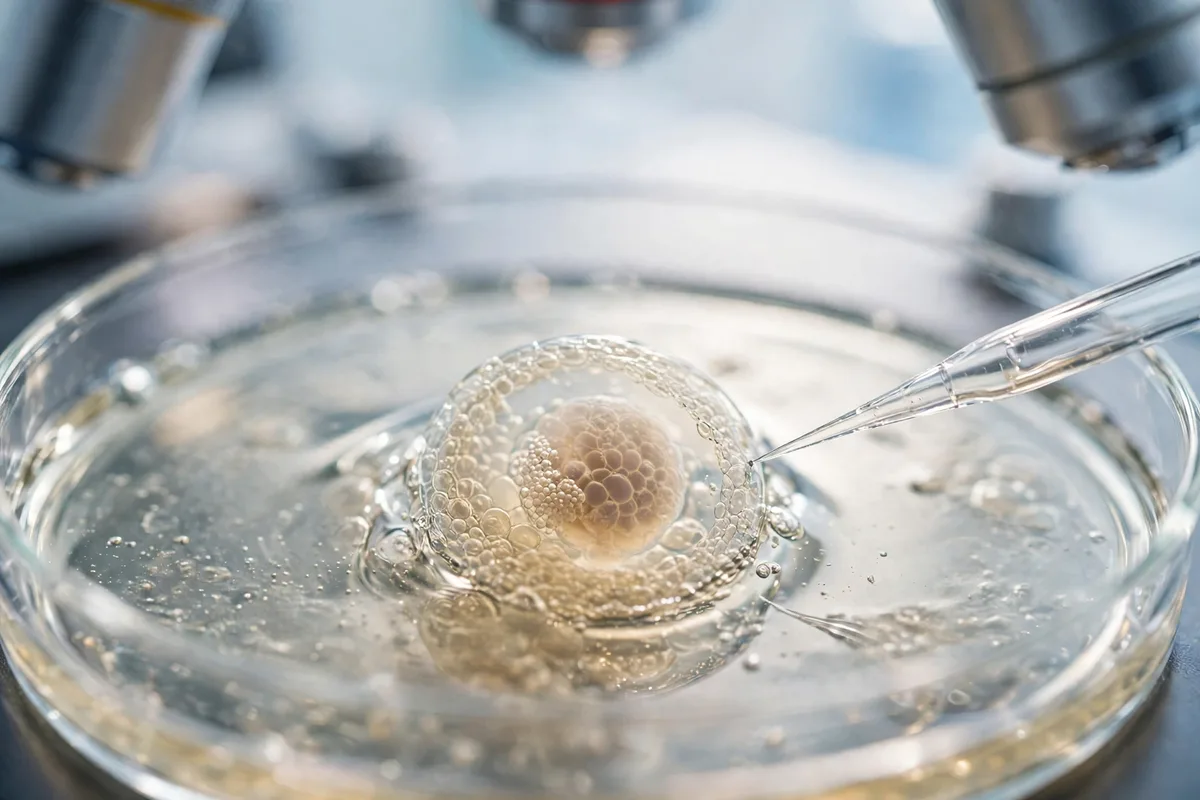
PGT-A does not test the whole embryo. At the blastocyst stage, an embryologist removes about 5–10 cells from the trophectoderm — the outer layer that becomes the placenta — and the lab measures the chromosome signal in that sample. If all sampled cells look normal, the embryo is reported euploid; if all look abnormal, aneuploid; if the signal sits in between, the result is called mosaic, usually with a percentage (for example, 30% abnormal cells). The crucial limitation: the biopsied cells come from the future placenta, not from the inner cell mass that becomes the baby. The sample may overstate or understate what is happening in the embryo itself — one reason mosaic results are a grey zone rather than a verdict. For background on how embryos are graded before testing, see our guide to embryo grading explained.
Low-Level vs High-Level Mosaic Embryos
Labs divide mosaic results by the share of abnormal cells in the sample. Exact cut-offs vary by lab, but a common scheme is: low-level mosaic — about 20–40% abnormal cells; high-level mosaic — about 40–80% abnormal cells. (Below ~20% is usually reported as euploid and above ~80% as aneuploid.) This distinction matters more than the word “mosaic” itself: low-level mosaics behave much more like normal embryos in outcome studies, while high-level mosaics implant less often and miscarry more. Which chromosome is involved also matters — mosaicism affecting some chromosomes is considered lower risk than others, which is one reason individual genetic counselling (below) is so important.
Can a Mosaic Embryo Be Transferred?
Yes — in the right circumstances. Professional guidance (including ASRM and international PGT consortium statements) accepts that mosaic embryos can be considered for transfer, usually in a clear priority order: euploid embryos first, then low-level mosaics, then high-level mosaics. Transfer is most often discussed when a patient has no euploid embryos — for many people, a mosaic embryo is their only embryo, and the alternative is another full stimulation cycle or no transfer at all. Clinics typically require a documented discussion and consent covering the lower success rates, the higher miscarriage risk, and the recommendation for prenatal testing in pregnancy. Some clinics will not transfer certain high-risk mosaic results at all (for example, mosaics involving chromosomes linked to viable syndromes or imprinting disorders) — policies genuinely differ, and asking your clinic for theirs in writing is reasonable.
Success Chances: What the Studies Show
Outcomes depend on the level of mosaicism and which chromosome is involved, but the overall pattern across large studies is consistent: euploid embryos implant most reliably (often around 50–60% per transfer in good-prognosis patients, varying with age); low-level mosaic embryos implant somewhat less often — many series report live-birth rates around 35–45% per transfer; high-level mosaic embryos do worse, with lower implantation and higher miscarriage rates. Healthy babies have been born from mosaic embryo transfers since the first reported cases in 2015, and follow-up studies of children born from mosaic transfers are broadly reassuring. Two honest caveats: these are averages across different labs and patient groups, so your clinic’s own data matters; and a share of “mosaic” pregnancies likely succeed because the embryo was effectively normal (a confined or false mosaic result) — one more reason the test is a guide, not a guarantee. Age still shapes overall odds strongly, as our IVF success rates by age breakdown shows.
Risks and Safety Questions to Understand
- Miscarriage: higher than with euploid transfers, especially for high-level mosaics.
- Affected baby: the risk of a baby being born with the mosaic abnormality appears low, but it is not zero — this is why prenatal testing is recommended.
- Confined placental mosaicism: the abnormality may be limited to the placenta; it is occasionally linked with growth problems in pregnancy, so extra monitoring may be advised.
- False reassurance either way: a mosaic result can discard embryos that might have succeeded — and a euploid result never guarantees a baby.
If a mosaic transfer leads to pregnancy, specialists usually recommend prenatal diagnosis (such as amniocentesis) rather than relying on screening tests like NIPT alone, because NIPT also samples placental DNA — the same source as the original biopsy.
Genetic Counselling: The Conversation You Should Not Skip

Before transferring a mosaic embryo, ask for a session with a genetic counsellor. Bring these questions: Which chromosome(s) are involved, and what conditions are associated with them? Is my result low-level or high-level, and what cut-offs does your lab use? What are this clinic’s own live-birth and miscarriage rates for mosaics like mine? If I conceive, exactly which prenatal tests do you recommend? What happens to my remaining embryos if I choose not to transfer? A good clinic will welcome these questions and give you their answers in writing. For general patient background on genetic testing in IVF, the ASRM patient site ReproductiveFacts.org is a reliable starting point.
The Bottom Line on Mosaic Embryos
A mosaic result is neither a write-off nor a clean bill of health — it is a probability statement about a tiny sample of cells. Low-level mosaic embryos give many patients a genuine chance of a healthy baby, particularly when no euploid embryo is available; high-level mosaics carry poorer odds and need careful, individual advice. The right next step is almost never a snap decision: it is a proper conversation with your clinic and a genetic counsellor, using your specific result — chromosome, level and your own history — rather than averages from the internet.
What is a mosaic embryo in IVF?
A mosaic embryo has a mix of chromosomally normal and abnormal cells, detected when a PGT-A biopsy sample shows an in-between chromosome signal. It sits between a fully normal (euploid) and a fully abnormal (aneuploid) result.
Can a mosaic embryo produce a healthy baby?
Yes. Healthy babies have been born from mosaic embryo transfers since 2015, and follow-up studies are broadly reassuring. Success is not guaranteed — implantation rates are lower and miscarriage rates higher than with euploid embryos — which is why counselling and prenatal testing are recommended.
What is the difference between low-level and high-level mosaic embryos?
It is the share of abnormal cells in the biopsy sample. Low-level (roughly 20–40%) behaves much more like a normal embryo; high-level (roughly 40–80%) implants less often and miscarries more. Exact cut-offs vary between labs.
Should I transfer a mosaic embryo or do another IVF cycle?
It depends on your age, how many embryos you have, which chromosome is involved and the mosaic level. Many patients transfer a low-level mosaic before committing to another costly stimulation cycle — but this is exactly the decision to make with your clinic and a genetic counsellor, not from averages online.
Do clinics transfer mosaic embryos?
Many do, under professional guidance, usually when no euploid embryo is available and after documented counselling and consent. Policies differ — some clinics decline certain high-risk mosaic results — so ask your clinic for its policy in writing.
Does a mosaic result mean the baby will have a genetic condition?
Not usually. The biopsied cells come from the future placenta, not the baby itself, and most successful mosaic transfers result in chromosomally normal babies. The risk is low but not zero, so prenatal diagnostic testing (such as amniocentesis) is usually recommended in pregnancy.
Why did my embryo come back mosaic if my eggs were fine?
Mosaicism usually arises from a copying error during cell division after fertilisation — it is a mitotic error in the early embryo, not necessarily a problem with the egg or sperm. It can happen in embryos from younger patients too, though rates vary.
Is PGT-A wrong when it reports mosaicism?
The test accurately reports the sample it received — but the sample is 5–10 placenta-destined cells, not the whole embryo. That sampling limit is why mosaic results are treated as a grey zone and why some transferred mosaic embryos produce completely normal pregnancies.
By Emily Johnson, Content Writer & Fertility Advocate • Reviewed by Dr. Sarah Ahmed, Medical Content Advisor
Medical disclaimer: This article is for general information only and is not medical advice. Decisions about transferring a mosaic embryo must be made with your own fertility team and a genetic counsellor.
