
Best Time to Take Pregnancy Test: How Soon Is Too Soon?

The best time to take pregnancy test is the day your period is due — or the day after it is missed. That is the short answer, and for most people it is the only one that matters. Here is why: a home pregnancy test cannot detect a pregnancy until the embryo has implanted in the uterus and the hormone hCG has risen high enough in your urine, and that process finishes, at the earliest, only a few days before your period is due. Test on the day of your missed period with a standard test and you get the up-to-99% accuracy the box promises. Test four or five days earlier and the same test misses roughly half of real pregnancies — not because it is faulty, but because the hormone it looks for is not there yet. Below we walk through the timing science (implantation at 6–12 days past ovulation, then the hCG climb), a day-by-day accuracy table so you can see exactly what an early result is worth, the best time of day to test, how to adjust the timing for short, long or irregular cycles, and the exact protocol to follow if your test is negative but your period still does not come.
Table of Contents
The Short Answer: When Should You Test?
- Most accurate: the day of your missed period (about 14 DPO in a typical cycle) or later.
- Earliest reasonable: 12 DPO — roughly two days before your period is due — with a sensitive early test, knowing a negative still is not final.
- Testing before 10 DPO is almost always wasted money: even most pregnant women test negative that early.
- Best time of day: first morning urine, especially when testing early.
- Negative but no period? Wait 48 hours and test again — hCG roughly doubles every two days in early pregnancy, so two days can change the result completely.
If you would rather have a date than a rule, our early pregnancy test calculator works out your personal earliest sensible test date from your last period or conception date.
Why Timing Rules Everything: Implantation Comes First
A pregnancy test does not detect an egg, sperm or fertilization. It detects hCG (human chorionic gonadotropin), a hormone that is only produced after a fertilized egg implants in the lining of the uterus. No implantation, no hCG — and no possible positive test, however sensitive the kit.
That makes implantation the starting gun of every testing timeline, and its timing varies more than most people expect. In the landmark study of 199 natural conceptions published by Wilcox and colleagues in the New England Journal of Medicine, implantation happened 6 to 12 days after ovulation (DPO), and in 84% of successful pregnancies it occurred on days 8, 9 or 10. In other words, two women who ovulate on the same day can implant four days apart — and their tests turn positive four days apart.
Once implantation begins, hCG starts low and climbs fast, roughly doubling every 48 hours in the first days (Mayo Clinic puts the early doubling time at two to three days). It appears in the blood first and in urine shortly after. A blood test at a clinic can pick it up within about 7–10 days of conception; a home urine test needs the level to cross its detection threshold, which takes a little longer. If you are unsure of your exact implantation window, our implantation date calculator estimates it from your cycle dates.
Test Sensitivity: What “Early Detection” Really Means
Home tests are not equally sensitive, and the differences explain a lot of confusing results. Sensitivity is printed (often in small type) as the hCG level a test can detect, in mIU/mL:
- Standard tests: 25 mIU/mL — the most common threshold, and the level used in most validation studies.
- Early tests: around 10 mIU/mL — marketed for use several days before a missed period.
- Some cheaper or older-style tests need 50 mIU/mL or more, which can mean testing positive days later than a sensitive brand.
How much sensitivity is enough? Research reviewed by Gnoth and Johnson estimated that a test needs to detect about 12.5 mIU/mL to catch 95% of pregnancies on the day of the expected period — which is why genuine early tests cluster around 10 mIU/mL, and why a 25 mIU/mL test is dependable from the missed period but shaky before it. Independent laboratory evaluations have also found wide variation between brands: in one blinded study of seven over-the-counter tests, the most sensitive detected 6.3 mIU/mL and over 95% of pregnancies on the day of the missed period, while several others had effective thresholds of 100 mIU/mL or more and would have missed most pregnancies that day. The practical lesson: if you are testing early, the brand matters almost as much as the day.
Pregnancy Test Accuracy by DPO: A Realistic Table
So what does a test actually show on each day? The table below combines the implantation data above with the largest real-world dataset we have: the PRESTO cohort study (published in Fertility and Sterility), which analyzed nearly 20,000 home tests from almost 6,000 women who conceived and measured how often a test was positive on each day relative to the expected period. Percentages are the share of pregnant women whose test was positive that day, using standard 25 mIU/mL tests.
| DPO | Days before expected period* | Chance of a positive if you ARE pregnant | What is happening |
|---|---|---|---|
| 8 DPO | ~6 days before | Very low — the rare exception | Implantation has only just occurred for the earliest implanters (6–8 DPO); urine hCG is effectively zero for almost everyone |
| 9 DPO | ~5 days before | Low — a small minority | Most embryos have not implanted yet, or implanted today; a faint positive is possible but uncommon |
| 10 DPO | ~4 days before | About 1 in 2 (roughly 54%) | PRESTO measured a 46.4% false-negative rate 4 days before the expected period — a coin flip |
| 11 DPO | ~3 days before | About 4 in 5 (roughly 79%) | Most implantations have happened; PRESTO false-negative rate 21.4% |
| 12 DPO | ~2 days before | About 7 in 8 (roughly 87%) | A sensible earliest test day; PRESTO false-negative rate 12.7% |
| 13 DPO | ~1 day before | Around 9 in 10 | Nearly all implantations are complete, but late implanters (11–12 DPO) may still test negative |
| 14 DPO | Day of expected period | Up to ~99% under ideal conditions | The day the “99% accurate” claim refers to — real-world results are slightly lower than the lab claim |
| 15–18 DPO | 1–4 days after | Over 99% by 4 days after the expected period | PRESTO: more than 99% of pregnant participants tested positive by 4 days after their period was due |
*Assumes the common pattern of a period arriving about 14 days after ovulation. If your luteal phase is shorter or longer, shift the “days before period” column — the DPO column is the one that follows the biology.
Read the table the way clinicians do: an early positive is almost always real, but an early negative proves very little. Even at 12 DPO, about 1 in 8 pregnant women still sees a negative. A negative only becomes trustworthy once you are past your expected period — and even then, an unusual cycle can mean you ovulated later than you think.
Best Time to Take Pregnancy Test: Which Day Is Best?
Putting it together: the best day is the first day of your missed period. Cleveland Clinic’s guidance is to wait until after you have missed your period for the most accurate result, and Mayo Clinic gives the same advice — results are simply more likely to be accurate after the first missed day, because hCG has had time to build. If your period is a day or two late already, testing today is fine; there is no benefit to waiting longer once you are past the due date.
If waiting feels impossible, the honest compromise is 12 DPO with a sensitive early test and first morning urine — and a firm plan to retest at 14–15 DPO if it is negative. What we would not do is test at 8–9 DPO and treat the (almost certainly negative) result as information. If pinpointing ovulation is the hard part, our ovulation calculator can help you estimate your DPO from your cycle pattern.
Best Time of Day: First Morning Urine (and When It Stops Mattering)

The best time of day to take a pregnancy test is with your first morning urine. Overnight, hCG concentrates in your bladder for hours, so the first urine of the day carries the highest level you will produce — Cleveland Clinic recommends it for exactly this reason, and it matters most in the early days, when your hCG may be hovering right at the test’s threshold. If you cannot test first thing, the fallback is to hold your urine for at least three to four hours and avoid drinking large amounts of fluid beforehand, so the sample is not diluted.
When does time of day stop mattering? Once you are a few days past your missed period, hCG is typically high enough that any time of day works. In the first days, though, dilution is a genuine cause of false negatives: drinking a lot of water before an afternoon test at 11–12 DPO can push a borderline hCG level below the test’s threshold. Rule of thumb: testing early → morning, concentrated urine; testing after a missed period → any time, as long as the urine is not very dilute.
Short, Long and Irregular Cycles: Adjust the Rule, Not the Biology
DPO is the clock that matters — calendar cycle days are just an estimate of it. That distinction decides when to test if your cycle is not a textbook 28 days:
- Short cycles (24–26 days): you likely ovulate around day 10–12, so your “14 DPO” arrives sooner — around cycle day 24–26, which is also when your period is due. Testing on the day of your missed period still works.
- Long cycles (32–35+ days): ovulation happens later (around day 18–21 in a 35-day cycle), so a test on cycle day 28 is effectively a 7–10 DPO test — far too early, even if a 28-day-cycle friend would be testing then. Wait until your period is due, or until 14 days after your estimated ovulation.
- Irregular cycles: if you cannot predict the due date, use the longest of your recent cycles as the reference, or test 14 days after a suspected ovulation (tracked by ovulation tests, temperature or cervical mucus). If you have no ovulation estimate at all, a practical rule is to test about three weeks after unprotected sex, then weekly until your period arrives or a test turns positive. If you reach roughly three missed cycles (or 60–90 days) with no period and negative tests, see a doctor — that pattern needs evaluation in its own right.
One more wrinkle: even in regular cycles, ovulation day moves. Mayo Clinic notes that ovulation timing can vary month to month, and a “late” period with negative tests is often simply a late ovulation — which also means a later implantation and a later positive than your app predicted.
Negative Test but No Period? The 48-Hour Protocol
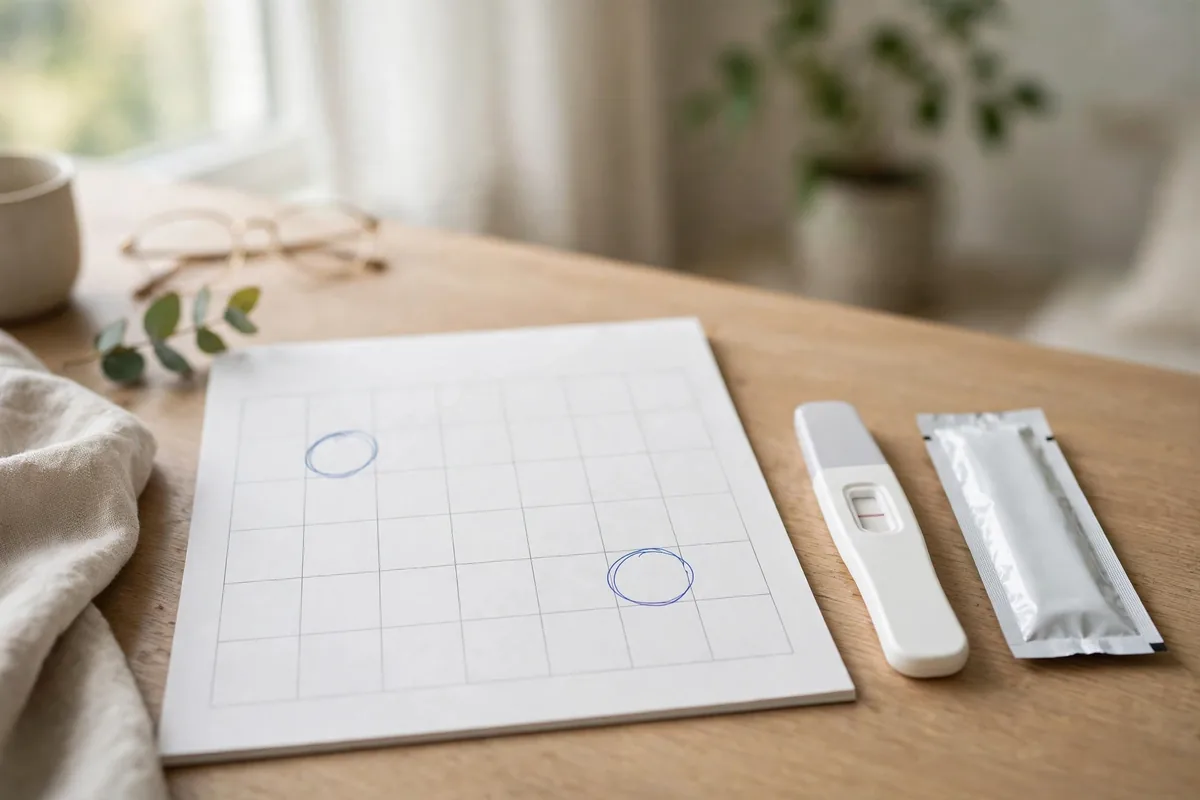
This is the most common testing dilemma, and there is a simple, evidence-based way through it:
- Wait 48 hours and test again with first morning urine. Because hCG roughly doubles every two days in early pregnancy, a level that was just below the threshold on Monday is often clearly above it by Wednesday. (If your first test was well before your period was due, waiting until the due date instead is even better.)
- Still negative and still no period after a week? Test once more. Mayo Clinic’s advice is to repeat the test one week after your missed period — by then, a pregnancy from that cycle will essentially always show.
- Still negative, period now a week or more late? Contact your doctor. Pregnancy is now unlikely to be the explanation, and a clinician can check for other causes of a missed period (thyroid problems, prolactin, PCOS, significant stress, weight change, perimenopause) and, if needed, run a blood hCG to close the question definitively.
Also check the basics before concluding anything: an expired test, reading the result outside the stated time window (evaporation lines appear later and are a classic false alarm), or testing with very dilute urine can all produce a misleading negative.
Testing After Fertility Treatment: Two Extra Rules
If you conceived with fertility treatment rather than naturally, two things change — and the detailed timelines live in our dedicated guides rather than here.
Embryo transfer timing is its own system. After an IVF transfer, testing is counted in days past transfer, the clinic’s scheduled blood test is the reference point, and testing too early at home causes well-documented misery. We cover exactly when in when to take a pregnancy test after an IVF transfer, and the blood-test numbers themselves in our beta hCG levels after IVF transfer guide.
Trigger shots can cause false positives. Ovulation-trigger injections (such as Ovidrel and other hCG triggers used in IUI and IVF cycles) contain hCG itself — the very hormone the test detects. The manufacturer’s product information warns that a trigger shot can make urine and blood pregnancy tests positive for up to about 10 days after the injection, and higher-dose urinary hCG triggers can linger longer, sometimes up to two weeks. A positive test inside that window may be leftover medication rather than a pregnancy, which is why clinics set your official test date beyond it. For the full picture of how home tests work, their sensitivity and their limits, see our complete guide to pregnancy tests. A related caution: fertility drugs containing hCG are one of the few medication causes of false positives — Mayo Clinic notes most other medications, including antibiotics and birth control pills, do not affect home test accuracy.
After a Positive: What Happens Next
A positive home test — even a faint line read within the time window — is almost always a true positive; false positives are rare. The next steps are unglamorous but important: book an appointment with your doctor or midwife (they will usually schedule a first visit or confirmatory test), start or continue folic acid if you are not already taking it, and stop alcohol and smoking. Seek care promptly, rather than waiting for a routine appointment, if you have one-sided pelvic pain, sharp abdominal pain, shoulder-tip pain, dizziness or heavy bleeding — those can be signs of an ectopic pregnancy and need same-day assessment.
How soon can I take a pregnancy test after ovulation?
The earliest a home test can possibly turn positive is about 8–10 DPO, and only for the minority whose embryo implanted at 6–8 DPO. Implantation happens 6–12 days after ovulation (84% of the time on days 8–10), and hCG then needs a day or two to reach detectable levels in urine. A realistic earliest day is 12 DPO; the day of your missed period (~14 DPO) is when results become dependable.
What is the best time of day to take a pregnancy test?
First thing in the morning, with your first urine of the day — it is the most concentrated, so it contains the highest hCG level, which matters most when testing early (Cleveland Clinic). If you test later in the day, hold your urine for at least three to four hours and do not drink excessive fluids first. Once you are a few days past a missed period, hCG is usually high enough that the time of day no longer matters.
Is 10 DPO too early to take a pregnancy test?
For a reliable answer, yes. In the PRESTO real-world study of nearly 20,000 home tests, testing about four days before the expected period (roughly 10 DPO) produced a false negative in 46.4% of pregnancies — about half of pregnant women still tested negative. A positive at 10 DPO is trustworthy; a negative is not. Wait 48 hours and retest, or hold out for the day of your missed period.
I got a negative pregnancy test but my period has not started. Could I still be pregnant?
Yes — that is exactly the pattern of testing too early, ovulating later than usual, or implanting late (11–12 DPO). Wait 48 hours and retest with first morning urine, since hCG roughly doubles every two days. If the test is still negative a week after your missed period, pregnancy is unlikely and Mayo Clinic advises repeating once more or contacting your doctor, who can run a blood test and look for other causes of a late period.
How accurate are “early” pregnancy tests that claim results 5–6 days before a missed period?
Much less accurate than the headline suggests. Those claims are based on detecting some pregnancies, not all: real-world data show roughly half of pregnancies are still missed four days before the expected period, and about 1 in 5 three days before. Even test sensitivity varies widely between brands (from about 6 to 100 mIU/mL in independent lab evaluations). Early tests are fine if you accept that a negative means “not yet,” not “no.”
Can drinking a lot of water before a pregnancy test affect the result?
Yes, especially when testing early. Large fluid intake dilutes your urine and can pull a borderline hCG concentration below the test’s detection threshold, causing a false negative. This is why first morning urine — naturally concentrated after a night without fluids — is recommended, and why you should avoid drinking excessive amounts right before testing at any time of day.
When should I take a pregnancy test if my cycles are irregular?
Count from ovulation, not from the calendar. If you track ovulation, test 14 days after it. If you do not, use your longest recent cycle to estimate when a period is “due,” or test about three weeks after unprotected sex and then weekly until your period comes or a test is positive. Irregular cycles usually mean ovulation day shifts, and implantation and hCG follow ovulation — testing by a 28-day schedule leads to needlessly early, misleading negatives.
Can a trigger shot cause a false positive pregnancy test?
Yes. hCG trigger shots used in fertility treatment (such as Ovidrel) contain the same hormone pregnancy tests detect. Product information warns tests can read positive for up to about 10 days after the injection, and higher-dose triggers can linger up to two weeks. That is why your clinic sets an official test date after that window, and why a home positive within it should be confirmed by the clinic’s blood test rather than celebrated or mourned on its own.
This article is educational information only and is not a substitute for medical advice. If you are concerned about a possible pregnancy, a missed period, pain or bleeding, contact your doctor, midwife or local clinic for personal advice.
By Emily Johnson, Content Writer & Fertility Advocate • Medically reviewed by Dr. Sarah Ahmed, Medical Content Advisor
