
Sperm Donor: How to Choose, Costs and the Full Process

A sperm donor is a man whose sperm is used — through a sperm bank, a fertility clinic, or a private arrangement — to help someone else conceive a child. For most people, the process works like this: you choose a regulated sperm bank, pick a donor from its catalogue, buy one or more frozen vials of that donor’s sperm, have them shipped to your clinic in a liquid-nitrogen tank, and your clinic uses the sperm for IUI or IVF treatment. Every vial from a licensed bank comes from a donor who has passed FDA-required infectious-disease testing, genetic carrier screening and a semen analysis, and whose samples were frozen and quarantined for at least six months before release. This guide covers how donors are screened, anonymous vs open-ID vs known donors, what ICI, IUI and IVF vials actually mean, what everything costs, the legal basics — and, for men considering it, how becoming a donor works and what it pays.
Table of Contents
Who Uses Donor Sperm?
Donor sperm is one of the oldest and most established fertility treatments. The American Society for Reproductive Medicine (ASRM) lists the main situations where donor sperm insemination is recommended:
- The male partner produces no sperm (azoospermia) or very few, poor-quality sperm that have not worked even with treatment.
- Ejaculatory dysfunction or a previous failed attempt to fertilise eggs with the partner’s sperm, including with ICSI.
- A significant genetic condition in the male partner that the couple does not want to pass on, where testing cannot fully remove the risk.
- Women without a male partner — single women and lesbian couples are now among the most common users of donor sperm.
- Rarely, severe Rh incompatibility, where the female partner is Rh-negative and already sensitised and the male partner is Rh-positive.
Whatever the reason, the route is the same: the sperm comes from a screened donor rather than a partner, and everything else about treatment — monitoring, insemination or IVF — follows the standard process.
Where Donor Sperm Comes From: Sperm Banks
Almost all donor sperm used in the United States comes from commercial sperm banks (also called cryobanks). A sperm bank recruits donors, screens them, freezes and stores their sperm in liquid nitrogen, and sells vials to patients and clinics. In the US, sperm banks are registered with the FDA as tissue establishments and must follow the federal donor-eligibility rules in 21 CFR Part 1271 — donor sperm is legally regulated as donated human tissue, not sold as an ordinary product.
When people search for a “sperm bank near me”, the location matters less than they expect. Because vials travel frozen in specialised shipping tanks, most patients choose a bank by its donor catalogue, screening standards and prices — the big national banks ship to clinics in all 50 states and dozens of countries. What does need to be local is your fertility clinic, which receives the shipment and performs the insemination or IVF. Some clinics only accept vials from certain banks, so confirm your clinic’s policy before you fall in love with a donor profile.
How Sperm Donors Are Screened
Screening is the core of what a sperm bank sells, and it is far stricter than most people realise. A bank donor has to pass all of the following before a single vial is released:
- Medical history and physical examination. Donors complete a detailed health and risk questionnaire covering their own medical history, sexual history and risk factors for infectious disease, and undergo a physical examination. FDA rules exclude anyone whose history suggests a relevant infection risk.
- Infectious-disease testing (FDA-required). Every donor is tested for HIV-1 and HIV-2, hepatitis B (surface antigen and core antibody), hepatitis C, syphilis, chlamydia, gonorrhoea, HTLV-I and HTLV-II, and cytomegalovirus (CMV). Testing is done close to the time of collection, in an FDA-registered laboratory.
- Quarantine and retesting. This is the step most people don’t know about: samples from anonymous (non-directed) donors are frozen and held in quarantine for at least 180 days — six months. Only after the donor returns, is retested, and is still negative are those vials released for sale. The quarantine exists because some infections, including HIV, have a window period in which a recently infected person can test negative. The six-month freeze-and-retest closes that window.
- Semen analysis. Donors must produce samples that meet the bank’s quality standards for count, motility (movement) and morphology (shape) — including after freezing and thawing, which is harder on sperm than a fresh sample. Banks guarantee minimum post-thaw motile counts for each vial type.
- Genetic carrier screening. The FDA does not require genetic testing, but ASRM recommends it and every major bank does it. Donors receive carrier screening for conditions such as cystic fibrosis, spinal muscular atrophy and haemoglobin disorders (sickle cell disease, thalassaemias), plus a review of a three-generation family health history. The largest banks now run expanded carrier panels covering 260 or more inherited conditions, and some include a karyotype (chromosome check).
- Psychological evaluation. ASRM strongly recommends that donors are assessed and counselled by a mental health professional — both to make sure they understand what donation involves, and to screen for significant psychiatric history in the donor and his family.
Donors must be legal adults — ASRM suggests ideally 21 or older — and banks typically recruit men aged 18 to 39, because sperm quality and the risk profile change with paternal age. To reduce the chance of donor-conceived half-siblings unknowingly meeting, ASRM suggests limiting a single donor to about 25 births per population of 800,000, and banks set their own family limits and run sibling registries on top of that.
Types of Sperm Donors: Anonymous, Open-ID and Known
“Anonymous” is no longer the only — or even the most common — option. You will choose between three broad categories:
| Donor type | How it works | Contact in the future |
|---|---|---|
| Anonymous (non-directed) | You know the donor only by a number and his profile. The bank never releases his identity to you or your child. | No identifying information is released. Note: home DNA testing means no bank can honestly promise a donor lifelong anonymity. |
| Open-ID / identity-release | You get a fuller profile now, and the donor has agreed in advance that the bank may release his identity to your child. | Your child can request the donor’s identifying information once they turn 18. This is now the default or only option at several large banks. |
| Known (directed) | The donor is someone you know — a friend or family member — whose sperm is screened, frozen and used through a clinic or bank programme. | Whatever you arrange between you; a written legal agreement is essential (see Legal Basics below). |
Two trends are worth knowing. First, major banks keep shifting their catalogues toward identity-release donors, as donor-conceived adults increasingly ask for access to their origins. Second, a few places have removed anonymity by law — the UK in 2005, and Colorado now requires identity-release donation for newly collected gametes — so the category may be set by where you have treatment. If future contact matters to you either way, decide before choosing a donor, because it cannot be changed afterwards.
Vial Types Explained: ICI, IUI and IVF Vials
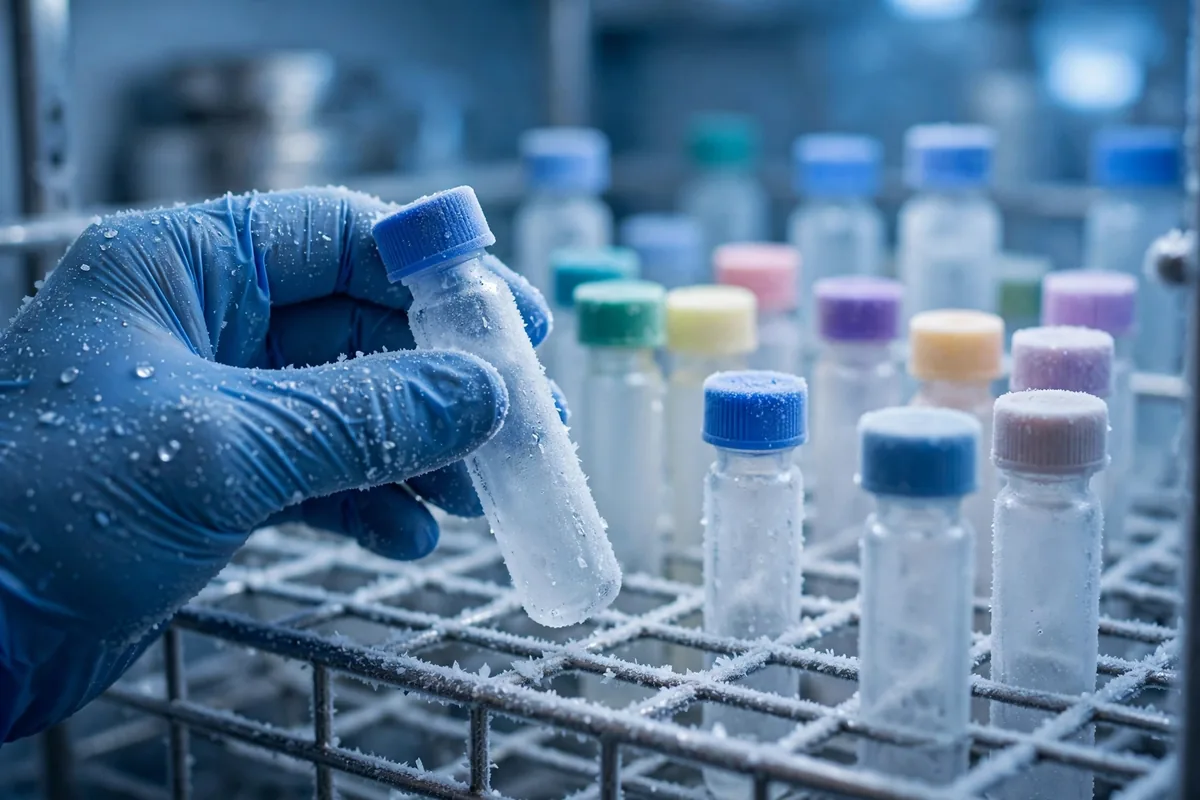
Donor sperm is sold by the vial, and the vial type must match your treatment. Buying the wrong type is a common and expensive mistake, so check with your clinic first:
| Vial type | What it is | Used for | Notes |
|---|---|---|---|
| ICI vial | Unwashed sperm, still in seminal fluid (typically 0.8–1.0 mL) | Intracervical insemination — placed near the cervix, at a clinic or, where permitted, at home | Must never be placed directly into the uterus. Often has the highest total motile count per vial. |
| IUI vial | Washed sperm — seminal fluid removed, sperm concentrated (typically 0.4–0.5 mL) | Intrauterine insemination at a clinic | Ready to use straight after thawing. Banks guarantee a minimum post-thaw motile count (premium vials commonly around 10 million motile sperm or more). |
| IVF / ART vial | A smaller preparation, washed or unwashed, with fewer motile sperm | IVF and ICSI in the laboratory | Enough for lab fertilisation, where very few sperm are needed — a single sperm per egg with ICSI. Often the cheapest vial type. |
European and some US banks grade vials by “MOT” (motile sperm per mL after thaw) — for example MOT10 or MOT20. The practical rule: one vial per insemination attempt is standard, and your clinic will tell you which type and grade it wants. All vial types from a bank have been through the same donor screening and quarantine; the difference is preparation and sperm count, not safety.
How to Choose a Sperm Donor

Once you have a shortlist of banks, donor selection usually comes down to a few layers, in this order:
Health first: CMV status. Early in the process you will be tested for CMV, a very common virus. If you are CMV-negative (never exposed), most clinics recommend a CMV-negative donor, or ask you to sign an informed-consent waiver for a CMV-positive one, because a first CMV infection during pregnancy can affect the baby. ASRM’s guidance allows CMV-positive donors (without active infection) with a CMV-positive recipient or with informed consent — but matching negative-to-negative is the simplest path, and it can narrow your donor pool, so test early.
Health second: genetic matching. Get your own carrier screening done and compare it with the donor’s panel. The goal is simple: avoid pairing two carriers of the same recessive condition. Banks call this “genetic reconciliation”, and good banks will flag a risky match before you buy. Also read the donor’s three-generation family history for patterns — heart disease, cancers, mental health conditions — that a carrier panel cannot show.
Then the personal layer. Donor profiles typically include physical characteristics (height, build, hair and eye colour, ethnic background), blood type, education and occupation, baby and sometimes adult photos, written essays, and at some banks audio interviews and staff impressions. Many families look for a donor who resembles the non-genetic parent or shares their background. There is no medically “right” answer here — but the open-ID decision above is effectively permanent, so make it consciously.
Buy for the family you hope to have. Donors sell out, retire, or hit their family limit. If you hope for siblings who are full genetic siblings, buy extra vials of the same donor now and store them. Several banks run buy-back programmes (for example, Fairfax Cryobank refunds 50% of the purchase price for vials that never left its facility), which softens the risk of over-buying.
The Process, Step by Step
- Talk to your fertility clinic first. Confirm it accepts outside bank sperm, which vial type it requires, and whether it wants any additional testing of you (infectious-disease screening and carrier screening are routinely recommended for recipients too).
- Create accounts and browse catalogues. Basic search is free; extended profiles, photos and essays may sit behind a paid access package. Shortlist two or three donors in case your first choice sells out.
- Complete the health matching. Compare your CMV status and carrier screening with each shortlisted donor’s results (see above).
- Choose the vial type and quantity with your clinic. One vial per IUI cycle is standard; consider extra vials for future cycles or siblings, and check the bank’s storage and buy-back terms.
- Place the order, timed to your cycle. Vials ship in a liquid-nitrogen dry shipper — a tank that keeps them frozen for days in transit. Shipping usually has to be arranged so the tank arrives before your insemination or egg retrieval day, and the tank must be returned afterwards.
- The clinic receives and stores the tank, then thaws the vial on the day of treatment.
- Treatment. For IUI, the thawed, washed sperm is placed into the uterus around ovulation — the full treatment is covered in our IUI treatment guide. For IVF, the vial goes to the laboratory instead; our walkthrough of how long IVF takes, from first consult to pregnancy test, shows where donor sperm fits into that timeline.
- Report the outcome. Banks ask you to report pregnancies and births. This is not paperwork for its own sake — it feeds the family limits and sibling registries that protect all donor families. If you conceived with donor IUI, our IUI due date calculator guide explains how your due date is worked out.
Success rates depend mostly on the age and fertility of the person carrying the pregnancy and the treatment used, not on the donor: donor-sperm IUI is commonly reported in the range of about 10–20% per cycle for women in their early-to-mid thirties, and donor-sperm IVF follows standard IVF success rates for the egg provider’s age — see our breakdown of IVF success rates by age.
How Much Does Donor Sperm Cost?
Donor sperm is a significant line item, and prices at the large US banks have risen steadily. These are the published prices of major banks, checked in November 2026 — expect the vial itself to be only part of your total:
Per-vial prices (US major banks)
| Bank / example | Price per vial |
|---|---|
| California Cryobank — Core collection, anonymous or open donors | $897 |
| Cryobank America — ICSI-category and ART vials | $950–$1,100 |
| Cryobank America — open-ID premium IUI/ICI vials | $1,200 |
| Fairfax Cryobank — all vial types (range by prep and testing) | $1,300–$2,100 |
| California Cryobank — latest-release ID-disclosure vials | $2,397 |
In plain terms: budget roughly $900 to $2,400 per vial. Identity-release donors and the newest donor releases sit at the top of the range; IVF/ART vials, which need fewer sperm, are often (not always) cheaper.
The costs around the vial
| Extra | Typical cost |
|---|---|
| Shipping (FedEx, liquid-nitrogen tank, US domestic) | About $200–$500 per shipment, depending on speed and bank — e.g. $200 for two-day delivery at Cryobank America, $355 two-day / $390–$425 overnight at Fairfax, $499 priority at California Cryobank |
| Storage of spare vials (per account, not per vial) | About $50–$60 per month, or roughly $370–$530 per year; multi-vial purchases often include 1–2 years of free storage |
| Extended donor information (photo packages, full profiles, memberships) | From free basic profiles up to about $499/year for an all-access membership |
| Clinic treatment itself (monitoring, the IUI procedure, or an IVF cycle and medication) | Charged separately by your clinic — usually the largest cost of all |
Prices change and vary by donor, so treat any figure here as a planning range and confirm on the bank’s own fee page before ordering.
Legal Basics: What to Know (General Information Only)
Laws on donor conception differ by country and, within the US, by state — but a few principles hold widely:
- When conception happens through a licensed clinic or bank sperm, the donor is generally not a legal parent. In most US states, the recipient (and, where applicable, her consenting spouse or partner) are the child’s legal parents, and the donor has neither parental rights nor responsibilities, including no child-support obligation. This protection is one of the main reasons to use a bank rather than an informal arrangement.
- Known-donor arrangements need a written agreement before conception. If your donor is a friend, have a lawyer in your state draft an agreement covering parental rights, contact, and what happens if circumstances change — and still do the medical screening through a clinic. Informal at-home arrangements made without a clinic or paperwork have led to court disputes in some states, in which known donors were treated as legal fathers with support obligations.
- Identity-release is a legal commitment, not a preference. If you choose an open-ID donor, your child will be able to request his identity at 18 whether or not your family still feels the same way then.
- Rules differ sharply outside the US. Some countries ban anonymous donation, cap payment to donors, restrict who may use donor sperm, or require donors to be registered nationally. If you are importing vials or having treatment abroad, check the destination country’s rules and your clinic’s import requirements first.
This section is general information, not legal advice — for anything involving a known donor, a partner’s parental status, or treatment across borders, speak to a family or fertility lawyer in your jurisdiction.
Becoming a Sperm Donor
Everything above also explains why becoming a bank sperm donor is harder than most men expect. Banks typically recruit men aged 18 to 39 who live within commuting distance of a donation centre and can commit to donating one to three times a week for at least six to twelve months. Applicants go through the same gauntlet described in the screening section — semen analysis, infectious-disease and genetic testing, physical examination, family-history review and psychological assessment — and only a small minority are accepted: banks commonly report that fewer than 5% of applicants qualify, and some put the figure at around 1%, most often because of semen quality after freezing, genetic findings, or family history.
Accepted donors are compensated for their time and commitment rather than paid “for sperm” as such. Typical compensation at US banks is about $70 to $150 per approved donation, usually split: part is paid at each visit, and the remainder is released after the samples clear the six-month quarantine and final testing. Donating two to three times a week adds up to roughly $1,000 to $1,500 a month, and the income is taxable (donors are treated as independent contractors and receive a 1099 form). Men who donate through a licensed bank are not legal parents of children conceived with their donations. One modern reality every applicant is counselled on: with consumer DNA testing widespread, a donor should assume he may be identifiable to donor-conceived people in the future, whatever category he donates under.
How much does a sperm donor vial cost?
At the major US sperm banks, one vial typically costs between about $900 and $2,400, depending on the bank, the vial type and whether the donor is identity-release. Examples from published fee pages include $897 for California Cryobank’s Core anonymous/open vials, $1,300–$2,100 across Fairfax Cryobank’s catalogue, and $2,397 for California Cryobank’s latest ID-disclosure releases. Shipping (about $200–$500), storage (about $50–$60 a month) and your clinic’s treatment fees are extra.
What is the difference between ICI, IUI and IVF vials?
It is about preparation and sperm count. ICI vials are unwashed and are placed near the cervix (intracervical insemination); they must never be put directly into the uterus. IUI vials are washed and concentrated, ready for a clinic to place into the uterus, with a guaranteed minimum number of motile sperm after thawing. IVF/ART vials contain fewer sperm because the laboratory needs very few — with ICSI, just one sperm per egg. All three come from the same screened, quarantined donor pool; your clinic will specify which type it requires.
Can my child ever find out who the sperm donor was?
It depends on the donor type you choose. With an identity-release (open-ID) donor, your child can request the donor’s identifying information from the bank when they turn 18. With an anonymous donor, the bank will not release his identity — but no one can guarantee permanent anonymity in the era of home DNA testing, which can identify donors through relatives. This is why donor type should be a deliberate decision made before you buy vials.
How are sperm donors screened?
Under FDA rules, every US bank donor is tested for HIV-1/2, hepatitis B and C, syphilis, chlamydia, gonorrhoea, HTLV-I/II and CMV, completes a risk questionnaire and physical examination, and — for anonymous donors — has his samples frozen and quarantined for at least 180 days, then is retested before any vial is released. On top of the FDA minimum, ASRM recommends and major banks perform genetic carrier screening (often 260+ conditions), a three-generation family history review, semen analysis with post-thaw standards, and a psychological evaluation.
How many vials of donor sperm should I buy?
One vial is used per insemination attempt, so most people buy at least a few: enough for several IUI cycles, or for IVF plus a backup. If you hope for genetically full siblings later, buy extra vials of the same donor at the start — donors sell out and retire. Spare vials can be kept in storage at the bank (about $50–$60 a month per account), and some banks offer partial buy-back (for example 50% at Fairfax) for vials that never left their facility.
Can I use a friend as a known sperm donor?
Yes — this is called directed or known donation. Done properly, the donor completes the same medical screening as a bank donor, the sperm is frozen and quarantined through a clinic, and you both sign a legal agreement, drawn up by a lawyer in your state, confirming he is a donor and not a legal parent. Skipping the clinic and the paperwork is risky: informal arrangements have led to disputes, and in some states known donors acting outside the clinic system have been treated as legal fathers.
How much do sperm donors get paid?
Donors are compensated for time and commitment, typically about $70 to $150 per approved donation at US banks, with part paid at each visit and the rest released after the samples clear the six-month quarantine. Donating two to three times a week, an active donor can earn roughly $1,000 to $1,500 a month; the income is taxable. Getting in is the hard part — banks accept only a small percentage of applicants (often quoted as fewer than 5%, sometimes around 1%) after full medical, genetic, semen-quality and psychological screening.
Will the baby be healthy — and whose child is it legally?
Screening greatly reduces risk but cannot remove it entirely: carrier panels do not cover every condition, and a donor’s family history can change after he donates, which is why banks keep records and update reports. Legally, when bank sperm is used through a licensed clinic, the donor is not the child’s legal parent in most US states — the recipient (and her consenting partner, where applicable) are. Laws vary by state and country, so confirm your position with a fertility lawyer if anything about your situation is non-standard.
This article is educational information only and is not a substitute for medical advice. Talk to your fertility specialist about your own situation before choosing a donor or treatment. The legal information above is general information about how donor conception is usually treated, not legal advice; consult a qualified attorney in your state or country for advice about your circumstances.
By Emily Johnson, Content Writer & Fertility Advocate • Medically reviewed by Dr. Sarah Ahmed, Medical Content Advisor
