
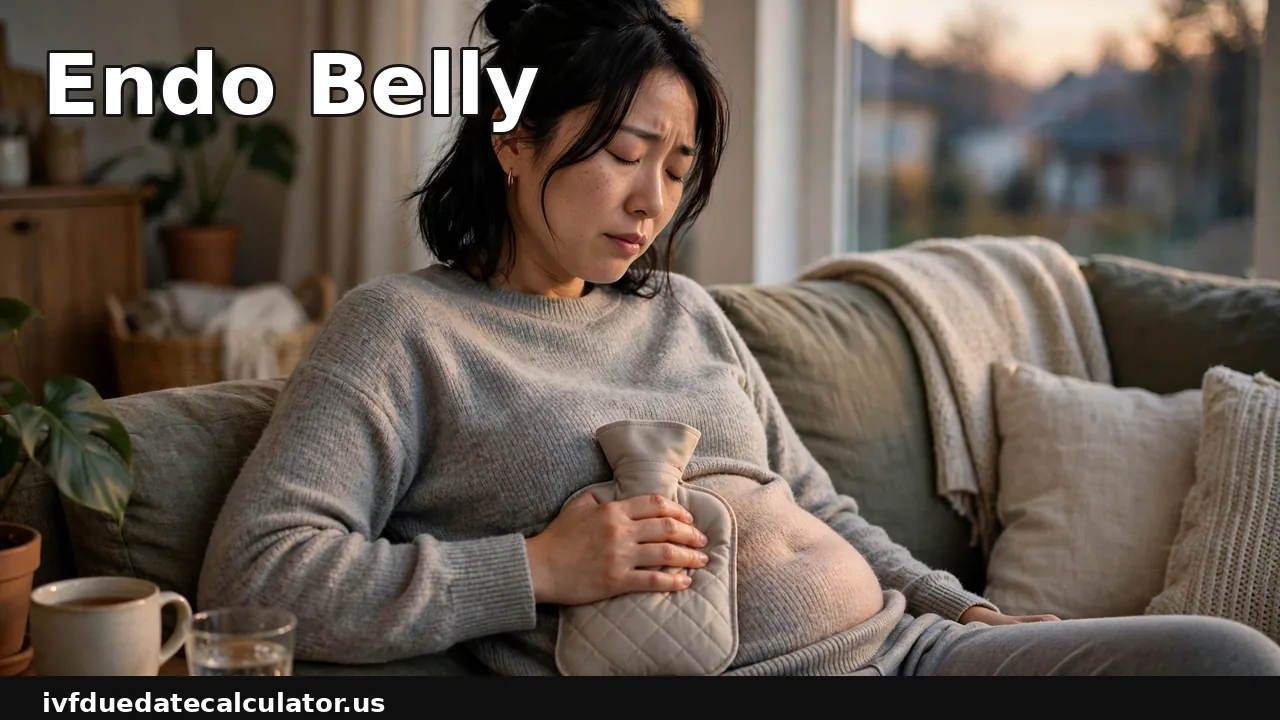
Endo Belly: What It Is, Why It Happens and How to Ease It

You were fine at breakfast. By evening, your waistband will not close, your abdomen is visibly swollen and tender, and you look several months pregnant when you are not. “Endo belly” is the name women use for the severe, often painful bloating that comes with endometriosis: abdominal swelling that can appear within hours, follows the menstrual cycle, and is driven mainly by inflammation rather than by anything you ate. It is not an official medical diagnosis, but the symptom behind it is well documented: in one study of women undergoing laparoscopy for suspected endometriosis, 90% had gastrointestinal symptoms and bloating was the most common, reported by about 83%. This guide explains what endo belly is, why it happens, how it differs from ordinary bloating and IBS, what genuinely helps during a flare, and the warning signs that need prompt care.
Table of Contents
What Is Endo Belly?
Endo belly is a symptom of endometriosis, the condition in which tissue similar to the lining of the uterus grows outside it — on the ovaries, fallopian tubes, bowel, bladder and pelvic lining. The World Health Organization estimates it affects roughly 1 in 10 women and girls of reproductive age worldwide, around 190 million people. Those patches respond to the hormonal cycle much like the uterine lining does: they thicken, inflame and bleed — but the blood has no way to leave the body, so each cycle adds more irritation, swelling and, over time, scar tissue.
Endo belly is what that process feels like from the outside: distension, tightness and discomfort that rise and fall with the cycle. Three things about the term are worth being clear on:
- It is a patient term, not a diagnosis. Doctors are more likely to write “endometriosis-related bloating” in your notes.
- It is a symptom, not a stage. Bloating severity and the amount of disease found at surgery often do not match — troublesome bloating can occur with minimal visible disease, and extensive disease can cause surprisingly little.
- It is not weight gain. The swelling is fluid, gas and inflamed tissue, which is why it can appear and disappear far faster than fat ever could.
What Does Endo Belly Look and Feel Like? (And How Long Does It Last?)
The classic endo belly pattern is a flat or normal stomach in the morning that swells as the day goes on, sometimes dramatically by evening. Women commonly describe:
- Visible distension of the lower abdomen — enough to look several months pregnant and to make fitted clothes unwearable
- A hard, tight, “inflated” feeling, with pressure or heaviness in the pelvis
- Aching, cramping or sharp pain alongside the swelling — the bloating itself is often painful, not just uncomfortable
- Gas, bowel changes (constipation, diarrhoea, or alternating), nausea and fatigue
Timing follows the cycle more than the menu. Flares typically build in the second half of the cycle, are worst just before and during a period, and may flare around ovulation — though they can occur at any point, and meals, stress, poor sleep and constipation can all pour fuel on one.
How long an episode lasts varies a lot: a few hours, several days, or — for some women — a week or more around their period; some describe lower-level bloating that feels almost constant at certain points in the month. That variability is one reason endo belly is so often dismissed as “something you ate.”
Why Does Endo Belly Happen?
There is no single proven mechanism — several processes probably combine, and the balance differs between women. Here is what is thought to contribute, and how solid the evidence is for each:
- Inflammation (strongest explanation). Around a period, the lesions bleed and the pelvis fills with inflammatory chemicals, including prostaglandins — the substances that drive period cramps and can make the bowel contract, secrete fluid and become more sensitive. Swelling and a reactive gut are the predictable result.
- Hormonal shifts across the cycle. Endometriosis is estrogen-dependent, and estrogen and progesterone both influence gut motility and fluid balance — likely why flares track the late luteal phase and menstruation so reliably.
- A more sensitive gut (well supported). Women with endometriosis show visceral hypersensitivity — bowel nerves that register stretching and gas at lower thresholds than usual, demonstrated in research published in Gut. A normal amount of intestinal gas can feel like severe bloating because the alarm system is turned up.
- Bowel involvement (real, but not required). Endometriosis can grow on or into the bowel, directly causing bloating and painful bowel movements. But note the nuance from the laparoscopy study above: only about 8% had bowel lesions, yet 90% had gut symptoms. You do not need bowel endometriosis to have endo belly.
- Adhesions and scar tissue (plausible, hard to measure). Repeated inflammation can leave scar bands that tether organs and may slow or kink the bowel, contributing to constipation and trapped gas — reasonable, though hard to prove in an individual case without surgery.
- Co-occurring IBS (common and well documented). Across studies, roughly a quarter of women with endometriosis meet criteria for IBS (estimates range from about 1 in 10 to 1 in 2), and women with endometriosis are about three times as likely to meet IBS criteria as the general population. Many carry an IBS diagnosis for years before the endometriosis underneath is found.
- SIBO — small intestinal bacterial overgrowth (possible; evidence still early). Some studies report higher SIBO rates in endometriosis, but research is limited and breath testing is imperfect. Raise it with a gastroenterologist if symptoms fit — it is not a settled cause, nor a reason to self-prescribe antibiotics.
Endo Belly vs Ordinary Bloating vs IBS
All three can make your abdomen swell. The pattern around the bloating is what separates them:
| Feature | Endo belly | Ordinary / PMS bloating | IBS bloating |
|---|---|---|---|
| Main driver | Endometriosis inflammation, hormone cycle, sensitive gut | Fluid retention, diet, a heavy or gassy meal | Gut–brain interaction disorder; no structural disease |
| Timing | Follows the cycle — builds before/during a period, may flare at ovulation | A day or two before a period, or within hours of a meal | Any time; worse with stress and certain foods, not reliably cycle-linked |
| Severity | Often severe and painful; can look several months pregnant | Mild to moderate discomfort | Moderate; distension usually less dramatic |
| Duration | Hours to days, sometimes a week or more | Hours, or a day or two | Comes and goes; can be near-daily |
| Travels with | Pelvic pain, painful periods, pain during sex, painful bowel movements around periods, fertility difficulties | Few other symptoms | Pain related to bowel movements; changed stool form/frequency (the basis of an IBS diagnosis) |
| Relieved by | Settling of the flare; heat; treating the endometriosis | Passing gas; a day or two; period starting | Passing stool or gas often helps noticeably |
Two honest cautions. First, the rows overlap: endometriosis and IBS often coexist, and treating one may only partly calm the bloating. Second, no pattern here can diagnose you — they are reasons to talk to a doctor who takes cyclical gut symptoms seriously rather than stopping at an IBS label.
What Helps During an Endo Belly Flare

Nothing makes a flare vanish on command, and any source promising a cure for endo belly is selling something. These are the measures that most consistently help during an episode.
- Heat. A hot water bottle or heat pad on the lower abdomen relaxes cramping pelvic and bowel muscles and is the single most-reached-for remedy.
- Loose clothing, immediately. Swap waistbands for soft, high-stretch or drawstring options on flare days; having a “flare outfit” ready removes a daily battle with compression on a tender, distended abdomen.
- Gentle movement. A slow walk, gentle stretching or restorative yoga can help move gas through the bowel. Keep it easy, and stop if pain sharpens.
- Eat small and simple during the flare. Large meals stretch a sensitive gut; smaller, plainer meals eaten slowly, with fluids sipped steadily, are usually better tolerated.
- Treat constipation if it is part of the picture. A backed-up bowel reliably worsens endo belly. Fluids, fibre as tolerated, movement and — if needed — an osmotic laxative discussed with a pharmacist can help.
- Over-the-counter options, used sensibly. Anti-gas preparations such as simethicone help some people; peppermint oil capsules (an IBS remedy) ease gut spasm for some. An NSAID may take the edge off the inflammatory ache — follow your own medical advice, especially if trying to conceive, as fertility specialists often advise limiting NSAIDs around ovulation.
- Rest without guilt. A flare is an inflammatory event, not a character flaw. Heat, rest and an early night are legitimate management, not laziness.
If flares are frequent and disabling, the underlying endometriosis needs a treatment review — hormonal treatments and, in selected cases, surgery aim to reduce flares rather than rescue each one. Hormonal treatments are off the table while trying to conceive, which is why a flare plan matters during fertility treatment.
Eating Patterns: What the Evidence Actually Supports
Diet content around endometriosis is noisy, so here is the evidence-graded version:
- Low FODMAP — the best direct evidence so far. In 2025, Monash University researchers published the EndoFOD trial, the first randomised controlled crossover feeding study of diet in endometriosis: 35 women with poorly controlled gut symptoms followed a supplied low-FODMAP diet and a control diet for 28 days each. 60% responded to the low-FODMAP diet with clinically meaningful improvement — pain, bloating, stool form, quality of life — versus 26% on the control diet, with gains visible by week two. Promising, with fine print: a small, short, proof-of-concept study. Do it with a dietitian, in its proper phases — not as a permanent, ever-shrinking list of banned foods.
- Anti-inflammatory eating patterns — reasonable, indirect evidence. A Mediterranean-style pattern (vegetables, fruit, whole grains, oily fish, olive oil; fewer ultra-processed foods) makes sense for an inflammatory condition, but has not been proven in trials to switch off endo belly specifically. A sensible default, not a treatment.
- Individual triggers — worth finding; yours will differ. Common culprits identified through tracking include alcohol, carbonated drinks, very large high-fat meals, and — for some — gluten or dairy; evidence for blanket gluten-free or dairy-free rules is weak. Cut what your own diary repeatedly implicates, and be wary of protocols that leave you eating almost nothing — under-fuelling harms fertility and health.
- What does not have credible evidence: detoxes, “hormone-balancing” supplement stacks, and parasite or candida cleanses marketed at endo belly.
Track the Pattern: Your Cycle Diary Is Diagnostic Gold

Because endo belly’s defining feature is its relationship to your cycle, a few months of simple tracking is among the most useful things you can bring to a medical appointment. Each day, note:
- Cycle day and whether you are bleeding
- Bloating severity (0–10 is fine) and when in the day it peaked
- Bowel habit (constipated / normal / loose) and any pain with bowel movements
- Pelvic pain score, plus suspected triggers (foods, alcohol, stress, poor sleep) and anything that relieved symptoms
Patterns usually declare themselves within two to three cycles: bloating that ignites premenstrually, flares at ovulation, pain with bowel movements only during periods. That last detail matters — bowel symptoms flaring specifically with menstruation point toward endometriosis rather than IBS alone. Our ovulation calculator and fertile window tracker can anchor the notes to your cycle dates.
When to Seek Care: Red Flags Not to Sit On
Most flares are miserable but safe to manage at home. The following are not “just endo belly” until a clinician has said so — seek urgent care the same day if you have:
- Vomiting, or inability to keep fluids down — dehydration can develop quickly
- Fever alongside abdominal or pelvic pain — possible infection or an abscess
- Inability to pass stool or gas, with worsening distension — possible bowel obstruction (a particular risk with bowel endometriosis or adhesions)
- Severe one-sided pelvic pain that comes on suddenly — a ruptured or twisted ovarian cyst (torsion) is a surgical emergency, and endometriomas raise the risk of both
- Fainting, shoulder-tip pain, or severe pain with a positive pregnancy test — possible ectopic pregnancy, more common with endometriosis-damaged tubes
- Blood in your stool, black stools, or unexplained weight loss — these need prompt (not emergency, if you feel otherwise well) medical review
One softer rule: new bloating that is present most days for several weeks, or clearly changing pattern, always needs a proper work-up — persistent bloating is also a symptom of ovarian pathology, so “endo belly” must never become a bin for every abdominal symptom.
Endo Belly and Fertility: The Connection That Matters
Endometriosis and fertility are closely linked, so the bloating may not be your only concern. The American Society for Reproductive Medicine (ASRM) estimates that up to 30–50% of women with endometriosis may experience infertility — and, from the other side, 30–50% of women with infertility have endometriosis. It can interfere at several points: pelvic inflammation, adhesions that distort anatomy or scar the fallopian tubes, ovarian cysts (endometriomas), and effects on egg quality and implantation.
Two things follow from that, and both are worth stating plainly:
- Endo belly itself does not damage fertility — it is a symptom, not a cause. But the condition behind it deserves a fertility-aware plan, especially if you have been trying for a while. Our guide to how to get pregnant covers the timing and basics of conception; if treatment becomes part of the picture, our comparison of IVF vs IUI explains which route suits which situation — IVF is often the more direct path when tubes are damaged or disease is advanced — and our guide to how long IVF takes walks through the timeline.
- Do not let anyone file you under “just bloating.” Cyclical bloating plus pelvic pain plus difficulty conceiving is a triad that should trigger an endometriosis work-up, not repeated reassurance. You are allowed to ask directly: “Could this be endometriosis, and what would we do to check?”
Getting a Diagnosis: The Honest Picture
If this pattern sounds familiar but you have no diagnosis, here is how endometriosis is — and is not — confirmed; the pathway has changed in recent years.
- There is no blood test for endometriosis. Bloods may rule out other causes, and markers such as CA-125 are sometimes raised — but they cannot confirm or exclude it.
- Imaging comes first in modern practice. Under the ESHRE 2022 guideline, transvaginal ultrasound and MRI are first-line: in experienced hands they detect endometriomas and deep infiltrating endometriosis well. Your history and a pelvic examination belong to the same first assessment.
- A normal scan does not rule it out. Superficial peritoneal endometriosis — the most common form — is frequently invisible on ultrasound and MRI, and ESHRE is explicit that negative imaging does not exclude the disease.
- Laparoscopy is no longer the automatic “gold standard” first step. ESHRE 2022 moved away from requiring surgery: a working diagnosis can be made from symptoms plus imaging, and treatment can start on that basis. Laparoscopy (keyhole surgery, which can also treat lesions at the same time) is now recommended mainly when imaging is negative but suspicion remains high, or when empirical treatment has failed, is unsuitable, or is declined.
- Expect the process to take longer than it should — and persist anyway. Studies commonly put the average delay from first symptoms to diagnosis at roughly 7 to 10 years, much of it spent being treated for IBS or “bad periods.” A symptom diary, a clear timeline, and referral to a gynaecologist with a special interest in endometriosis are the practical tools that shorten that road.
The bottom line: endo belly is real, common, and has identifiable mechanisms — inflammation, hormonal cycling, a sensitised gut, sometimes bowel involvement or coexisting IBS on top. No supplement or stricter diet will fix it, but heat, pacing, constipation care, a tracked pattern and (for many) a time-limited low-FODMAP trial are a solid, evidence-respecting toolkit — and persistent cyclical bloating deserves a proper work-up, not a shrug.
What is endo belly?
Endo belly is the popular name for the severe, painful bloating that many women with endometriosis experience. The abdomen can swell visibly within hours — sometimes enough to look several months pregnant — driven mainly by pelvic inflammation, hormonal changes across the cycle and a sensitised gut. It is a symptom of endometriosis, not a diagnosis or a stage of the disease.
How long does endo belly last?
It varies a lot. An episode can last a few hours, several days, or a week or more around a period, and some women have lower-level bloating that feels almost constant at certain points in their cycle. Flares typically build in the second half of the cycle and are worst just before and during menstruation.
What does endo belly feel like?
Commonly: a hard, tight, inflated abdomen that is often flat in the morning and swollen by evening, with aching or cramping pain, pelvic pressure, gas, and bowel changes such as constipation or diarrhoea. Unlike mild bloating, endo belly is frequently painful and can make normal clothes unwearable for the duration of a flare.
Is endo belly the same as IBS?
No — but they overlap heavily. Endo belly is bloating driven by endometriosis; IBS is a separate gut–brain interaction disorder. Roughly a quarter of women with endometriosis also meet IBS criteria in studies, and many women are treated for IBS for years before endometriosis is found. Bloating and bowel symptoms that flare specifically with your period point more toward endometriosis and deserve a gynaecology review.
What helps endo belly during a flare?
Heat on the lower abdomen, loose clothing, gentle walking or stretching, small plain meals, steady fluids, and treating any constipation are the most consistently helpful measures. Anti-gas remedies and your usual endometriosis pain relief may help some people. Nothing cures a flare instantly — if flares are frequent and disabling, the underlying endometriosis treatment needs reviewing.
Can diet fix endo belly?
Diet can help the gut side of symptoms but does not treat endometriosis itself. The strongest evidence is for a low-FODMAP diet: in a 2025 randomised crossover trial (Monash University), 60% of women with endometriosis and gut symptoms improved meaningfully on low FODMAP versus 26% on a control diet. It should be done with a dietitian and is not meant to be permanent. Detoxes and “hormone-balancing” supplement stacks have no credible evidence.
Does endo belly mean my endometriosis is severe?
No. Bloating severity does not reliably match the amount or stage of endometriosis found at surgery — severe endo belly can occur with minimal visible disease, and advanced disease can cause little bloating. This mismatch (likely explained by inflammation and nerve sensitivity) is one reason symptom-based dismissal is so common, and so unhelpful.
When should I see a doctor about endo belly?
Urgently, the same day, if you develop vomiting, fever, inability to pass stool or gas, sudden severe one-sided pelvic pain, or pain with a positive pregnancy test. Book a routine review if cyclical bloating is a recurring pattern, if it comes with painful periods, pain during sex or difficulty conceiving, or if bloating is new and present most days for several weeks — those patterns warrant a proper endometriosis work-up.
This article is educational information only and is not a substitute for medical advice. If you have severe or sudden pain, vomiting, fever, cannot pass stool or gas, or a positive pregnancy test with pain or bleeding, seek urgent medical care. For ongoing symptoms, discuss your situation with your gynaecologist, gastroenterologist, or fertility specialist.
By Emily Johnson, Content Writer & Fertility Advocate • Medically reviewed by Dr. Sarah Ahmed, Medical Content Advisor
