

Exercise After Embryo Transfer: What Is Safe, What to Avoid & When to Resume

Yes, you can exercise after embryo transfer — but the type and intensity matter. Gentle activity such as walking and light stretching is usually safe right away, while running, heavy lifting and hot yoga should wait until your clinic clears you. This guide explains what the evidence actually says, which activities are safe during the two-week wait, what to avoid, and how to build back up once you get a positive test.
Table of Contents
The Short Answer: Can You Exercise After Embryo Transfer?
Light to moderate exercise after embryo transfer is generally safe. Walking, gentle yoga, light stretching and normal daily activities do not reduce the chance of implantation, and no study has shown that ordinary movement can dislodge an embryo. What doctors do advise against during the two-week wait is strenuous exercise: running, high-impact training, heavy lifting, hot yoga and contact sports. Bed rest, on the other hand, is not recommended either — the American Society for Reproductive Medicine states there is good evidence against routine bed rest after embryo transfer, and several randomised trials have found it does not improve pregnancy rates. If your clinic gave you specific instructions for your cycle, those always take priority over general guidance.
What the Evidence Says About Exercise After Embryo Transfer
The honest picture is reassuring but not absolute. A systematic review of physical activity around embryo transfer found no clear evidence that moderate activity harms implantation, miscarriage or live birth rates — but it also found too little evidence to make firm claims in either direction, especially for very vigorous exercise. More recent research points the same way. A 2026 study from University Hospital Basel followed 2,576 patients through 6,850 IVF cycles and found the best cumulative live birth rate (43.1% per egg retrieval) in women who exercised one to two times a week, compared with 37.2% in women who did not exercise regularly and 37.1% in women who trained three or more times a week. That study was observational, so it shows an association rather than proof — but it supports the same “moderate is best” pattern that fertility clinics already advise. A separate 2026 study of frozen embryo transfer cycles found that professional and physical activity on the day of transfer and during the following three days did not worsen clinical outcomes. Our full bed rest after embryo transfer guide looks at the bed-rest trials in detail.
Safe Exercises After Embryo Transfer
These activities are generally fine during the two-week wait, as long as you feel well and your clinic has not restricted you.
Walking
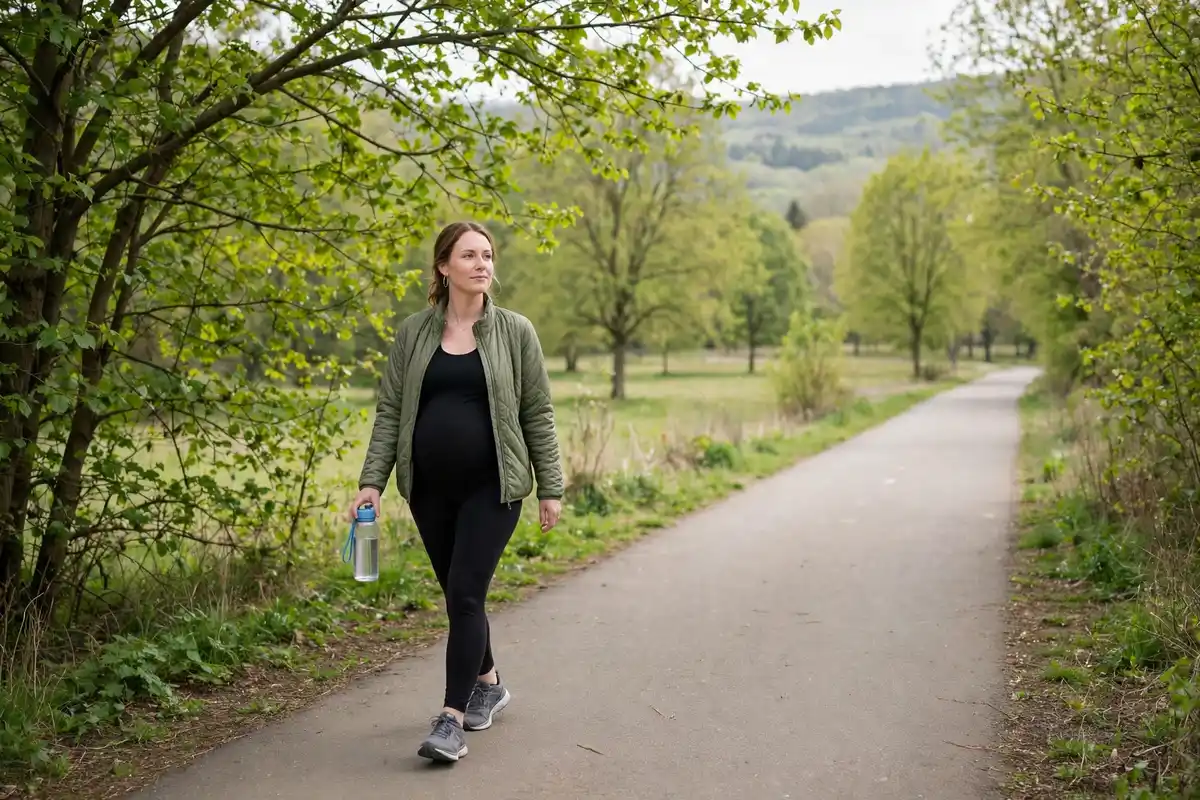
Walking is the safest and most recommended exercise after embryo transfer. It keeps blood moving, helps with constipation and bloating from progesterone, and lowers stress without raising your core temperature or jarring your pelvis. Aim for short, comfortable walks of 10 to 30 minutes, building toward about 150 minutes of moderate activity a week — the same weekly target the American College of Obstetricians and Gynecologists recommends in pregnancy.
Gentle Yoga and Stretching
Slow, gentle yoga and light stretching are usually fine after transfer. Stick to restorative or prenatal-style classes, keep the room at a normal temperature, and skip deep twists, inversions and anything that compresses or twists your abdomen. If a pose causes pelvic discomfort, stop. Hot yoga is not gentle yoga — it belongs on the avoid list below.

Swimming (Easy Pace)
Easy swimming in a clean pool is a low-impact option many clinics allow, but check with yours first — some clinics ask you to avoid pools, baths and tampons for a few days after transfer because of infection risk. If you swim, keep it slow and short, and get out if you feel tired or cold.
Light Upper-Body Strength Work
Light upper-body strengthening with small weights or resistance bands is generally acceptable, as long as you are not straining, holding your breath or lifting heavy. Skip core workouts and any exercise where you twist your torso, especially in the first two weeks.
Pelvic Floor Exercises
Gentle pelvic floor (Kegel) exercises are safe after transfer and useful in early pregnancy. They involve no impact, no heat and no abdominal strain.
Normal Daily Activity
Standing, light housework, climbing stairs and going to work are all normal daily activity, not exercise to be avoided. Staying mobile is better than staying in bed — prolonged bed rest has been linked with constipation, reduced circulation and a higher risk of blood clots, with no benefit to implantation.
What to Avoid After Embryo Transfer
The list below is precautionary. It is based on clinic guidance and physiology — overheating, dehydration, abdominal trauma and ovarian torsion — rather than proof that any one of these activities causes implantation to fail.
Running and High-Impact Exercise
Running, jumping, plyometrics, box jumps and other high-impact activities are usually discouraged until after the pregnancy test. They jolt the pelvis and raise core temperature and heart rate more than walking does. If you are a regular runner, ask your clinic when you can resume — many allow a gradual return after a positive test.
Heavy Lifting and Maximal Strength Training
Heavy weightlifting and maximal-effort strength work raise intra-abdominal pressure, especially when you hold your breath during a lift. Avoid lifting heavy objects, moving furniture and maximal gym sessions during the two-week wait.
Hot Yoga, Saunas and Hot Tubs
Anything that raises your core temperature substantially should wait. Hot yoga, saunas, steam rooms and hot tubs are all on the avoid list during the implantation window, and the same caution applies in early pregnancy.
Contact Sports and Fall-Risk Activities
Contact sports, outdoor cycling, skiing, horseback riding and gymnastics carry a risk of falls or abdominal trauma. Skip them until your clinic clears you.
Intense Core Work and Twisting
Sit-ups, crunches, Russian twists and other intense core exercises — including any movement that twists your torso — are best avoided in the first two weeks. This matters most after a fresh stimulated cycle, when the ovaries may still be enlarged and twisting movements raise the small but real risk of ovarian torsion.
Exercise Timeline After Embryo Transfer
| When | What is usually OK | What to avoid |
|---|---|---|
| Transfer day | Gentle walking, normal daily activity, rest if you feel tired | Strenuous workouts, heavy lifting, hot baths or saunas |
| First 48–72 hours | Short walks (10–30 min), gentle stretching, light upper-body work; keep exertion below 5 out of 10 | Running, jumping, HIIT, heavy lifting, hot yoga, core-twisting exercises |
| Days 3–14 (two-week wait) | Build walking toward 150 min/week; easy swimming if your clinic allows it; pelvic floor exercises | Same avoid list; no new intense training; no contact sports |
| After a positive test | Continue walking and gentle yoga; gradually rebuild toward your usual routine with your clinic’s OK | Extreme exertion; stop and call your clinic for bleeding, pain or dizziness |
The “5 out of 10” rule is a practical guide used by rehabilitation specialists: during the first two weeks, keep your effort low enough that you can still speak in full sentences while you move. If you cannot talk comfortably, you are working too hard.
Fresh vs Frozen Transfer: Does It Change the Advice?
Yes, a little. After a fresh stimulated cycle, your ovaries are often still enlarged from the stimulation drugs, which raises the risk of ovarian torsion — a painful twisting of the ovary — during vigorous activity or movements that twist the abdomen. That is why the advice to avoid running, jumping, heavy lifting and twisting is strictest after a fresh transfer. After a frozen embryo transfer in a natural or hormonally prepared cycle, the ovaries are usually not enlarged, so that particular concern is smaller — but clinics still tend to advise moderation during the two-week wait, and your own clinic’s instructions still come first. If you had a fresh transfer and notice sudden severe one-sided pelvic pain, nausea or vomiting, seek urgent medical care — those can be signs of torsion.
How Much Is Too Much? The Talk Test and Warning Signs
A simple rule covers most situations: you should be able to hold a conversation while you exercise. If you are too breathless to talk, slow down. Keep sessions short, drink water before and during activity, and avoid exercising in hot, humid conditions. Stop exercising and call your clinic if you notice vaginal bleeding, cramping or pelvic pain, dizziness or faintness, shortness of breath, chest pain, fluid leaking from the vagina, or a sudden severe headache. These are warning signs in any early pregnancy, not just after IVF. The NHS exercise in pregnancy page lists the same warning signs and the activities to avoid once you are pregnant. For general guidance on safe exercise in pregnancy, the MedlinePlus page on exercising during pregnancy is a clear, plain-language reference.
Exercise Myths After Embryo Transfer
Walking will not make the embryo “fall out.” The embryo sits inside the uterus, cushioned by fluid and tissue, and normal walking does not create enough force to dislodge it. Lying still for two weeks does not help implantation either — the trials on bed rest after transfer show no benefit, and immobility brings its own problems. Light activity is not the same as “doing too much”: the risk, where it exists, comes from strenuous, high-impact or overheating exercise, not from a gentle walk or a stretch. And a single workout cannot decide your cycle — implantation depends on embryo quality and a receptive uterus, not on whether you walked to the shops.
Frequently Asked Questions (FAQs)
Can I walk after embryo transfer?
Yes. Walking is the most widely recommended activity after embryo transfer. Short, comfortable walks are fine from transfer day itself, and you can build up to about 150 minutes a week during the two-week wait, as long as you feel well and your clinic has not restricted you.
How soon after embryo transfer can I exercise?
Light activity such as walking and gentle stretching is usually fine immediately. Strenuous exercise, running, heavy lifting and hot yoga are typically deferred for at least the first 48 to 72 hours, and often until after the pregnancy test — follow your clinic’s instructions.
Can exercise cause implantation failure?
There is no evidence that moderate exercise causes implantation to fail. A systematic review found no clear harm from moderate physical activity around transfer, and a 2026 study of more than 2,500 IVF patients found the best live birth rates in women who exercised one to two times a week. Very vigorous exercise has been studied less, which is why clinics advise caution with it.
Is it safe to do yoga after embryo transfer?
Gentle, slow yoga at normal room temperature is usually safe. Avoid hot yoga, deep twists, inversions and any pose that causes pelvic pain. Prenatal or restorative yoga classes are the best fit during the two-week wait.
Can I swim after embryo transfer?
Easy swimming is low-impact and often allowed, but some clinics ask you to avoid pools for a few days after transfer because of infection risk. Check with your clinic first, keep swims short and slow, and skip hot tubs and saunas.
Should I rest in bed after embryo transfer?
No. The American Society for Reproductive Medicine states there is good evidence against routine bed rest after embryo transfer, and trials have found no improvement in pregnancy rates. Normal daily activity and gentle walking are better than staying in bed.
When can I run again after embryo transfer?
Most clinics ask you to wait until after the pregnancy test, and often until your first scan confirms the pregnancy is progressing. If you are a regular runner, ask your clinic for a personalised timeline — it depends on your transfer type and how your ovaries responded.
What exercise is safe in the first trimester after IVF?
Walking, gentle yoga, easy swimming and light strength work are the usual recommendations, at about 150 minutes of moderate activity a week. Avoid contact sports, heavy lifting, hot yoga and anything with a fall risk, and stop and call your clinic if you notice bleeding, pain or dizziness.
The Bottom Line
Exercise after embryo transfer is not something to fear — it is something to moderate. Walk daily, stretch gently, keep your effort low enough to talk, and avoid the few things that genuinely add risk: strenuous and high-impact training, heavy lifting, hot yoga and saunas, contact sports and twisting core work. Bed rest does not help, and ordinary movement does not hurt. If anything feels wrong, or your clinic gave you different instructions, follow your clinic. For the day-by-day picture of the wait itself, see our two-week wait after embryo transfer guide, and when test day arrives, our guide to when to test after IVF transfer explains the timing.
By Emily Johnson, Content Writer & Fertility Advocate · Medically reviewed by Dr. Sarah Ahmed, Medical Content Advisor
About the author: Emily Johnson is a Content Writer & Fertility Advocate who covers IVF and fertility treatment topics. Meet the team
Medical review: This article was medically reviewed by Dr. Sarah Ahmed, Medical Content Advisor, for clinical accuracy. Meet the team
Medical disclaimer: This article is for informational purposes only and is not medical advice, diagnosis, or treatment. Due dates are estimates, and every pregnancy is different. Always confirm your due date and any testing or treatment decisions with your clinic or healthcare provider.
